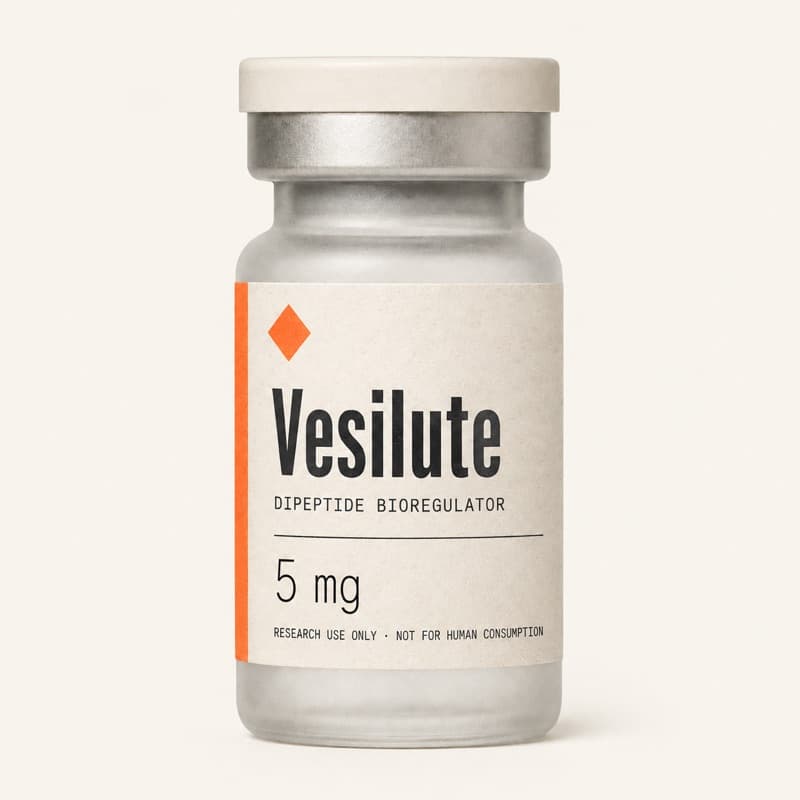
Vesilute
ED Dipeptide · Bladder & Urinary Tract Bioregulator
Dipeptide bioregulator (ED) of glutamic acid and aspartic acid, from the Khavinson series, developed at the St. Petersburg Institute of Bioregulation and Gerontology. Function of the urinary tract and bladder is what it is designed to support, and research indicates potential benefit to prostate health in men. Proposed effects are smooth muscle regulation, better blood flow through tissue, and cellular regeneration in urogenital tissues. It is a distinct compound from Vesugen, the KED tripeptide, whose target is vascular endothelium.
Overview
Dipeptide bioregulator (ED) of glutamic acid and aspartic acid, from the Khavinson series, developed at the St. Petersburg Institute of Bioregulation and Gerontology. Function of the urinary tract and bladder is what it is designed to support, and research indicates potential benefit to prostate health in men. Proposed effects are smooth muscle regulation, better blood flow through tissue, and cellular regeneration in urogenital tissues. It is a distinct compound from Vesugen, the KED tripeptide, whose target is vascular endothelium.
The targets are smooth muscle cells and vascular endothelium within the urogenital system. Five actions are proposed: (1) contraction and relaxation of smooth muscle in the bladder wall are regulated, (2) microcirculation and blood flow improve in pelvic tissues, prostate included, (3) cellular regeneration and tissue repair in the urinary tract are supported, (4) hyperemia and inflammation-related dysfunction are reduced, and (5) gene expression tied to urogenital tissue homeostasis is modulated along the bioregulation pathways characteristic of Khavinson peptides.
Research indications
What the compound has been studied for, grouped by body system. Effect size is the reported magnitude where it was measured — not a recommendation.
Symptom relief in bladder dysfunction, by way of smooth muscle regulation, is under investigation.
Overall support is possible for tissue health and urinary tract function.
Possible benefit to the health and function of pelvic tissue.
In prostate tissue, research points to better blood flow and less dysfunction.
Symptoms tied to benign prostatic hyperplasia may be eased.
Included in comprehensive bioregulator protocols aimed at age-related urogenital changes.
Cellular regeneration in tissues of the urinary and reproductive systems is supported.
- Class
- Dipeptide bioregulator
- Research status
- Moderate research
- Chain length
- 2 residues
- Molecular weight
- 262 Da
- Typical dose
- 10–20 mg daily
- Frequency
- Daily for 10–20 consecutive days (Khavinson bioregulator cycle)
- Cycle length
- 10–20 day cycle
- Storage
- Lyophilized powder: room temperature or 2-8°C; Reconstituted: 2-8°C refrigerated, use within 4 weeks
Molecular data
- Type
- Dipeptide bioregulator
- Molecular weight
- 262 Da
- Chain length
- 2 residues
Dosing reference
Doses reported in the literature and by suppliers. These are a record of what has been used in research — reference, never instruction.
| Context | Route | Amount | Frequency |
|---|---|---|---|
| Standard protocol | SubQ or IM | 10-20 mg | Daily for 10-20 days |
| Maintenance | SubQ or IM | 20 mg | 2-3 cycles yearly |
| Oral protocol | Oral capsules | 10-20 mg | Daily for 10-20 days |
Interactions
Prostate and urogenital health are targeted by each; combination gives comprehensive support.
The targets differ: vascular for Vesugen, bladder and prostate for Vesilute. Combination is possible.
The two are complementary in protocols for urogenital and male reproductive health.
A frequent combination inside comprehensive anti-aging bioregulator protocols.
Target systems differ, and no negative interactions are known.
What to expect
Safety
Mechanistic flags — properties of the pathway, not observed adverse events.
- Minimal reported side effects
- Mild reactions where injected, if an injectable form is used
- Tolerated well overall
- Signs of allergic reaction
- Unusual urinary symptoms
- Urination patterns changing unexpectedly
- Pregnancy or breastfeeding
- Prostate cancer (consult physician)
- Hypersensitivity to any of the peptide components, known
- Urinary tract infection currently active, to be treated first
Quality checklist
What to confirm before trusting a batch of research material. A verification aid — not an endorsement of any supplier.
- Third-party Certificate of AnalysisIndependent lab · dated · lot-matched.
- HPLC purity ≥ 98%Reverse-phase trace included.
- Mass-spec confirms 262 g/molMALDI-TOF or ESI-MS.
- Counterion stated (acetate ≫ TFA)TFA salts can confound bioassays.
- Endotoxin / sterility statementRelevant once reconstituted.
- Lyophilised · cold-chain shippedStored −20 °C, shipped on ice.
- Labelled “research use only”No therapeutic or dosing claims.
Recorded signals for this compound · 8
- ✓Certificate of analysis available
- ✓Proper packaging and storage
- ✓Lyophilized powder, white to off-white
- ✓Solution clear once reconstituted
- !Source unknown, or purity never verified
- ×Damaged packaging
- ×Powder discolored
- ×Solution cloudy or with particles
FAQ
Is prostate health within Vesilute's scope, or only bladder function?
Both are targeted — bladder smooth muscle function and prostate health — by way of enhanced blood flow and tissue regeneration. Relief of BPH (benign prostatic hyperplasia) symptoms is indicated as a potential by research, though the clinical evidence is limited. Being a small dipeptide, it penetrates prostatic tissue and acts on cells directly.
Where does Vesilute diverge from Prostamax and other prostate-targeting peptides?
Vesilute, the ED dipeptide, is a specific Khavinson bioregulator built around bladder and smooth muscle regulation; Prostamax goes at prostate tissue directly. The two are complementary — urinary tract function for one, prostate inflammation for the other. Comprehensive urogenital support may come from combining them.
Do urinary symptoms in women fall within Vesilute's reach?
Study has been primarily in men, for prostate support. Its regulatory effect on bladder smooth muscle and its enhancement of microcirculation could in theory benefit women with bladder dysfunction or urinary symptoms. Research split by gender is limited; the mechanism suggests potential in both sexes.
What is the time course for improvement in urinary flow or BPH symptoms?
Cycling is typical of Khavinson bioregulators — 10–20 days on, then a break — with improvement developing across 2–4 weeks of the first cycle. Maximum benefit arrives only after multiple cycles, 2–3 a year. Epigenetic changes keep effects in place between cycles, though bioregulator action is gradual set against pharmaceutical diuretics.