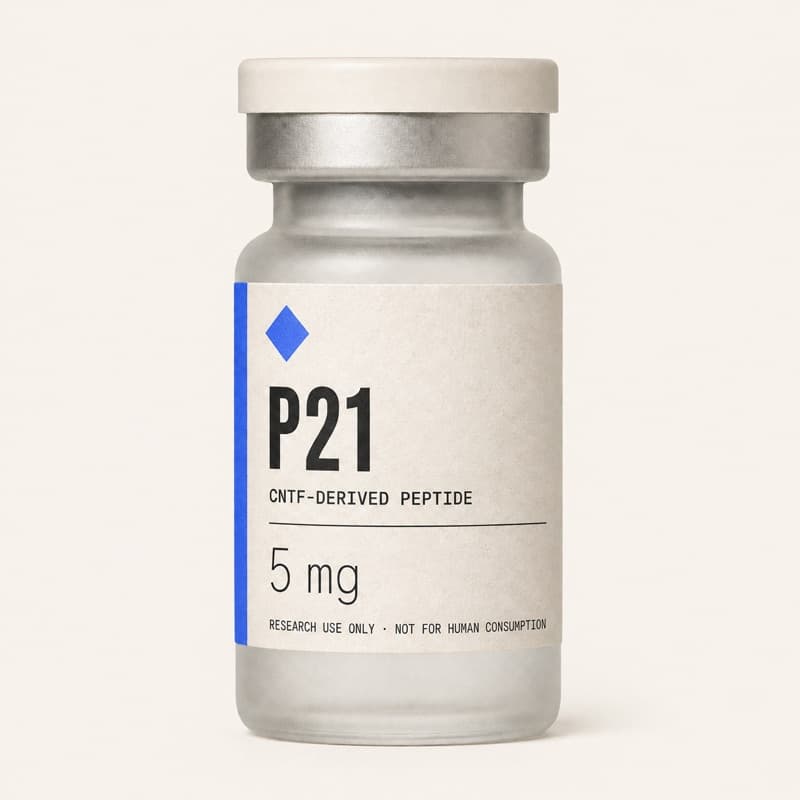
P21
P021 · CNTF-Derived Neurogenic Peptide
Nootropic peptide derived from ciliary neurotrophic factor (CNTF) that raises neurogenesis and cognitive function. An adamantane moiety carries it across the blood-brain barrier. Research reports increased BDNF expression, inhibition of LIF signaling to promote neurogenesis, and reduced tau and amyloid pathology in Alzheimer's disease models. In diseased brains, P21 can push neurogenesis past the level seen in healthy untreated brains.
Overview
Nootropic peptide derived from ciliary neurotrophic factor (CNTF) that raises neurogenesis and cognitive function. An adamantane moiety carries it across the blood-brain barrier. Research reports increased BDNF expression, inhibition of LIF signaling to promote neurogenesis, and reduced tau and amyloid pathology in Alzheimer's disease models. In diseased brains, P21 can push neurogenesis past the level seen in healthy untreated brains.
Several pathways are involved. Leukemia inhibitory factor (LIF) signaling is inhibited, which lifts a key roadblock to neurogenesis and moves the brain toward a more embryologic state that favors neuron growth. Expression of brain-derived neurotrophic factor (BDNF) rises, and the BDNF/TrkB/PI3-K/AKT/GSK3β pathway is activated. Cognitive function improves under that pathway modulation, and tau and amyloid pathologies are reduced.
Research indications
What the compound has been studied for, grouped by body system. Effect size is the reported magnitude where it was measured — not a recommendation.
In 3xTg-AD mice, tau pathology was markedly reduced by P021, Aβ generation attenuated, and impairment of episodic memory rescued.
Given during the synaptic compensation period, treatment can prevent neurodegeneration and lower mortality.
Attenuation of tau pathologies is robust, and it comes by way of the BDNF/TrkB/PI3-K/AKT/GSK3β pathway.
Dentate gyrus neurogenesis is enhanced to a degree that exceeds levels found in healthy untreated brains.
Memory processes are enhanced through BDNF increases and restoration of synaptic function.
In aged models, natural decline of learning and memory may lessen as the neurogenesis deficit is rescued.
Synaptic deficits in the cortex and hippocampus are restored.
Neuronal plasticity deficits are rescued.
- Class
- CNTF-derived peptide
- Research status
- Emerging
- Molecular weight
- 1100 Da
- Half-life
- ~3 h
- Typical dose
- Research compound; dosing not established for humans
- Frequency
- Daily in animal research protocols
- Cycle length
- Not established; experimental peptide without human trials
- Storage
- Refrigerate at 2-8°C
Molecular data
- Type
- CNTF-derived peptide
- Molecular weight
- 1100 Da
- Half-life
- 180 min
Levels in single-dose multiples. A shape, not a pharmacokinetic prediction.
Dosing reference
Doses reported in the literature and by suppliers. These are a record of what has been used in research — reference, never instruction.
| Context | Route | Amount | Frequency |
|---|---|---|---|
| Research protocol | SubQ or IP | Variable by study | Daily |
Interactions
Nootropic mechanisms differ and may be complementary.
Neurogenesis is promoted by both, along different pathways.
Mechanisms differ; no negative interactions known.
Mechanisms of cognitive enhancement differ.
What to expect
Safety
Mechanistic flags — properties of the pathway, not observed adverse events.
- Tolerated well overall in animal studies
- Data are limited; the research is primarily preclinical
- Allergic reactions
- Unusual neurological symptoms
- Pregnancy or breastfeeding
- Human safety profile unknown
- Human use is not approved
Quality checklist
What to confirm before trusting a batch of research material. A verification aid — not an endorsement of any supplier.
- Third-party Certificate of AnalysisIndependent lab · dated · lot-matched.
- HPLC purity ≥ 98%Reverse-phase trace included.
- Mass-spec confirms 1100 g/molMALDI-TOF or ESI-MS.
- Counterion stated (acetate ≫ TFA)TFA salts can confound bioassays.
- Endotoxin / sterility statementRelevant once reconstituted.
- Lyophilised · cold-chain shippedStored −20 °C, shipped on ice.
- Labelled “research use only”No therapeutic or dosing claims.
Recorded signals for this compound · 8
- ✓White lyophilized powder
- ✓High purity (>95%)
- ✓Solution clear once reconstituted
- ✓Vacuum seal intact
- !A research chemical; quality standards are limited
- ×Discoloration
- ×Cloudy solution
- ×Visible particulates
FAQ
Does P21 raise neurogenesis past healthy-brain levels?
Yes. In diseased brains, neurogenesis under P21 can rise above the levels seen in healthy untreated brains. Most treatments aim to restore function, whereas P21 may pass normal baseline. The demonstration is confined to Alzheimer's disease models, and human data is absent.
What does the adamantane modification do for P21?
Attaching the adamantane moiety gives P21 blood-brain barrier penetration: at roughly 1,100 Da the peptide would not normally cross, yet it reaches brain tissue. The modification is critical to the mechanism and sets P21 apart from other neuroprotective peptides.
Does P21 extend to normal age-related cognitive decline, or only Alzheimer's?
Possibly. Restoration of BDNF and synaptic function is the proposed route by which P21 may reduce age-related cognitive decline, though the rating is 'moderate' effectiveness and the basis is animal models. Whether it works for normal aging is unknown in the absence of human studies. For age-related decline, Semax and NA-Semax Amidate carry more clinical evidence.