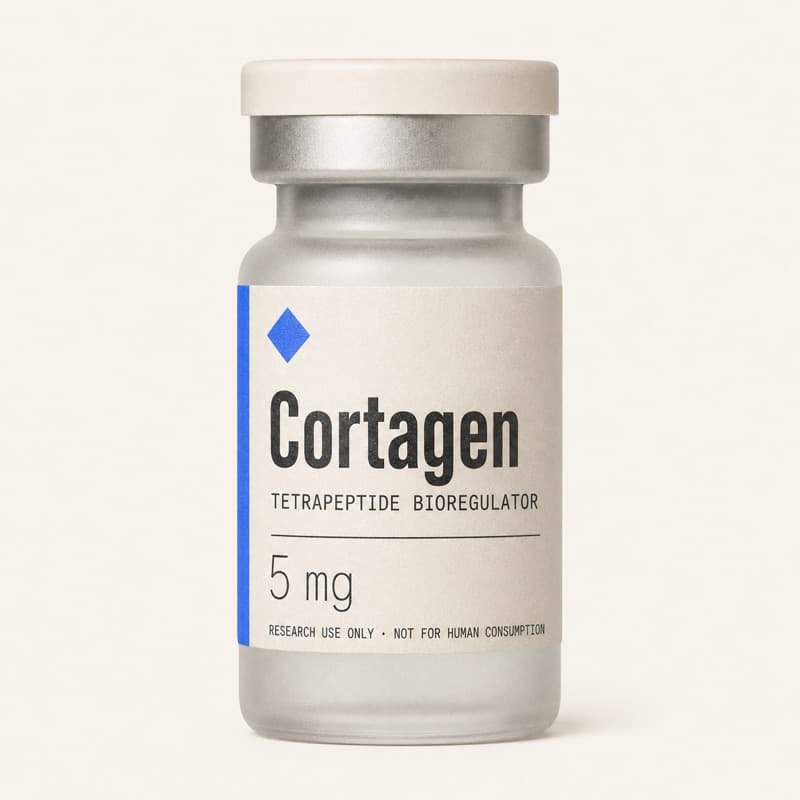
Cortagen
AEDP · Brain Cortex Bioregulator Peptide
Tetrapeptide bioregulator (AEDP) of the Khavinson series; the brain and central nervous system are its primary targets. Work at Russia's St. Petersburg Institute of Bioregulation and Gerontology produced it. In the nervous system it regulates inflammatory responses, it restores the balance of pro- and anti-oxidative processes, and expression of interleukin-2 is stimulated. Research points to potential benefits for nerve regeneration, for recovery from ischemic brain injury, and for reducing autoimmune reactions that affect the CNS.
Overview
Tetrapeptide bioregulator (AEDP) of the Khavinson series; the brain and central nervous system are its primary targets. Work at Russia's St. Petersburg Institute of Bioregulation and Gerontology produced it. In the nervous system it regulates inflammatory responses, it restores the balance of pro- and anti-oxidative processes, and expression of interleukin-2 is stimulated. Research points to potential benefits for nerve regeneration, for recovery from ischemic brain injury, and for reducing autoimmune reactions that affect the CNS.
Epigenetic regulation is the mechanism: cell nuclei are penetrated, DNA interacted with, gene expression modulated. Cardiac genes affected include Pass1, Hsc70, Bmp2, Wnt4, Eps15, and Eps15-rs. Inflammatory responses in the nervous system are strongly regulated, which helps restore a proper balance between oxidative and anti-oxidative processes. IL-2 expression is stimulated and immune function regulated — reduction of autoimmune reactions in particular.
Research indications
What the compound has been studied for, grouped by body system. Effect size is the reported magnitude where it was measured — not a recommendation.
In research after ischemic brain injury, the long-term results are beneficial.
Effects on restoring function in injured nerve are demonstrated by research.
Regulation extends to inflammatory response within the nervous system.
Autoimmune reactions are reduced, which helps regulate immune function.
Interleukin-2 expression is stimulated, serving immune regulation.
Pro-oxidative and anti-oxidative processes are brought back into balance.
Age-related CNS changes are addressed through bioregulation.
- Class
- Tetrapeptide bioregulator
- Research status
- Moderate research
- Chain length
- 4 residues
- Molecular weight
- 416 Da
- Typical dose
- 10–20 mg daily
- Frequency
- Once daily for 10–20 consecutive days
- Cycle length
- 10–20 days per cycle
- Storage
- Capsules: room temperature; Injectable lyophilized: 2-8°C; Reconstituted: 2-8°C refrigerated
Molecular data
- Type
- Tetrapeptide bioregulator
- Molecular weight
- 416 Da
- Chain length
- 4 residues
AEDPDosing reference
Doses reported in the literature and by suppliers. These are a record of what has been used in research — reference, never instruction.
| Context | Route | Amount | Frequency |
|---|---|---|---|
| Standard protocol | Oral capsules | 10-20 mg | Daily for 10-20 days |
| Maintenance | Oral capsules | 10 mg | 2-3 cycles yearly |
| Research protocol | IM or SubQ | 10 mg | Daily for 10 days |
Interactions
CNS bioregulators that complement: the cortex is Cortagen's target, the brain generally is Pinealon's.
Comprehensive Khavinson anti-aging protocols often include both.
Organ targets differ; comprehensive bioregulator protocols can include both.
Belongs to the Khavinson bioregulator family, with a different tissue target.
What to expect
Safety
Mechanistic flags — properties of the pathway, not observed adverse events.
- Tolerated well overall
- Side effects reported as minimal
- Allergic reactions
- Unusual neurological symptoms
- Neurological emergencies in progress — medical care required
- Known hypersensitivity
- Pregnancy or breastfeeding
Quality checklist
What to confirm before trusting a batch of research material. A verification aid — not an endorsement of any supplier.
- Third-party Certificate of AnalysisIndependent lab · dated · lot-matched.
- HPLC purity ≥ 98%Reverse-phase trace included.
- Mass-spec confirms 416 g/molMALDI-TOF or ESI-MS.
- Counterion stated (acetate ≫ TFA)TFA salts can confound bioassays.
- Endotoxin / sterility statementRelevant once reconstituted.
- Lyophilised · cold-chain shippedStored −20 °C, shipped on ice.
- Labelled “research use only”No therapeutic or dosing claims.
Recorded signals for this compound · 7
- ✓White powder or capsules
- ✓If reconstituted, a clear solution
- ✓Packaging and labeling done properly
- !Source or purity unknown
- ×Discoloration
- ×Unusual odor
- ×Damaged packaging
FAQ
Does Cortagen aid recovery after stroke or brain injury?
Yes. Research evidence covers beneficial effects after ischemic brain injury, with neurological function improving over the long term. Inflammatory responses in nervous tissue are regulated and nerve regeneration promoted, which puts it in range of post-stroke recovery protocols run alongside medical rehabilitation.
Where does Cortagen differ from brain-supporting peptides such as Semax?
The cortex is Cortagen's specific target, reached by IL-2 stimulation and modulation of inflammation, while Semax works through BDNF upregulation for cognitive effects. Neuroinflammation and recovery suit Cortagen better; cognitive enhancement is Semax's focus, and comprehensive protocols often run the two together.
Is Cortagen of use in autoimmune neurological conditions?
Potential for autoimmune modulation is there, by way of IL-2 regulation and a reduction in autoimmune reactions affecting the nervous system. The research is still preclinical, though. Physician consultation before use is warranted in autoimmune conditions, since immune-modulating peptides call for careful monitoring.
What does a typical Cortagen protocol look like for anti-aging use?
The standard anti-aging pattern is oral capsules at 10-20mg daily, taken 10-20 consecutive days and repeated 2-3 times a year. Because gene expression is changed epigenetically, effects carry on past the cycle. Injectable forms are preferred by some for more direct delivery, though oral bioavailability is generally good in a peptide this short.