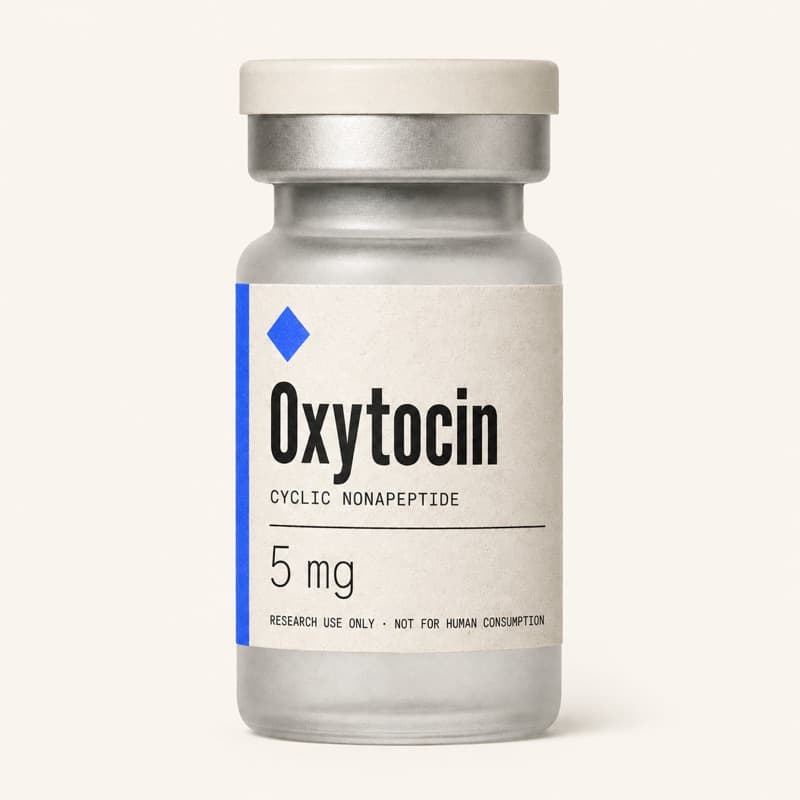
Oxytocin
Neurohypophysial Peptide · Social Bonding & Reproductive Hormone
Peptide hormone of nine amino acids, made in the hypothalamus and released from the posterior pituitary. Its functions span social bonding, trust, empathy, reproduction, childbirth, lactation. The synthetic form holds FDA approval for labor induction and postpartum hemorrhage.
Overview
Peptide hormone of nine amino acids, made in the hypothalamus and released from the posterior pituitary. Its functions span social bonding, trust, empathy, reproduction, childbirth, lactation. The synthetic form holds FDA approval for labor induction and postpartum hemorrhage.
Receptor binding on uterine smooth muscle drives calcium influx, and myometrial contractions follow. Prostaglandin release is also stimulated. Centrally, the peptide modulates GABAergic, serotonergic and dopaminergic neurotransmission, with cortisol and HPA axis activity falling.
Research indications
What the compound has been studied for, grouped by body system. Effect size is the reported magnitude where it was measured — not a recommendation.
Where vaginal delivery is medically indicated, uterine contractions are started or reinforced.
Third-stage use stimulates uterine contraction, which controls postpartum bleeding.
Second-trimester incomplete or inevitable abortion, as adjunctive therapy.
Social functioning has been researched extensively; the results are mixed and the optimal dose remains unclear.
Given alongside exposure therapy; reduced PTSD/depression symptoms are shown.
Reactivity of the amygdala to social threats decreases; brain connectivity normalizes.
Libido, arousal and orgasm intensity improve in both sexes.
- Class
- Cyclic nonapeptide
- Research status
- FDA approved
- Chain length
- 9 residues
- Molecular weight
- 1007.19 Da
- Half-life
- ~5 min
- Typical dose
- Intranasal: 20–24 IU; injectable: 10–40 IU; sublingual: 50–100 IU
- Frequency
- As needed for social/sexual support, or 1–2 times daily for anxiety/PTSD protocols; maximum 1 dose per 24 hours for sexual function
- Cycle length
- As needed for research applications; 4–12 weeks for anxiety/autism protocols
- Storage
- Refrigerate at 2-8°C; protect from light
Molecular data
- Type
- Cyclic nonapeptide
- Molecular weight
- 1007.19 Da
- Chain length
- 9 residues
- Half-life
- 5 min
Levels in single-dose multiples. A shape, not a pharmacokinetic prediction.
Dosing reference
Doses reported in the literature and by suppliers. These are a record of what has been used in research — reference, never instruction.
| Context | Route | Amount | Frequency |
|---|---|---|---|
| Labor Induction | IV (diluted) | 0.5-2 mU/min initial, titrate to 1-2 mU/min every 30-60 min | Continuous IV infusion |
| Postpartum Hemorrhage Prevention | IM or IV infusion | 10 units IM or 10-40 units in IV solution | Single dose after placental delivery |
| Social anxiety/bonding enhancement | Intranasal spray | 20-24 IU | Once daily or before social situations |
| Autism research protocols | Intranasal spray | 24-48 IU daily | Twice daily |
| PTSD therapy augmentation | Intranasal spray | 40 IU | Before therapy sessions |
| Sexual function enhancement | Intranasal spray | 24-40 IU | 30-45 minutes before activity |
| General wellness/bonding support | Sublingual troche | 50-100 IU | Once daily |
| Sexual function support | Sublingual troche | 100 IU | 30-45 minutes before activity |
Interactions
Similar in structure, with receptor affinity that overlaps and effects that may be additive.
Anxiolytic effects that complement: GABA modulation from Selank, central receptor action from oxytocin.
Different pathways, with complementary effects on sexual function.
Reproduction involves both: GnRH is stimulated by kisspeptin, arousal enhanced by oxytocin.
No direct interaction — the mechanisms differ, tissue repair against social function.
Endogenous oxytocin may be affected by SSRIs; oversight from a healthcare provider is required when the two are combined.
Oxytocin release is suppressed by alcohol, and therapeutic effects are reduced.
What to expect
Safety
Mechanistic flags — properties of the pathway, not observed adverse events.
- Mild headache
- Nasal irritation (intranasal)
- Nausea or vomiting
- Transient changes in blood pressure
- Fetal distress or uterine hyperstimulation (injectable)
- Headache, severe or persistent
- Water intoxication signs — confusion, seizures, swelling
- Severe nasal bleeding or irritation
- Allergic reaction, with rash or breathing difficulty
- Pregnancy (without medical supervision)
- Active sinus infection (intranasal)
- Severe hyponatremia
- Certain obstetric conditions — refer to prescribing info
Quality checklist
What to confirm before trusting a batch of research material. A verification aid — not an endorsement of any supplier.
- Third-party Certificate of AnalysisIndependent lab · dated · lot-matched.
- HPLC purity ≥ 98%Reverse-phase trace included.
- Mass-spec confirms 1007.19 g/molMALDI-TOF or ESI-MS.
- Counterion stated (acetate ≫ TFA)TFA salts can confound bioassays.
- Endotoxin / sterility statementRelevant once reconstituted.
- Lyophilised · cold-chain shippedStored −20 °C, shipped on ice.
- Labelled “research use only”No therapeutic or dosing claims.
Recorded signals for this compound · 10
- ✓Injectable: FDA-approved pharmaceutical product sourced from licensed pharmacies
- ✓Solution clear and colorless, free of particles or discoloration
- ✓Correct packaging; lot number, expiration and concentration all verified
- ✓Sourced from a licensed compounding pharmacy that complies with USP
- !Compounding quality differs from pharmacy to pharmacy
- !Intranasal absorption is reduced by nasal congestion
- !Bioavailability is lower sublingually than intranasally
- ×Solution cloudy, discolored, or carrying particulates
- ×Sources that are unlicensed or unverified
- ×Storage improper, or the cold chain broken
FAQ
Does intranasal oxytocin improve social anxiety, or is the effect placebo?
Research reports lower amygdala reactivity to social threats and normalized brain connectivity in social processing. Placebo it is not, and neither is it a miracle. Brain imaging and behavioral tests both register the effects, though the magnitude varies from person to person. Consistent dosing is needed by many before benefits appear.
Is oxytocin used for sexual function absent a medical reason?
Yes — sexual enhancement is a research use, and sexual function is listed as an indication at 24–40 IU taken 30–45 minutes ahead of activity. FDA approval, however, covers obstetric use only. Off-label use of research or compounded forms for sexual dysfunction and enhancement does happen, with quality and safety varying by source.
What separates intranasal oxytocin from the obstetric injection?
The obstetric injection — Pitocin, FDA-approved — is high-dose IV for labor induction, with immediate onset and precise control of dose. The intranasal route carries much lower doses and reaches the brain by olfactory pathways, onset slower at 15–30 minutes and duration longer at 2–4 hours. Two formulations, essentially, for two purposes.