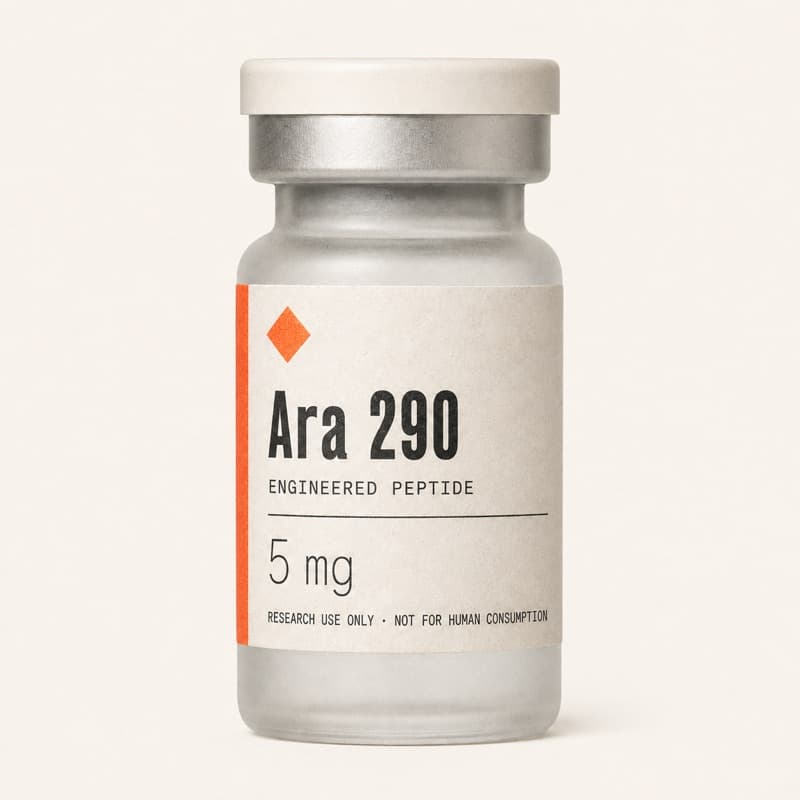
Ara 290
Tissue-Protective Peptide · Innate Repair Receptor Agonist
Engineered peptide of 11 amino acids that activates the Innate Repair Receptor (IRR), giving tissue-protective effects while leaving red blood cell production unstimulated. FDA Orphan Drug status applies.
Overview
Engineered peptide of 11 amino acids that activates the Innate Repair Receptor (IRR), giving tissue-protective effects while leaving red blood cell production unstimulated. FDA Orphan Drug status applies.
The EPOR/β-common receptor complex is the route to IRR activation; the signaling that follows protects tissue while leaving erythropoiesis untouched.
Research indications
What the compound has been studied for, grouped by body system. Effect size is the reported magnitude where it was measured — not a recommendation.
Cardiac function is preserved in models of aging.
Infarct size falls in models of myocardial infarction.
Upregulated VEGF, with angiogenesis and epithelialization both improved.
Corneal nerve fiber area rose 23%, with pain improvement sustained.
Metabolic improvements and nerve regeneration, recorded in patients with Type 2 diabetes.
Passage across the blood-brain barrier supports neuroprotection in stroke and TBI.
Production of TNF-α, IL-6 and IL-12 falls.
Animal models of colitis show reduced severity.
Graft survival rises; rejection falls.
- Class
- Engineered peptide
- Research status
- Extensively studied
- Chain length
- 11 residues
- Molecular weight
- 1257 Da
- Half-life
- ~20 min
- Typical dose
- 4 mg daily
- Frequency
- Once daily
- Cycle length
- 28 days
- Storage
- Lyophilized: 2-8°C refrigerated, protect from light. Reconstituted: use immediately or refrigerate up to 24 hours
Molecular data
- Type
- Engineered peptide
- Molecular weight
- 1257 Da
- Chain length
- 11 residues
- Half-life
- 20 min
Levels in single-dose multiples. A shape, not a pharmacokinetic prediction.
Dosing reference
Doses reported in the literature and by suppliers. These are a record of what has been used in research — reference, never instruction.
| Context | Route | Amount | Frequency |
|---|---|---|---|
| Neuropathy Treatment | SubQ | 4 mg daily | Once daily |
| Tissue Protection | SubQ | 1-8 mg daily | Once daily |
| Acute Intervention | IV | 2 mg | 3x weekly |
Interactions
Tissue-repair pathways complement, and may increase wound healing.
Mechanisms combine to improve recovery after injury.
Tissue protection by separate mechanisms; no interactions known.
Receptor interference is why clinical trials exclude EPO within the prior 2 months.
Cellular metabolism is affected by both; additive effects warrant monitoring.
Trials involving GLP-1 agonists recorded no adverse interactions.
Tissue repair is affected by both; excessive growth factor activity needs monitoring.
A 6-month washout is required before Ara 290 so immune interactions are avoided.
What to expect
Safety
Mechanistic flags — properties of the pathway, not observed adverse events.
- Excellent safety profile across clinical trials; serious drug-related adverse events did not occur
- Unexpected blood count changes
- New neurological symptoms
- Any serious adverse events
- Signs of an allergic reaction
- Deterioration of the underlying condition
- Severe reactions at the injection site
- Pregnancy
- BMI > 34 kg/m²
- Anti-TNF therapy within the past 6 months
- EPO within the past 2 months
Quality checklist
What to confirm before trusting a batch of research material. A verification aid — not an endorsement of any supplier.
- Third-party Certificate of AnalysisIndependent lab · dated · lot-matched.
- HPLC purity ≥ 98%Reverse-phase trace included.
- Mass-spec confirms 1257 g/molMALDI-TOF or ESI-MS.
- Counterion stated (acetate ≫ TFA)TFA salts can confound bioassays.
- Endotoxin / sterility statementRelevant once reconstituted.
- Lyophilised · cold-chain shippedStored −20 °C, shipped on ice.
- Labelled “research use only”No therapeutic or dosing claims.
Recorded signals for this compound · 6
- ✓Manufactured to pharmaceutical grade under GMP conditions
- ✓Peptide sequence verified as correct — 11 amino acids, N-terminal pyroglutamate
- ✓Powder sterile and lyophilized, freeze-dried properly
- ✓Clinical batch documented: sterility confirmed, endotoxin <1 EU/mg, purity >95%
- !Formulation is light-sensitive; protection needed in storage and in use
- ×Degradation shows as a cloudy or discolored solution; the range that is acceptable runs clear to slightly cloudy
FAQ
Where does Ara-290 diverge from erythropoietin (EPO) in neuroprotection?
Engineered from the structure of EPO, Ara-290 is an 11-amino acid peptide that activates the Innate Repair Receptor (IRR) while leaving erythropoiesis untriggered. Tissue protection and nerve regeneration match what EPO offers; stimulation of red blood cells, polycythemia risk and thrombotic complications do not follow.
How does nerve regeneration progress over time on Ara-290 in diabetic neuropathy?
Phase 2 trials recorded a 23% increase in corneal nerve fiber area on 4mg daily across 28 days, with pain improvements that were sustained. Markers of nerve fiber regeneration surfaced in weeks 2–4; by weeks 4–6 therapeutic effects peaked and improvements reached maximum. Through months 2–6 the benefits persist by way of molecular switch effects.
Does Ara-290 combine with other neuroprotective peptides such as BPC-157?
Yes. Tissue repair pathways targeted by BPC-157 and Ara-290 complement each other, and no direct interactions are known. Synergy also holds for TB-500. Recovery from injury is likely improved by these combinations, though no clinical data cover concurrent use.
Why are anti-TNF biologics and recent EPO use avoided before Ara-290 is started?
Risk of immune interaction sets a 6-month washout for anti-TNF therapy ahead of Ara-290. EPO carries a 2-month washout, since related receptor pathways are targeted by both. Those intervals exist to prevent unpredictable receptor interference and the potential adverse immune effects of concurrent use.
References
- 1A Small Nonerythropoietic Helix B Surface Peptide Based Upon Erythropoietin Structure Is Cardioprotective Against Ischemic Myocardial DamageBrines M, Patel NSA, Villa P, et al. · Proceedings of the National Academy of Sciences · 2008
Engineered helix B surface peptide (pHBSP/ARA-290) from EPO structure. Increased reactive oxygen species threshold for mitochondrial permeability transition by 40%. Reduced ischemic myocardial infarct size equivalent to EPO without erythropoietic effects.
Animal in vivoPubMed 18676614 ↗ - 2Neuroprotection with an Erythropoietin Mimetic Peptide (pHBSP) in a Model of Mild Traumatic Brain Injury Complicated by Hemorrhagic ShockRobertson CS, Garcia R, Gaddam SSK, et al. · Journal of Neurotrauma · 2013
pHBSP reduced contusion volume from 20.8mm3 (control) to 5.9mm3. Improved cerebral blood flow recovery and beam-walking performance. Neuroprotective effects similar to EPO without thrombotic risk.
Animal in vivoPubMed 21545288 ↗ - 3ARA 290, a Nonerythropoietic Peptide Engineered from Erythropoietin, Improves Metabolic Control and Neuropathic Symptoms in Patients with Type 2 DiabetesBrines M, Dunne AN, van Velzen M, et al. · Molecular Medicine · 2015
Phase 2 trial, 4mg SC daily for 28 days in T2DM patients. Improvement in HbA1c and lipid profiles sustained 4 weeks post-dosing. Neuropathic symptoms significantly improved. Corneal nerve fiber density increased.
Human RCTPubMed 25387363 ↗ - 4Cibinetide Improves Corneal Nerve Fiber Abundance in Patients With Sarcoidosis-Associated Small Nerve Fiber Loss and Neuropathic PainDahan A, Brines M, Niesters M, Cerami A, van Velzen M · Investigative Ophthalmology & Visual Science · 2017
Phase 2b trial, 64 subjects with sarcoid neuropathy, 1-8mg SC daily for 28 days. Cibinetide significantly increased corneal and skin small nerve fiber abundance, consistent with disease-modifying effect. 23% increase in corneal nerve fiber area at 4mg dose.
Human RCTPubMed 28475703 ↗ - 5A Phase 2 Clinical Trial on the Use of Cibinetide for the Treatment of Diabetic Macular EdemaLois N, Gardner E, McFarland M, et al. · Translational Vision Science & Technology · 2020
9 patients, 4mg SC daily for 12 weeks. No serious adverse events. Improvement in NEI VFQ-25 composite quality of life scores. Some participants showed improvements in CRT, tear production, diabetic control, and albuminuria.
Review · inferredPubMed 32674280 ↗
In a mouse model of cerebral ischaemic stroke, the erythropoietin-derived peptide ARA290 protected brain tissue through the beta-common receptor, lowering apoptosis of neurons and levels of inflammatory cytokines without inducing erythropoiesis.
Long-term dosing with ARA-290, a non-haematopoietic peptide derived from erythropoietin, lessened age-related cardiac remodelling, lowering the non-myocyte to myocyte ratio, leukocyte infiltration and pro-inflammatory cytokines, while cardiac function was preserved and healthspan extended.