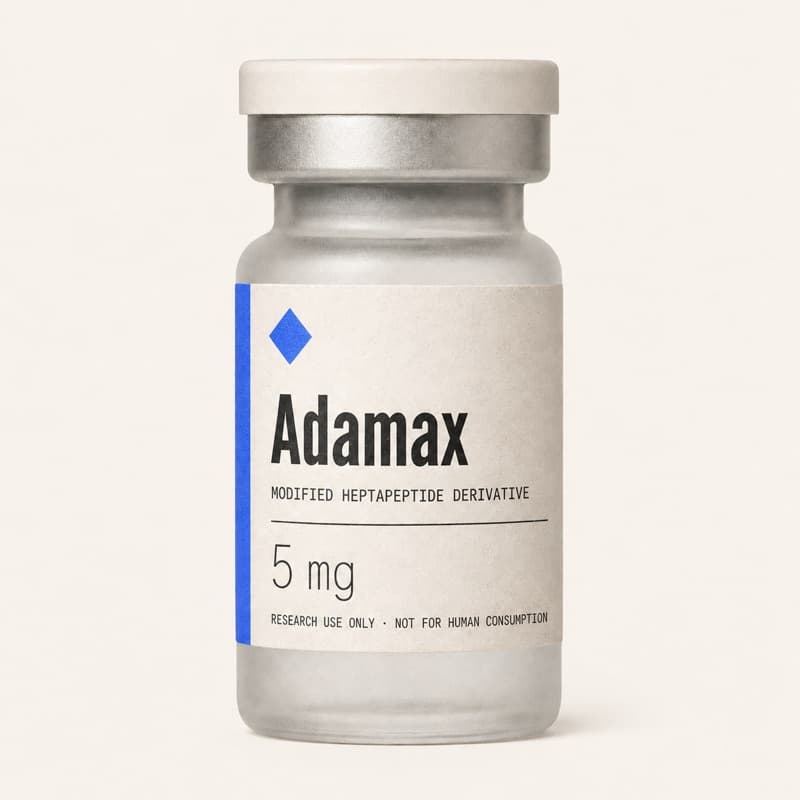
Adamax
Next-Generation Semax Derivative · Nootropic Neuropeptide
Nootropic peptide, synthetic, carrying an acetyl group at the N-terminus and an adamantane modification at the C-terminus; both raise stability and blood-brain barrier penetration. Research covers cognitive enhancement, neuroprotection, and neuroplasticity.
Overview
Nootropic peptide, synthetic, carrying an acetyl group at the N-terminus and an adamantane modification at the C-terminus; both raise stability and blood-brain barrier penetration. Research covers cognitive enhancement, neuroprotection, and neuroplasticity.
The adamantane group raises lipophilicity enough to carry it across the BBB; BDNF and TrkB receptor sensitivity are upregulated; dopamine, norepinephrine and serotonin are modulated; microtubules are stabilized through ADNP-derived mechanisms; neuroprotection comes with antioxidant and anti-inflammatory character.
Research indications
What the compound has been studied for, grouped by body system. Effect size is the reported magnitude where it was measured — not a recommendation.
Preliminary research points to gains in handling complex tasks, consolidating memory, mental clarity, and focus.
New neural connections and synaptic plasticity are promoted by BDNF upregulation and TrkB enhancement, toward long-term improvements.
Activation of the hippocampal BDNF-TrkB pathway may enhance learning efficiency, information retention, and memory formation.
Neurological outcomes improve on preliminary observation, by way of neuronal repair and reduced oxidative stress.
Antioxidant properties are demonstrated, guarding against inflammation-induced neuronal injury and oxidative damage.
Neuronal survival and growth are supported through microtubule stabilization and BDNF enhancement.
Serotonin and dopamine are influenced; through neurotransmitter modulation, mood is elevated and depressive symptoms reduced.
Anecdotal reports describe less anxiety and less overwhelm, attributed to balanced neurotransmitter activity.
Modulation of the HPA axis may improve emotional well-being and stress response.
- Class
- Modified heptapeptide derivative
- Research status
- Emerging
- Chain length
- 9 residues
- Molecular weight
- 1032.24 Da
- Half-life
- ~9 h
- Typical dose
- 200–300 µg
- Frequency
- Once or twice daily
- Cycle length
- 2–4 weeks
- Storage
- Lyophilized: room temp or freezer. Reconstituted: 2-8°C for 14-30 days
Molecular data
- Type
- Modified heptapeptide derivative
- Molecular weight
- 1032.24 Da
- Chain length
- 9 residues
- Half-life
- 540 min
Levels in single-dose multiples. A shape, not a pharmacokinetic prediction.
Dosing reference
Doses reported in the literature and by suppliers. These are a record of what has been used in research — reference, never instruction.
| Context | Route | Amount | Frequency |
|---|---|---|---|
| Cognitive Enhancement | SubQ | 200-300mcg | 1x daily |
| Neuroprotection | SubQ | 300mcg | 1-2x daily |
| Mood Support | SubQ | 200mcg | 1x daily (morning) |
| Initial Trial | SubQ | 100-200mcg | 1x daily |
| Cognitive Enhancement | Oral/Sublingual | 100-200mg | 1x daily (morning) |
| Sustained Focus | Oral/Sublingual | 100-200mg | 2x daily (morning, early afternoon) |
| Mood Support | Oral/Sublingual | 100mg | 1x daily (morning) |
| Initial Assessment | Oral/Sublingual | 100mg | 1x daily |
Interactions
An enhanced derivative, Adamax improves on stability and bioavailability.
The adamantyl portion of P21 is incorporated into Adamax; cognitive benefits may complement.
Mechanisms differ: Adamax acts on neurological function, BPC-157 on tissue repair.
Cognition is enhanced by both, through different mechanisms, with BDNF upregulation shared; lower starting doses and monitoring for overstimulation apply.
What to expect
Safety
Mechanistic flags — properties of the pathway, not observed adverse events.
- Anxiety or overstimulation
- Headaches, particularly where doses run higher
- Sleep disruption, or insomnia
- Cardiovascular effects — palpitations, blood pressure elevated
- Headaches, persistent or severe
- Significant increases in blood pressure, heart palpitations, or chest pain
- Mood disturbances, insomnia, or severe anxiety
- Neurological symptoms out of the ordinary, or changes in mental status
- Gastrointestinal distress — diarrhea, vomiting, nausea
- Injection-site reactions that persist, or signs of an infection
- Pregnancy and breastfeeding
- Severe anxiety disorders
- Uncontrolled hypertension
- Cardiovascular conditions, absent medical supervision
Quality checklist
What to confirm before trusting a batch of research material. A verification aid — not an endorsement of any supplier.
- Third-party Certificate of AnalysisIndependent lab · dated · lot-matched.
- HPLC purity ≥ 98%Reverse-phase trace included.
- Mass-spec confirms 1032.24 g/molMALDI-TOF or ESI-MS.
- Counterion stated (acetate ≫ TFA)TFA salts can confound bioassays.
- Endotoxin / sterility statementRelevant once reconstituted.
- Lyophilised · cold-chain shippedStored −20 °C, shipped on ice.
- Labelled “research use only”No therapeutic or dosing claims.
Recorded signals for this compound · 6
- ✓Powder white and fluffy, a sign of proper freeze-drying
- ✓After reconstitution the solution is clear, without cloudiness or particles
- ✓Labeling done properly: peptide name, batch number, and date of manufacture
- !Shipping may leave slight compaction; acceptable where the powder dissolves completely
- ×Where cloudiness or particles persist, degradation or contamination is indicated
- ×Oxidation or degradation is indicated by discoloration or yellowing
FAQ
In what way does the cognitive effect of Adamax differ from that of Semax?
Adamax is the next-generation Semax derivative, modified at the C-terminus with adamantane for greater lipophilicity and blood-brain barrier penetration. Parent Semax shows cognitive benefits of its own; the superior stability and BBB crossing of Adamax potentially allow stronger cognitive effects at lower doses, with action more sustained.
Does combining Adamax with other nootropics risk overstimulation?
Yes. BDNF upregulation is shared with compounds such as Noopept, so a combination risks excessive neurotropic effects. Lower starting doses, and monitoring for overstimulation, anxiety, or sleep disruption, are the mitigations. Safe stacking demands careful dose titration and might be better avoided for most users.
Where do the headaches some report on Adamax originate?
Higher doses — above 300 µg in particular — are where headaches are most common. The likely relation is to potent modulation of dopamine, norepinephrine, and serotonin alongside BDNF upregulation, which creates temporary neurochemical shifts. A start at 100–200 µg with slow titration minimizes the risk.
After discontinuation, how long do the cognitive effects of Adamax hold?
Improvements in BDNF-mediated neuroplasticity keep cognitive benefits in place for weeks or months past discontinuation. Continuous use brings peak neuroprotective and structural brain benefits by week 4+, and the neuronal changes that BDNF upregulation induces last independently of whether the compound is still in circulation.
References
- 1A Nootropic Adrenocorticotropin Analog 4-10 Semax: 15 Years Experience in Its Design and Study (Parent Compound)Ashmarin IP, Nezavibatko VN, Levitskaya NG, et al. · Zhurnal Vysshei Nervnoi Deiatelnosti imeni I.P. Pavlova · 1997
Foundational Semax review: intranasal doses stimulate operative memory and attention for 20-24 hours. Adamax builds on the Semax core sequence with adamantane modification for enhanced stability and BBB penetration.
Review · inferredPubMed 9173745 ↗ - 2Semax, an Analog of ACTH(4-10), Regulates BDNF and trkB Expression in the Rat Hippocampus (Parent Compound)Dolotov OV, Karpenko EA, Inozemtseva LS, et al. · Brain Research · 2006
Single application at 50 mcg/kg produced 1.4-fold increase in BDNF protein and 1.6-fold increase in trkB tyrosine phosphorylation in rat hippocampus, supporting Adamax's BDNF-TrkB mechanism.
Animal in vivoPubMed 16996037 ↗ - 3The Peptide Semax Affects the Expression of Genes Related to the Immune and Vascular Systems in Rat Brain Focal Ischemia (Parent Compound)Dergunova LV, Limborska SA, et al. · BMC Genomics · 2014
Genome-wide analysis: Semax modulated 24 vascular genes at 3h and enhanced immune-response gene expression at 24h post-ischemia, demonstrating multi-pathway neuroprotection.
Animal in vivoPubMed 24661604 ↗ - 4The Efficacy of Semax in the Treatment of Patients at Different Stages of Ischemic Stroke (Parent Compound)Gusev EI, Barskov IV, et al. · Zhurnal Nevrologii i Psikhiatrii imeni S.S. Korsakova · 2018
110 ischemic stroke patients; Semax (6000 mcg/day intranasal) increased BDNF plasma levels and accelerated functional recovery, providing the clinical basis for Adamax neuroprotective applications.
Human pilotPubMed 29798983 ↗
In a transgenic mouse model of Alzheimer's disease, Semax and a derivative raised cognitive performance and cut amyloid plaque burden by a factor of 2.8, which is the basis for interest in related compounds such as Adamax.
The Semax peptide family chelates copper, pulling Cu(II) out of the complexes it forms with amyloid-beta, which lowers ROS output and the associated cytotoxicity.
Recovery of function after spinal cord injury was enhanced by Semax acting on the mu-opioid receptor gene Oprm1, with the USP18 deubiquitination pathway implicated, extending what is known of neuroprotection across the Semax family.