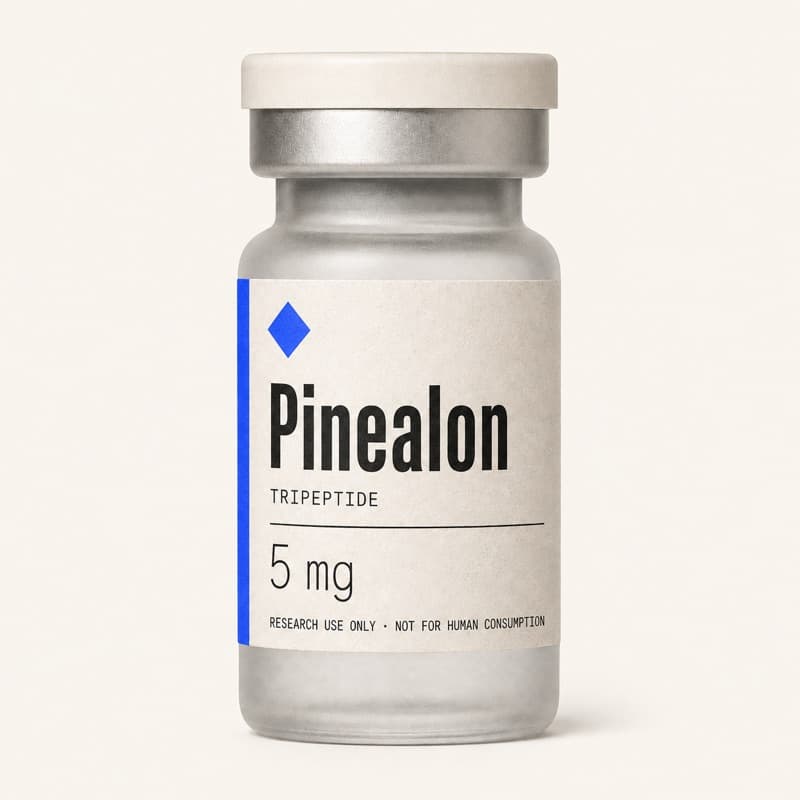
Pinealon
Synthetic Tripeptide · Neuroprotection & Cognitive Enhancement
Russian in origin, Pinealon acts through a unique interaction with DNA to deliver neuroprotection and cognitive enhancement. Recovery from traumatic brain injury and age-related cognitive decline both benefit, and the safety profile is clean.
Overview
Russian in origin, Pinealon acts through a unique interaction with DNA to deliver neuroprotection and cognitive enhancement. Recovery from traumatic brain injury and age-related cognitive decline both benefit, and the safety profile is clean.
Nuclear membranes are penetrated and DNA engaged directly; gene expression is modulated through histone H1.3 binding and activation of the MAPK/ERK pathway.
Research indications
What the compound has been studied for, grouped by body system. Effect size is the reported magnitude where it was measured — not a recommendation.
Neuroprotective effects follow subcutaneous administration, which lets systemic circulation carry the peptide to brain tissue.
In a 72-patient study, a clinical protocol of 5 mg daily showed significant cognitive improvements.
Suppression of caspase-3, reduction of ROS, protection against excitotoxicity.
Neurotransmitter function enhanced, with serotonin up 1.9× in cell cultures.
Spatial learning in the hippocampus improved at the optimal dose of 100 ng/kg.
Irisin expression rises, a change linked to protection of telomeres and enhanced mitochondria.
A 32-patient study showed aging indicators significantly improved over 20–30 days.
- Class
- Tripeptide
- Research status
- Well studied
- Chain length
- 3 residues
- Molecular weight
- 418.4 Da
- Typical dose
- Injectable: 5 mg daily or 100–300 µg daily; oral: 0.2 mg twice daily
- Frequency
- Injectable: daily for 20 days; oral: morning and afternoon on an empty stomach
- Cycle length
- 20 days per cycle
- Storage
- Refrigerate at 2-8°C, use within 30 days after reconstitution
Molecular data
- Type
- Tripeptide
- Molecular weight
- 418.4 Da
- Chain length
- 3 residues
Dosing reference
Doses reported in the literature and by suppliers. These are a record of what has been used in research — reference, never instruction.
| Context | Route | Amount | Frequency |
|---|---|---|---|
| Neuroprotection | SubQ | 5mg daily | Once daily |
| Cognitive Enhancement | SubQ | 100-300mcg | Daily or every other day |
| Anti-aging | SubQ | 5mg | 20 days, 2-3x yearly |
| Cognitive Enhancement | Empty stomach | 0.2mg twice daily | Morning and afternoon |
| Sleep Support | Oral | 200mcg | Daily |
Interactions
Neuroprotection is enhanced where telomerase activation pathways complement.
Brain-region targeting yields synergistic recovery of cognition in stroke patients.
A safe combination; the neural-immune axis is optimized.
Endogenous serotonin production is stimulated by Pinealon; sleep patterns warrant monitoring.
Separate mechanisms, no interactions known.
Anti-aging mechanisms that complement.
What to expect
Safety
Mechanistic flags — properties of the pathway, not observed adverse events.
- Minimal injection site reactions
- Mild gastrointestinal adjustment
- Occasional headache
- Fatigue
- Unusual neurological symptoms
- Allergic reactions
- Mood changes, or severe headaches
- Infection signs at the injection site
- Injection-site reactions that persist
- Pregnancy
- Lactation
Quality checklist
What to confirm before trusting a batch of research material. A verification aid — not an endorsement of any supplier.
- Third-party Certificate of AnalysisIndependent lab · dated · lot-matched.
- HPLC purity ≥ 98%Reverse-phase trace included.
- Mass-spec confirms 418.4 g/molMALDI-TOF or ESI-MS.
- Counterion stated (acetate ≫ TFA)TFA salts can confound bioassays.
- Endotoxin / sterility statementRelevant once reconstituted.
- Lyophilised · cold-chain shippedStored −20 °C, shipped on ice.
- Labelled “research use only”No therapeutic or dosing claims.
Recorded signals for this compound · 6
- ✓Powder white and crystalline, indicating proper freeze-drying
- ✓Reconstituted solution clear, free of particles or cloudiness
- ✓Pharmaceutical packaging showing batch numbers, from a reputable source
- !The distinction between research grade (lab only) and pharmaceutical grade (human use) matters
- ×Yellow or brown discoloration of the powder indicates heat or moisture degradation
- ×Contamination is indicated by a cloudy solution
FAQ
Is the direct DNA interaction documented, or a marketing claim?
Documented, not marketing. Nuclear membranes are penetrated and histone H1.3 and DNA structures bound directly, modulating gene expression. The mechanism is recorded in multiple peer-reviewed studies. Few peptides act by direct DNA interaction instead of receptor binding; this is one of them.
Is Pinealon taken orally, or does it require injection?
Both routes work. The oral form, 0.2 mg twice daily, relies on a 3-amino acid structure that survives stomach acid. Injection at 5 mg daily subcutaneous carries higher bioavailability. Oral is the more convenient; injection gives direct systemic delivery. The choice falls between convenience and guaranteed absorption.
What weight does 40+ years of Russian clinical use carry without FDA approval?
Long-term safety data across thousands of patients comes out of that use, far more than most research peptides have behind them. It does not equal FDA approval, but four decades of documented safety in clinical settings amount to meaningful evidence of tolerability. Rigorous Western clinical trials are still absent.
Pinealon or P21 for brain protection — how do the two compare?
Neuroprotection is the shared target, reached by different routes. MAPK/ERK modulation and raised serotonin come from Pinealon, weighting it toward mood support; raised BDNF and neurogenesis come from P21, weighting it toward cognition and learning. Clinical evidence sits with Pinealon, preclinical with P21, and Pinealon is the better-established of the two for TBI recovery.