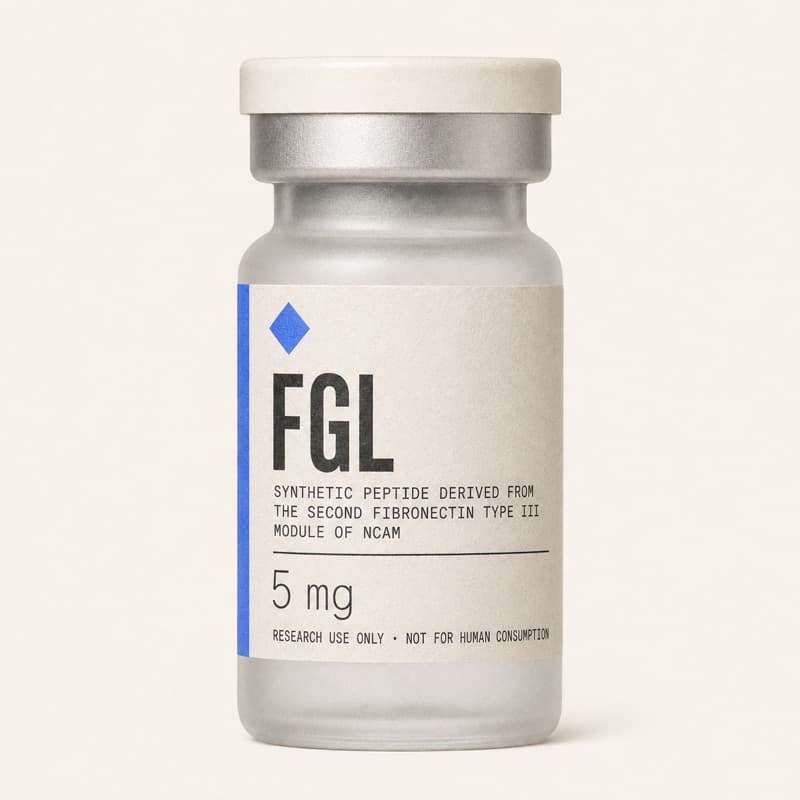
FGL
NCAM-Derived Peptide · Synaptic Plasticity & Neuroprotection
Synthetic peptide whose sequence comes from the neural cell adhesion molecule (NCAM), specifically its second fibronectin type III module. The interaction of NCAM with FGFR1, the fibroblast growth factor receptor 1, is what it mimics, and the downstream signaling cascades that follow promote neuroprotection, neurogenesis, and synaptic plasticity. Research has run mostly in animal models, where the compound has shown promise in stroke recovery, cognitive enhancement, and models of neurodegenerative disease.
Overview
Synthetic peptide whose sequence comes from the neural cell adhesion molecule (NCAM), specifically its second fibronectin type III module. The interaction of NCAM with FGFR1, the fibroblast growth factor receptor 1, is what it mimics, and the downstream signaling cascades that follow promote neuroprotection, neurogenesis, and synaptic plasticity. Research has run mostly in animal models, where the compound has shown promise in stroke recovery, cognitive enhancement, and models of neurodegenerative disease.
FGFR1 is bound and activated by FGL, which sets off receptor autophosphorylation and downstream signaling along the MAPK/ERK and PI3K/Akt pathways. What follows from that activation: long-term potentiation (LTP) is promoted, synaptic plasticity improves, neurogenesis is stimulated in the hippocampus, and neuroprotection is conferred against excitotoxicity and oxidative stress.
Research indications
What the compound has been studied for, grouped by body system. Effect size is the reported magnitude where it was measured — not a recommendation.
After ischemic injury, animal studies report smaller infarct volume and better functional outcomes.
Protective effects appear in preclinical Alzheimer's disease models and in other neurodegenerative conditions.
Long-term potentiation is promoted through FGFR1 activation, and synaptic connections strengthen.
New neurons are generated in the hippocampus of animal models.
In animal models, memory consolidation and spatial learning improve via FGFR1-mediated synaptic plasticity.
Neurogenesis and synaptic support may offset age-related cognitive decline, on preclinical evidence.
- Class
- Synthetic peptide derived from the second fibronectin type III module of NCAM
- Research status
- Limited research
- Molecular weight
- 1500 Da
- Typical dose
- 100–200 µg daily
- Frequency
- Once daily
- Cycle length
- Research protocols vary; limited human data on cycling
- Storage
- Lyophilized: -20C; Reconstituted: 2-8C, use within 4 weeks
Molecular data
- Type
- Synthetic peptide derived from the second fibronectin type III module of NCAM
- Molecular weight
- 1500 Da
Dosing reference
Doses reported in the literature and by suppliers. These are a record of what has been used in research — reference, never instruction.
| Context | Route | Amount | Frequency |
|---|---|---|---|
| Cognitive support (research protocol) | SubQ | 100-200mcg | 1x daily |
Interactions
Neuroplasticity and neuroprotection are supported by both, through complementary mechanisms — FGL activates FGFR1, Semax upregulates BDNF.
Cognitive support on different mechanisms: FGFR1 activation for FGL, HGF/c-Met for Dihexa.
Neurotrophic support comes from each by a separate pathway; no adverse interactions are known.
What to expect
Safety
Mechanistic flags — properties of the pathway, not observed adverse events.
- Reactions where injected — redness, mild swelling, irritation
- Rash, difficulty breathing, swelling: an allergic reaction indicated
- Injection site reactions that persist or worsen
- Neurological symptoms out of the ordinary — severe headache, dizziness, vision changes
- Pregnancy or breastfeeding
- Known allergy to peptides or NCAM-related compounds
- Human safety data is very limited, which warrants caution and medical supervision
Quality checklist
What to confirm before trusting a batch of research material. A verification aid — not an endorsement of any supplier.
- Third-party Certificate of AnalysisIndependent lab · dated · lot-matched.
- HPLC purity ≥ 98%Reverse-phase trace included.
- Mass-spec confirms 1500 g/molMALDI-TOF or ESI-MS.
- Counterion stated (acetate ≫ TFA)TFA salts can confound bioassays.
- Endotoxin / sterility statementRelevant once reconstituted.
- Lyophilised · cold-chain shippedStored −20 °C, shipped on ice.
- Labelled “research use only”No therapeutic or dosing claims.
Recorded signals for this compound · 9
- ✓Dissolves completely when reconstituted
- ✓Purity tested by a third party at >95%
- ✓Shipped with a proper cold chain
- ✓Lyophilized powder, white to off-white
- !Injection site irritation
- !Available human safety data: very limited
- ×Particles or aggregates visible
- ×Powder failing to dissolve fully
- ×After reconstitution, solution cloudy or discolored
FAQ
What separates FGL's mechanism from that of other cognitive peptides?
The NCAM-FGFR1 interaction is mimicked and the FGFR1 receptor activated — a route unique to FGL, where most cognitive peptides run through BDNF upregulation (Semax) or HGF/c-Met (Dihexa). Synaptic plasticity and neurogenesis follow from that FGFR1 pathway by way of distinct signaling cascades, which leaves FGL complementary to other cognitive peptides.
How strong is the evidence for FGL in human cognitive enhancement?
Animal models carry most of the research: spatial memory improves, hippocampal neurogenesis is promoted, and neurons are protected from excitotoxicity. Human clinical trials do not yet exist. With the evidence base still preclinical, FGL sits as a high-risk, exploratory peptide, appropriate only in research contexts where the limited human safety data is medically understood.
Does FGL act on age-related cognitive decline?
Stimulated neurogenesis and synaptic support are the proposed route, and animal studies suggest FGL could counteract age-related cognitive decline that way. No human study confirms it. The preclinical evidence looks favorable yet falls short of supporting clinical claims about aging — every available study was run in younger animal models.
Does FGL come in any form other than injectable?
The form mainly available is lyophilized powder for subcutaneous injection. Oral or nasal formulations exist in theory but lack research validation. Animal work has studied the subcutaneous route, which makes it the most established, while human administration data is essentially nonexistent.
References
- 1The FGL Peptide Derived from NCAM Acts as a Neurotrophic Factor and Promotes Neurite Outgrowth and Survival of NeuronsNeiiendam JL, Bhatt DK, Bhatt SS, et al. · Journal of Neurochemistry · 2004
FGL promoted neurite outgrowth and neuronal survival through activation of FGFR1 and downstream signaling pathways, establishing the mechanistic basis for its neurotrophic properties.
Animal in vivoPubMed 14675148 ↗ - 2Enhancement of Long-Term Potentiation and Memory by the NCAM-Derived Peptide FGLBhatt DK, et al. · Neuropharmacology · 2008
Systemic administration of FGL enhanced long-term potentiation in the dentate gyrus and improved associative memory in aged rats, demonstrating cognitive benefits through FGFR1-mediated mechanisms.
Animal in vivo · inferredPubMed 18420235 ↗ - 3A Peptide Agonist of the Neural Cell Adhesion Molecule NCAM, FGL, Enhances Synaptogenesis and Memory in RatsBhatt DK, Bhatt SS, et al. · European Journal of Neuroscience · 2009
FGL enhanced synaptogenesis in the hippocampus and improved spatial memory performance in rats, demonstrating the peptide's ability to promote functional synaptic plasticity.
ReviewPubMed 19473236 ↗ - 4FGL, a Neural Cell Adhesion Molecule-Derived Peptide, Promotes Recovery in a Rat Model of StrokeBhatt DK, et al. · European Journal of Neuroscience · 2013
FGL treatment reduced infarct volume and improved functional recovery following middle cerebral artery occlusion in rats, supporting its neuroprotective potential in ischemic stroke.
Animal in vivoPubMed 23551821 ↗