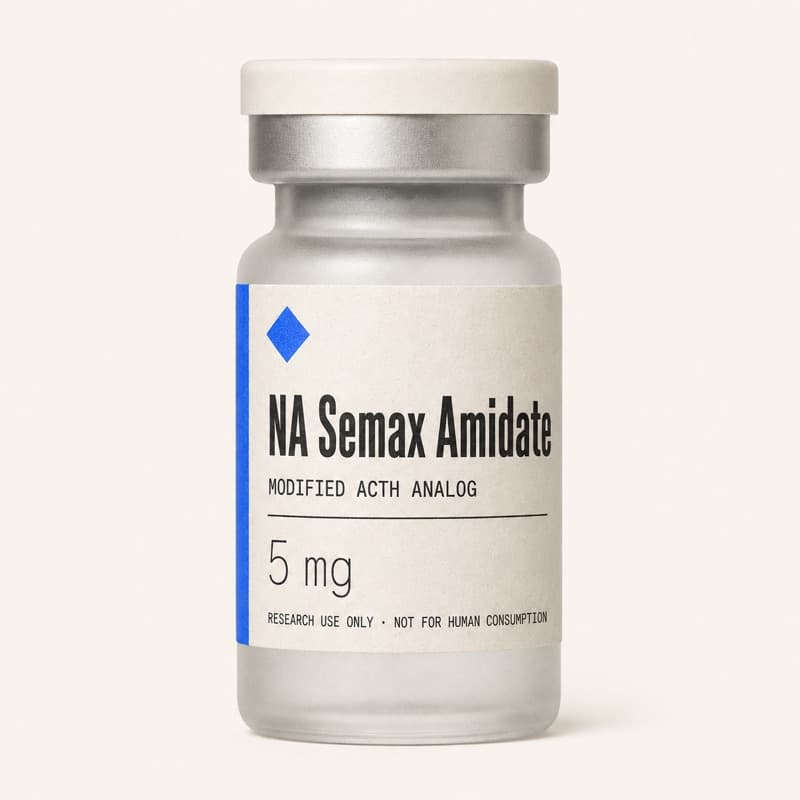
NA Semax Amidate
Enhanced Nootropic Peptide · Cognitive Enhancement & Neuroprotection
Version of the Russian nootropic Semax, enhanced and stabilized, with acetylation and amidation supplying superior stability, a longer half-life, and higher bioavailability.
Overview
Version of the Russian nootropic Semax, enhanced and stabilized, with acetylation and amidation supplying superior stability, a longer half-life, and higher bioavailability.
The olfactory nerves carry it past the blood-brain barrier, giving direct brain access; BDNF upregulation and hippocampal plasticity are both enhanced.
Research indications
What the compound has been studied for, grouped by body system. Effect size is the reported magnitude where it was measured — not a recommendation.
Within 15–30 minutes comes rapid improvement in sustained attention, in working memory, in mental clarity.
BDNF upregulation enhances memory consolidation, short-term and long-term alike.
Cognitive performance improves significantly under mental fatigue, and the effects last.
Functional recovery accelerates on enhanced neuroplasticity and elevated BDNF.
Neural oxidative damage is guarded against; cellular repair mechanisms are supported.
BDNF and TrkB receptor expression rise rapidly, which supports neuronal survival.
Optimizing the default mode network improves how episodic memories form and are recalled.
Improved synaptic plasticity enhances how new information is acquired.
- Class
- Modified ACTH analog
- Research status
- Well studied
- Chain length
- 7 residues
- Molecular weight
- 1007.16 Da
- Half-life
- ~6 h
- Typical dose
- 600–1200 µg per dose
- Frequency
- 1–2 times daily for 10–30 days
- Cycle length
- 10–30 days
- Storage
- Refrigerate at 2-8°C
Molecular data
- Type
- Modified ACTH analog
- Molecular weight
- 1007.16 Da
- Chain length
- 7 residues
- Half-life
- 360 min
Levels in single-dose multiples. A shape, not a pharmacokinetic prediction.
Dosing reference
Doses reported in the literature and by suppliers. These are a record of what has been used in research — reference, never instruction.
| Context | Route | Amount | Frequency |
|---|---|---|---|
| Cognitive enhancement | Intranasal spray | 600mcg | 1x daily |
| Mental fatigue resistance | Intranasal spray | 800mcg | 1x daily |
| Memory enhancement | Intranasal spray | 600mcg | 2x daily |
| Neuroprotection | Intranasal spray | 1200mcg | 1x daily |
| Research protocol | SubQ | 200mcg | 1x daily |
| Neuroprotection study | SubQ | 400mcg | 1x daily |
Interactions
An excellent combination: cognitive support is comprehensive, the benefits both nootropic and anxiolytic.
Separate mechanisms whose neuroprotective benefits complement each other.
BDNF and neuroplasticity are enhanced by both; cognitive benefits may be additive.
Focus is affected by both, and the combination may overstimulate in some individuals.
Semax may affect vascular function, so blood pressure warrants monitoring.
Neurotransmitter systems are affected by Semax; effects of the combination may be unpredictable.
What to expect
Safety
Mechanistic flags — properties of the pathway, not observed adverse events.
- Slight headache initially
- Nasal irritation, mild (intranasal)
- Persisting irritation of the nose, burning or bleeding
- Severe headaches or dizziness following administration
- Unusual changes in mood, anxiety, or agitation
- Allergic reactions of any kind (swelling, rash, difficulty breathing)
- Blood pressure or heart rate changing significantly
- Disturbed sleep or insomnia
- Not recommended during pregnancy
- Nasal congestion currently active, or sinus infection
- Those taking neurotransmitter-affecting medications, absent consultation
Quality checklist
What to confirm before trusting a batch of research material. A verification aid — not an endorsement of any supplier.
- Third-party Certificate of AnalysisIndependent lab · dated · lot-matched.
- HPLC purity ≥ 98%Reverse-phase trace included.
- Mass-spec confirms 1007.16 g/molMALDI-TOF or ESI-MS.
- Counterion stated (acetate ≫ TFA)TFA salts can confound bioassays.
- Endotoxin / sterility statementRelevant once reconstituted.
- Lyophilised · cold-chain shippedStored −20 °C, shipped on ice.
- Labelled “research use only”No therapeutic or dosing claims.
Recorded signals for this compound · 6
- ✓Powder white and fluffy, reconstituting clear
- ✓Solution clear, without particles or cloudiness
- ✓Certificates from third-party purity testing showing purity >98%
- !Cold chain properly maintained through shipping
- ×Powder discolored; degradation shows as yellow or brown
- ×Contamination shows as cloudiness once reconstituted
FAQ
Where does NA-Semax Amidate differ from regular Semax?
NA-Semax Amidate (N-acetylated, C-terminal amidated) carries enhanced stability and a half-life extended to 2–10 hours, against 0.5–2 hours for regular Semax. Blood-brain barrier penetration improves with the acetylation; bioavailability rises with the amidation. Cognitive benefits come out more sustained.
How fast is the onset of intranasal NA-Semax Amidate?
Onset is rapid: cognitive clarity and focus improve within 15–30 minutes of intranasal administration. The peak lands at 1–2 hours, and cognitive benefits hold for 2–6 hours. That speed makes it useful where cognitive demands are acute.
Does NA-Semax Amidate stack with other nootropics?
Yes, with care. Synergy holds with NA-Selank Amidate for comprehensive cognitive and anxiolytic support, and compatibility extends to BPC-157 and Lion's Mane. MAO inhibitors are to be avoided in combination, and modafinil calls for monitoring, given the potential for overstimulation.
References
- 1A Nootropic Adrenocorticotropin Analog 4-10 Semax: 15 Years Experience in Its Design and Study (Parent Compound)Ashmarin IP, Nezavibatko VN, Levitskaya NG, et al. · Zhurnal Vysshei Nervnoi Deiatelnosti imeni I.P. Pavlova · 1997
Foundational Semax review: intranasal doses stimulate operative memory and attention for 20-24 hours. Adamax builds on the Semax core sequence with adamantane modification for enhanced stability and BBB penetration.
Review · inferredPubMed 9173745 ↗ - 2Semax, an Analog of ACTH(4-10), Regulates BDNF and trkB Expression in the Rat Hippocampus (Parent Compound)Dolotov OV, Karpenko EA, Inozemtseva LS, et al. · Brain Research · 2006
Single application at 50 mcg/kg produced 1.4-fold increase in BDNF protein and 1.6-fold increase in trkB tyrosine phosphorylation in rat hippocampus, supporting Adamax's BDNF-TrkB mechanism.
Animal in vivoPubMed 16996037 ↗ - 3The Peptide Semax Affects the Expression of Genes Related to the Immune and Vascular Systems in Rat Brain Focal Ischemia (Parent Compound)Dergunova LV, Limborska SA, et al. · BMC Genomics · 2014
Genome-wide analysis: Semax modulated 24 vascular genes at 3h and enhanced immune-response gene expression at 24h post-ischemia, demonstrating multi-pathway neuroprotection.
Animal in vivoPubMed 24661604 ↗ - 4Effects of Semax on the Default Mode Network of the Brain (Parent Compound)Dolgorukova AM, Klyushnik TP, Gusev EI, et al. · Bulletin of Experimental Biology and Medicine · 2018
24 healthy volunteers; resting-state fMRI showed increased default mode network volume in medial frontal cortex after intranasal 1% Semax vs placebo, enhancing episodic memory.
Review · inferredPubMed 30225715 ↗ - 5The Efficacy of Semax in the Treatment of Patients at Different Stages of Ischemic Stroke (Parent Compound)Gusev EI, Barskov IV, et al. · Zhurnal Nevrologii i Psikhiatrii imeni S.S. Korsakova · 2018
110 ischemic stroke patients; Semax (6000 mcg/day intranasal) increased BDNF plasma levels and accelerated functional recovery, providing the clinical basis for Adamax neuroprotective applications.
Human pilotPubMed 29798983 ↗
In mice transgenic for Alzheimer's pathology, Semax and a derivative improved cognition and cut amyloid plaque counts 2.8-fold, supporting further work on analogues such as NA-Semax-Amidate.
Semax stops Abeta:Cu2+ complexes from assembling and suppresses amyloid fibre growth, an anti-aggregating action with relevance to Alzheimer's disease.
Semax acted on mu-opioid receptors encoded by Oprm1 to suppress pyroptosis and restore function after spinal cord injury, broadening what is known about neuroprotection by Semax-family peptides.