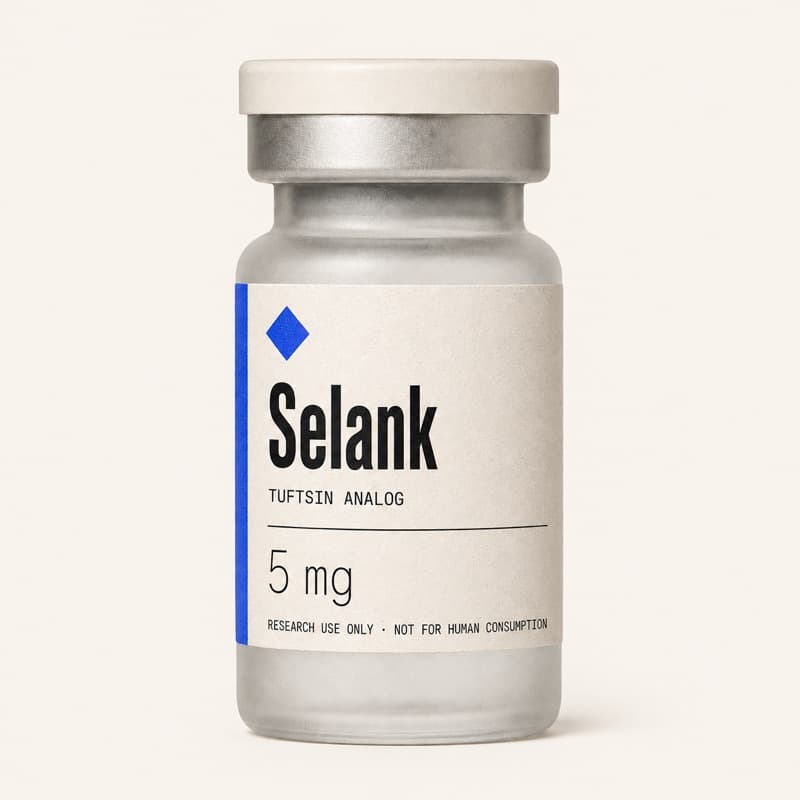
Selank
Anxiolytic & Nootropic Peptide · Tuftsin Analog
Synthetic heptapeptide analog of tuftsin, an immune peptide that occurs naturally; the Russian Academy of Sciences developed it. Anxiolytic effects are comparable to those of benzodiazepines, but sedation, amnesia, tolerance, and withdrawal do not follow.
Overview
Synthetic heptapeptide analog of tuftsin, an immune peptide that occurs naturally; the Russian Academy of Sciences developed it. Anxiolytic effects are comparable to those of benzodiazepines, but sedation, amnesia, tolerance, and withdrawal do not follow.
Five mechanisms are described: allosteric modulation of GABA-A receptors, optimization of the serotonin and dopamine systems, inhibition of enkephalin degradation, regulation of IL-6 and cytokine balance, and upregulation of hippocampal BDNF.
Research indications
What the compound has been studied for, grouped by body system. Effect size is the reported magnitude where it was measured — not a recommendation.
PTSD treatment is one area where research indicates effectiveness.
Anticipatory anxiety is reduced, as is performance stress.
In clinical trials anxiety symptoms fell significantly, to a degree comparable with benzodiazepines, and neither sedation nor amnesia followed.
Memory consolidation improves, and learning capacity with it.
Sustained attention improves where cognitive tasks are demanding.
Long-term brain health is supported by upregulated BDNF.
Immune function is balanced by way of cytokine regulation.
Antiviral activity is reported for influenza, HSV, and cytomegalovirus.
Inflammatory gene expression comes under modulation.
- Class
- Tuftsin analog
- Research status
- Well studied
- Chain length
- 7 residues
- Molecular weight
- 751.89 Da
- Half-life
- ~6 min
- Typical dose
- 250–500 µg per dose
- Frequency
- 1–2 times daily (morning and/or evening)
- Cycle length
- 2–8 weeks on
- Storage
- Reconstituted: 2-8°C, use within 30 days
Molecular data
- Type
- Tuftsin analog
- Molecular weight
- 751.89 Da
- Chain length
- 7 residues
- Half-life
- 6 min
TKPRPGPLevels in single-dose multiples. A shape, not a pharmacokinetic prediction.
Dosing reference
Doses reported in the literature and by suppliers. These are a record of what has been used in research — reference, never instruction.
| Context | Route | Amount | Frequency |
|---|---|---|---|
| Mild anxiety relief | SubQ | 250mcg | 1x daily |
| Moderate anxiety/cognitive | SubQ | 250mcg | 2x daily (morning & evening) |
| Intensive anxiety support | SubQ | 500mcg | 1x daily (divided doses) |
| Cognitive enhancement | SubQ | 250-350mcg | 1x daily (morning) |
| PTSD support | SubQ | 250mcg | 2x daily |
| Immune support | SubQ | 250mcg | 1x daily for 2-4 weeks |
| Acute anxiety relief | Nasal spray | 300-600mcg (1-2 sprays) | Once daily or as-needed |
Interactions
Combined, the cognitive and anxiolytic effects are enhanced.
Stress-response mechanisms that complement each other.
BDNF is enhanced by each, along different pathways.
Anxiety relief balanced against enhanced cognition.
GABAergic effects are similar; supervision by a clinician is advised.
Mood regulation is enhanced in combination; close monitoring applies.
Reduced anxiety balanced with wakefulness.
The GABA system is affected by each; excessive sedation is the risk.
What to expect
Safety
Mechanistic flags — properties of the pathway, not observed adverse events.
- Side effects minimal; the safety profile is excellent
- Neither sedation nor cognitive impairment
- Tolerance, dependence and withdrawal all absent
- Injection-site reactions that persist, or signs of an infection
- Neurological symptoms, or severe headaches
- Rash, difficulty breathing, or swelling — a severe allergic reaction
- Mood changes out of the ordinary, or anxiety increased
- Signs the product is contaminated — an odd smell, or cloudiness
- Fatigue without explanation, or cognitive impairment
- Reactions in the skin, or immune hypersensitivity
- Known peptide allergies
- Pregnancy or breastfeeding
- Where multiple psychiatric medications are in use, a healthcare provider should be consulted
Quality checklist
What to confirm before trusting a batch of research material. A verification aid — not an endorsement of any supplier.
- Third-party Certificate of AnalysisIndependent lab · dated · lot-matched.
- HPLC purity ≥ 98%Reverse-phase trace included.
- Mass-spec confirms 751.89 g/molMALDI-TOF or ESI-MS.
- Counterion stated (acetate ≫ TFA)TFA salts can confound bioassays.
- Endotoxin / sterility statementRelevant once reconstituted.
- Lyophilised · cold-chain shippedStored −20 °C, shipped on ice.
- Labelled “research use only”No therapeutic or dosing claims.
Recorded signals for this compound · 8
- ✓Lyophilized powder, white to off-white, showing no clumping
- ✓Batch information stated clearly, with purity testing and expiration dates
- ✓Packaging appropriate, shipping cold
- ✓Reconstituted solution clear and colorless
- !Bacterial contamination may be indicated by a burning sensation or an odd smell
- !Nasal spray shipped at room temperature
- ×Yellowing, clumping, or contact with moisture
- ×Cloudiness that persists after reconstitution
FAQ
Does long-term Selank use cost effectiveness, or build tolerance?
The tolerance and dependence that attend benzodiazepines do not apply to Selank, though this reference specifically limits cycles to 2–3 weeks with breaks in between. The implication is that GABAergic desensitization is possible under continuous use, without being true pharmacological tolerance. Cycling prevents it.
For anxiety, does intranasal Selank match the injection?
Yes, and potentially more. Onset is fastest intranasally at 15–30 minutes, with a 4–6 hour duration; injection takes 30–60 minutes but may last longer. Either is effective, and the choice turns on how quickly relief is needed. As-needed anxiety favors the nasal route; daily protocols favor injection.
Does Selank extend to PTSD, or is it confined to generalized anxiety?
PTSD is documented as an application. Research shows effectiveness in its treatment, rated there as 'effective'. The stress response is modulated across several systems — GABA, serotonin, dopamine, BDNF — which reaches trauma-related dysregulation. Use is typically alongside proper PTSD therapy rather than as sole treatment.
Where does Selank's 30% BDNF increase sit among other nootropics?
It is significant. Neuroplasticity and long-term potentiation — learning and memory — are supported by a 30% rise in hippocampal BDNF. Semax shows similar effects. Noopept and similar compounds also raise BDNF, by other pathways. What is distinctive about Selank is anxiety relief together with BDNF elevation and no sedation, a rare combination.
References
- 1Efficacy and Possible Mechanisms of Action of a New Peptide Anxiolytic Selank in the Therapy of Generalized Anxiety Disorders and NeurastheniaZozulia AA, Neznamov GG, Siuniakov TS, et al. · Zhurnal Nevrologii i Psikhiatrii imeni S.S. Korsakova · 2008
62 patients with GAD and neurasthenia; anxiolytic effects comparable to medazepam, with additional antiasthenic and psychostimulant effects lasting up to one week post-administration.
Human RCTPubMed 18454096 ↗ - 2Intranasal Administration of the Peptide Selank Regulates BDNF Expression in the Rat Hippocampus In VivoInozemtseva LS, Karpenko EA, Dolotov OV, et al. · Doklady Biological Sciences · 2008
Intranasal Selank regulates BDNF gene expression in the rat hippocampus in vivo, supporting its nootropic and neuroprotective properties.
Animal in vivoPubMed 18841804 ↗ - 3Experimental Optimization of Learning and Memory Processes by SelankSemenova TP, Kozlovskii II, Zakharova NM · Eksperimental'naia i Klinicheskaia Farmakologiia · 2010
Single injection of Selank activated serotonin metabolism in hypothalamus for 30 min to 2 hours and increased memory trace stability over 30 days.
Animal in vivoPubMed 20919548 ↗ - 4A Comparison of the Anxiolytic Effect and Tolerability of Selank and Phenazepam in the Treatment of Anxiety DisordersMedvedev VE, Tereshchenko ON, Kost NV, et al. · Zhurnal Nevrologii i Psikhiatrii imeni S.S. Korsakova · 2014
40 patients with anxiety disorders; combined Selank and phenazepam treatment decreased undesirable side-effects during treatment and after withdrawal.
Human pilotPubMed 25176261 ↗ - 5Selank Administration Affects the Expression of Some Genes Involved in GABAergic NeurotransmissionSemenova TP, Kozlovskii II, Zakharova NM, Kozlovskaya MM · Frontiers in Pharmacology · 2016
Rat frontal cortex study at 300mcg/kg showed modulation of 45 genes involved in neurotransmission at 1 hour post-administration; confirmed Selank acts as a positive allosteric modulator of GABA-A receptors.
Animal in vivo · inferredPubMed 26924987 ↗
In rats subjected to 20 days of social stress, Selank returned IL-6, IL-1β, TNF-α and TGF-β1 to near-control levels, indicating anti-inflammatory immunomodulation.
Selank stimulated cognition and blocked the development of ethanol-induced deficits in memory and attention, an effect linked to BDNF regulation within the hippocampus and prefrontal cortex.
Given prophylactically, selank fully blocked replication of the H3N2 strain A/Aichi 2/68 of influenza; the antiviral effect was traced to gene expression of IFN-alpha together with shifts in Th1/Th2 cytokines.
A review of the heptapeptide Selank concluding that its anxiolytic activity matches that of benzodiazepines through subtype-selective allosteric modulation at the GABA-A receptor, with neither sedation nor dependence.