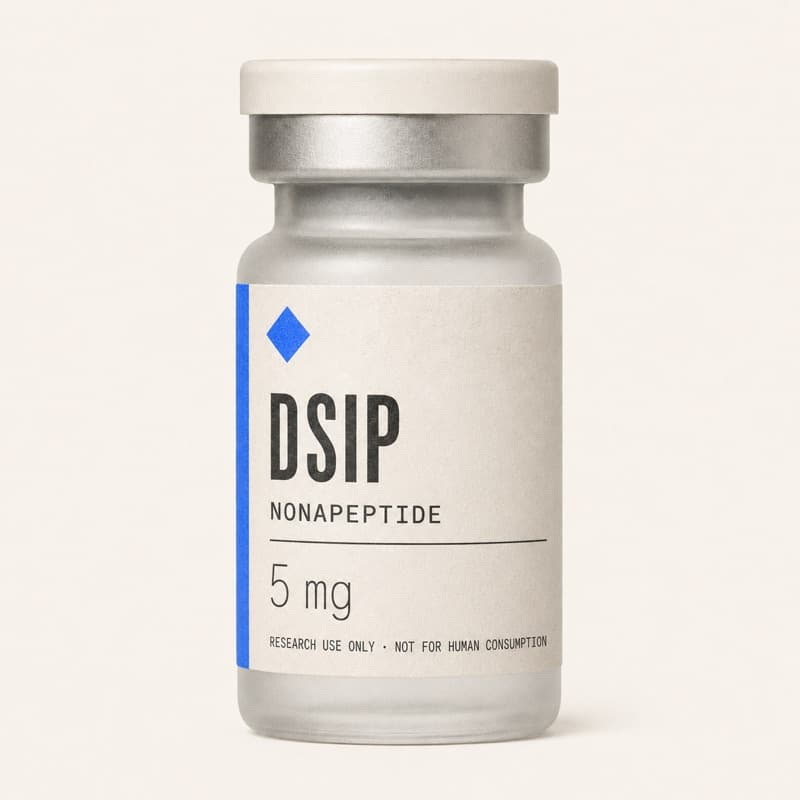
DSIP
Delta Sleep-Inducing Peptide · Sleep & Stress Modulator
Nonapeptide occurring naturally, first found in rabbit brain in 1974. Isolation followed from its sleep-promoting properties, but its neuromodulatory effects are wider: stress reduction, pain modulation, and endocrine regulation, all without traditional sedative effects.
Overview
Nonapeptide occurring naturally, first found in rabbit brain in 1974. Isolation followed from its sleep-promoting properties, but its neuromodulatory effects are wider: stress reduction, pain modulation, and endocrine regulation, all without traditional sedative effects.
Several neurotransmitter systems are modulated: GABA is enhanced, the NMDA receptor interacted with, the endogenous opioid system modulated. The hypothalamic-pituitary-adrenal axis is regulated too, for stress response.
Research indications
What the compound has been studied for, grouped by body system. Effect size is the reported magnitude where it was measured — not a recommendation.
Natural sleep cycles are supported, in place of the forced sedation of traditional sleep aids.
Delta wave sleep is promoted — the sleep phase most restorative for physical recovery.
Sleep latency and nocturnal awakenings both fall, with no morning grogginess.
Cortisol and the stress response are helped toward regulation by HPA axis modulation.
Emotional balance is supported, sedation absent.
Anxiety may be reduced by way of neuromodulatory effects.
Among 7 patients carrying chronic pain conditions, 6 saw pain levels significantly reduced.
Management of withdrawal symptoms is helped in patients dependent on alcohol or opioids.
Recovery after training is supported by enhanced sleep quality.
- Class
- Nonapeptide
- Research status
- Emerging
- Chain length
- 9 residues
- Molecular weight
- 848.81 Da
- Half-life
- ~15 min
- Typical dose
- 100–300 µg
- Frequency
- Once daily
- Cycle length
- 5–10 days
- Storage
- 2-8°C refrigerated
Molecular data
- Type
- Nonapeptide
- Molecular weight
- 848.81 Da
- Chain length
- 9 residues
- Half-life
- 15 min
WAGGDASGELevels in single-dose multiples. A shape, not a pharmacokinetic prediction.
Dosing reference
Doses reported in the literature and by suppliers. These are a record of what has been used in research — reference, never instruction.
| Context | Route | Amount | Frequency |
|---|---|---|---|
| Sleep enhancement | SubQ | 100-200mcg | Once nightly |
| Chronic pain support | SubQ or IV | 250-300mcg | Daily |
| Stress management | SubQ | 150mcg | Evening |
| Withdrawal support | IV preferred | 200-300mcg | Twice daily |
| Athletic recovery | SubQ | 100-150mcg | Post-training |
| Sleep induction | Nasal spray | 200-300mcg | Once at bedtime |
| Stress relief | Nasal spray | 150-200mcg | Twice daily |
| Neuroprotection | Nasal spray | 300-400mcg | Daily |
Interactions
Sleep-wake cycles are regulated by both; the benefits complement.
GABA is enhanced by DSIP; excessive sedation bears watching.
Combination is possible for comprehensive stress management.
Anxiolytic effects that complement.
Mechanisms differ; 24-hour function can be optimized.
Opioid receptors may be modulated; professional supervision is required.
No direct interaction — natural GH release during sleep may be supported by DSIP.
Circadian regulation and sleep quality are supported by both.
What to expect
Safety
Mechanistic flags — properties of the pathway, not observed adverse events.
- Early on: mild drowsiness or dizziness (some users)
- Headaches occasionally, in sensitive individuals
- Studies report neither tolerance nor dependence
- Tolerated well overall, with side effects minimal
- Excessive sedation during the day
- Allergic reactions of any kind
- Depression or changes in mood
- Distress caused by unusual dreams
- Paradoxical insomnia or agitation
- Persistent headaches
- Driving avoided until effects are known
- Pregnancy or breastfeeding
Quality checklist
What to confirm before trusting a batch of research material. A verification aid — not an endorsement of any supplier.
- Third-party Certificate of AnalysisIndependent lab · dated · lot-matched.
- HPLC purity ≥ 98%Reverse-phase trace included.
- Mass-spec confirms 848.81 g/molMALDI-TOF or ESI-MS.
- Counterion stated (acetate ≫ TFA)TFA salts can confound bioassays.
- Endotoxin / sterility statementRelevant once reconstituted.
- Lyophilised · cold-chain shippedStored −20 °C, shipped on ice.
- Labelled “research use only”No therapeutic or dosing claims.
Recorded signals for this compound · 8
- ✓Lyophilized powder, white, prior to reconstitution
- ✓Solution clear and colorless once mixed properly
- ✓Third-party testing from a reputable source
- !Stability period short: 14 days of use once reconstituted
- !Protection from temperature fluctuations and light exposure
- !Nasal formulation stability is limited — 10 days of use
- ×A yellow or cloudy solution points to degradation or contamination
- ×Powder discolored
FAQ
How fast does DSIP improve sleep next to melatonin?
Onset falls 30-60 minutes after injection, with sleep pressure noticeable on the first dose. That is faster than melatonin, which takes 1-2 hours, and what follows is natural delta-wave sleep architecture rather than sedation. Deeper, more restorative sleep from the first night is what most users report.
Does DSIP produce dependence or tolerance the way sleeping pills do?
No dependence or tolerance has been reported in clinical studies, which sets it apart from traditional sedatives. A naturally occurring structure and a neuromodulatory mechanism — GABA enhancement, HPA axis modulation — mean it acts through physiological pathways instead of receptor desensitization, so short cycles carry no habituation concern.
Does DSIP help in chronic pain, as the research suggests?
In a single clinical study, significant pain reduction came to 6 of 7 chronic pain patients on IV DSIP at 25 nmol for 10 days. Several pathways are involved, endogenous opioid modulation and stress reduction among them. Human data is confined mainly to small studies, so pain management calls for medical oversight.
Is DSIP of use in managing withdrawal from alcohol or opioids?
Yes. Research puts effectiveness for withdrawal management high: in clinical trials with IV administration (25 nmol/kg), beneficial effects appeared in 87% of alcoholics and 97% of opioid addicts. Withdrawal symptoms fall via immediate onset and normalization of the HPA axis, which makes it relevant to addiction medicine.
References
- 1Acute and Delayed Effects of DSIP (Delta Sleep-Inducing Peptide) on Human Sleep BehaviorSchneider-Helmert D, Schoenenberger GA · International Journal of Peptide and Protein Research · 1983
6 normal volunteers; 25 nmol/kg IV DSIP induced 59% increase in total sleep time within 130 minutes; improved subsequent night sleep efficiency without sedation.
Human RCTPubMed 6895513 ↗ - 2Therapeutic Effects of Delta-Sleep-Inducing Peptide (DSIP) in Patients with Chronic, Pronounced Pain Episodes: A Clinical Pilot StudySchoenenberger GA, Schneider-Helmert D · European Neurology · 1984
7 patients with chronic pain (migraine, vasomotor headaches); 25 nmol IV DSIP for 10 days significantly reduced pain levels in 6 of 7 patients.
Human pilot · inferredPubMed 6548970 ↗ - 3DSIP in the Treatment of Withdrawal Syndromes from Alcohol and OpiatesDick P, Costa C, Fayolle K, et al. · European Neurology · 1984
107 patients (47 alcohol, 60 opiate withdrawal); DSIP (25 nmol/kg IV) produced beneficial effects in 97% of opiate addicts and 87% of alcoholics with immediate onset and lasting symptom relief.
Review · inferredPubMed 6548969 ↗ - 4Successful Treatment of Withdrawal Symptoms with Delta Sleep-Inducing PeptideLarbig W, Gerber WD, Kluck M, Schoenenberger GA · Neuropsychobiology · 1984
DSIP (25 nmol/kg IV) administered to 67 patients; beneficial effect in 48 of 49 evaluable patients (22 alcoholics and 26 of 27 opiate addicts) with good tolerance.
Review · inferredPubMed 6328354 ↗ - 5Effects of Delta Sleep-Inducing Peptide on Sleep of Chronic Insomniac Patients: A Double-Blind StudySchneider-Helmert D · Neuropsychobiology · 1992
Double-blind placebo-controlled study; DSIP (15-30 nmol for 6 consecutive nights) showed higher sleep efficiency and shorter sleep latency, though statistical effects were weak.
Human RCTPubMed 1299794 ↗ - 6Delta Sleep-Inducing Peptide Recovers Motor Function in SD Rats After Focal StrokeTukhovskaya EA, Ismailova AM, Shaykhutdinova ER, et al. · Pharmaceutics · 2021
120 mcg/kg intranasal DSIP for 8 days accelerated motor function recovery (rotarod test) after focal stroke in rats; brain infarction was smaller but not statistically significant.
Animal in vivoPubMed 34500605 ↗
This review traces DSIP work from its discovery onward and catalogues neuromodulatory actions that extend past sleep, such as endocrine regulation, pain modulation, and protection against stress.
Rats given delta sleep-inducing peptide intranasally at 120 mcg/kg over 8 days regained motor function faster following focal stroke, pointing to neuroprotective uses beyond sleep.
Seven patients with severe chronic insomnia received 10 DSIP injections; six of the seven achieved normalised sleep, with benefit maintained over 3-7 months of follow-up.