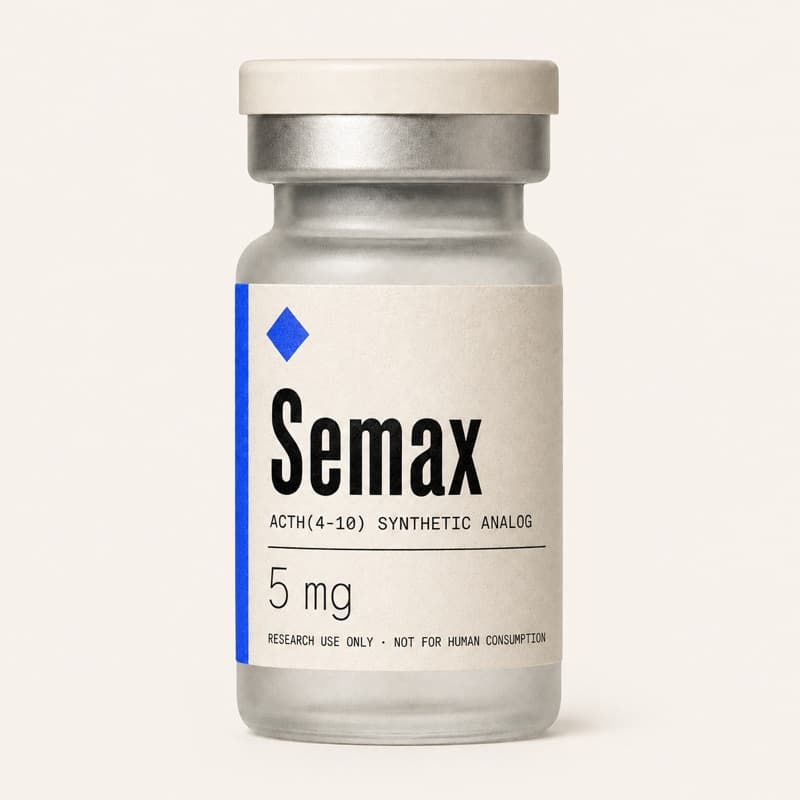
Semax
Synthetic ACTH Analog · Nootropic & Neuroprotective Peptide
Synthetic heptapeptide from fragment 4–10 of adrenocorticotropic hormone (ACTH), developed originally in Russia for stroke recovery. CNS penetration is raised by direct transport along the olfactory epithelium and trigeminal nerves, which bypasses the blood-brain barrier.
Overview
Synthetic heptapeptide from fragment 4–10 of adrenocorticotropic hormone (ACTH), developed originally in Russia for stroke recovery. CNS penetration is raised by direct transport along the olfactory epithelium and trigeminal nerves, which bypasses the blood-brain barrier.
BDNF levels rise rapidly, the dopaminergic and serotonergic systems are modulated, and olfactory transport delivers the peptide straight to the brain — 0.093% blood-brain barrier penetration, against 0.01% by IV.
Research indications
What the compound has been studied for, grouped by body system. Effect size is the reported magnitude where it was measured — not a recommendation.
Among fatigued individuals, short-term and working memory performance improved: 71% accuracy against 41%.
New information is acquired faster, and retention improves.
Sustained attention improves where cognitive tasks are demanding.
Recovery after traumatic brain injury is supported.
Anti-amyloid properties appear in models of Alzheimer's.
In stroke patients, rehabilitation accelerated and BDNF levels rose.
Neurogenesis is supported by raised brain-derived neurotrophic factor.
Brain network activity is enhanced, and neural connections with it.
Coping with cognitive stress improves.
- Class
- ACTH(4-10) synthetic analog
- Research status
- Well studied
- Chain length
- 7 residues
- Molecular weight
- 813.93 Da
- Half-life
- ~1.25 h
- Typical dose
- 300–600 µg per dose (up to 1000 µg for intensive use)
- Frequency
- 1–2 times daily, typically morning
- Cycle length
- 2–4 weeks on
- Storage
- Reconstituted: 2-8°C, use within recommended timeframe
Molecular data
- Type
- ACTH(4-10) synthetic analog
- Molecular weight
- 813.93 Da
- Chain length
- 7 residues
- Half-life
- 75 min
MEHFPGPLevels in single-dose multiples. A shape, not a pharmacokinetic prediction.
Dosing reference
Doses reported in the literature and by suppliers. These are a record of what has been used in research — reference, never instruction.
| Context | Route | Amount | Frequency |
|---|---|---|---|
| Cognitive enhancement | Intranasal spray/drops | 300-600mcg | 1-2x daily |
| Intensive cognitive support | Intranasal | 600-900mcg | 2-3x daily |
| Brain injury recovery | Intranasal | 900-1500mcg | 2-3x daily |
| Research protocol | SubQ | 500-750mcg | 1x daily |
| Intensive protocol | SubQ | 750-1000mcg | 1-2x daily |
Interactions
Simultaneous use is ruled out. One or the other: these are variants of a single peptide.
Anxiolytic effects complement; a popular pairing.
Both act on neuroplasticity, by different mechanisms.
Neuroprotection is comprehensive in combination.
Stimulant effects may be enhanced — careful monitoring applies, with stimulant doses reduced.
A theoretical risk to the monoamine system; caution applies.
What to expect
Safety
Mechanistic flags — properties of the pathway, not observed adverse events.
- Nasal discomfort, mild, by the nasal route
- A nasal sensation is possible on administration
- Nasal irritation that is severe, bleeding, or congestion that persists
- Anxiety or agitation out of the ordinary, or disturbed sleep
- Headaches that worsen as use continues
- Allergic reaction indicated by rash or breathing difficulty
- Blood pressure changing significantly, or heart palpitations
- Pregnancy or breastfeeding
- Known peptide allergies
- Continuous use beyond 4 weeks requires medical supervision
Quality checklist
What to confirm before trusting a batch of research material. A verification aid — not an endorsement of any supplier.
- Third-party Certificate of AnalysisIndependent lab · dated · lot-matched.
- HPLC purity ≥ 98%Reverse-phase trace included.
- Mass-spec confirms 813.93 g/molMALDI-TOF or ESI-MS.
- Counterion stated (acetate ≫ TFA)TFA salts can confound bioassays.
- Endotoxin / sterility statementRelevant once reconstituted.
- Lyophilised · cold-chain shippedStored −20 °C, shipped on ice.
- Labelled “research use only”No therapeutic or dosing claims.
Recorded signals for this compound · 12
- ✓Nasal solution, clear and colorless
- ✓The label states the concentration properly: 0.1% or 1% Semax
- ✓Cold packs in the shipment, cold chain intact
- ✓Packaging sterile, bottles or ampoules sealed
- ✓Lyophilized powder, white, for injection
- ✓Dissolves completely in solution
- ✓Testing by a third party, ≥98% purity
- !Reactions at the injection site — redness, swelling
- !Potential for nasal irritation
- ×Any visible particles
- ×Degradation is indicated by crystallization or precipitation
- ×Solutions cloudy or colored
FAQ
Why does intranasal Semax cross the blood-brain barrier 9x better than IV?
Olfactory nerve transport carries the peptide straight to the brain, bypassing the barrier altogether — 0.093% BBB penetration by the intranasal route. IV injection, at 0.01% BBB penetration, depends on the peptide crossing from blood into brain tissue, and the BBB blocks that. Counterintuitive as it is, this is why intranasal is the preferred route for Semax.
Is amyloid plaque buildup in Alzheimer's actually reversed by Semax?
In mouse models, yes: a 2025 study recorded a 2.8-fold reduction in amyloid plaques in Alzheimer's mice. The data are preclinical. For Semax and Alzheimer's there are no human clinical trials. Anti-amyloid and anti-aggregating effects make the mechanism promising, while efficacy in humans stays unknown.
Is Semax taken daily, or cycled?
Cycles of 2–4 weeks are the typical pattern rather than indefinite use. Dependence of the benzodiazepine kind does not arise, but continuous use without breaks has not been studied extensively for optimal long-term results. A 4–6 hour duration per dose makes daily dosing common; cycling off periodically lets receptor sensitivity reset.
Does Semax speed recovery after a stroke?
Yes. Stroke recovery is supported by clinical evidence. A 110-patient trial gave 6000 µg/day intranasally, which raised BDNF levels and accelerated functional recovery through rehabilitation. Among Semax's therapeutic applications this is one of the most established, with human clinical data behind it.
References
- 1A Nootropic Adrenocorticotropin Analog 4-10 Semax: 15 Years Experience in Its Design and Study (Parent Compound)Ashmarin IP, Nezavibatko VN, Levitskaya NG, et al. · Zhurnal Vysshei Nervnoi Deiatelnosti imeni I.P. Pavlova · 1997
Foundational Semax review: intranasal doses stimulate operative memory and attention for 20-24 hours. Adamax builds on the Semax core sequence with adamantane modification for enhanced stability and BBB penetration.
Review · inferredPubMed 9173745 ↗ - 2Semax, an Analog of ACTH(4-10), Regulates BDNF and trkB Expression in the Rat Hippocampus (Parent Compound)Dolotov OV, Karpenko EA, Inozemtseva LS, et al. · Brain Research · 2006
Single application at 50 mcg/kg produced 1.4-fold increase in BDNF protein and 1.6-fold increase in trkB tyrosine phosphorylation in rat hippocampus, supporting Adamax's BDNF-TrkB mechanism.
Animal in vivoPubMed 16996037 ↗ - 3The Peptide Semax Affects the Expression of Genes Related to the Immune and Vascular Systems in Rat Brain Focal Ischemia (Parent Compound)Dergunova LV, Limborska SA, et al. · BMC Genomics · 2014
Genome-wide analysis: Semax modulated 24 vascular genes at 3h and enhanced immune-response gene expression at 24h post-ischemia, demonstrating multi-pathway neuroprotection.
Animal in vivoPubMed 24661604 ↗ - 4Effects of Semax on the Default Mode Network of the Brain (Parent Compound)Dolgorukova AM, Klyushnik TP, Gusev EI, et al. · Bulletin of Experimental Biology and Medicine · 2018
24 healthy volunteers; resting-state fMRI showed increased default mode network volume in medial frontal cortex after intranasal 1% Semax vs placebo, enhancing episodic memory.
Review · inferredPubMed 30225715 ↗ - 5The Efficacy of Semax in the Treatment of Patients at Different Stages of Ischemic Stroke (Parent Compound)Gusev EI, Barskov IV, et al. · Zhurnal Nevrologii i Psikhiatrii imeni S.S. Korsakova · 2018
110 ischemic stroke patients; Semax (6000 mcg/day intranasal) increased BDNF plasma levels and accelerated functional recovery, providing the clinical basis for Adamax neuroprotective applications.
Human pilotPubMed 29798983 ↗
Cognition improved in transgenic Alzheimer's model mice treated with Semax or its derivative, and amyloid plaque counts fell 2.8-fold under Semax relative to untreated controls.
In artificial membrane models, Semax blocked assembly of the Aβ:Cu2+ complex and suppressed amyloid fibre formation, an anti-aggregating, neuroprotective action with bearing on Alzheimer's disease.
In mice, Semax aided functional recovery after spinal cord injury and suppressed pyroptosis, acting on the mu-opioid receptor gene Oprm1 and the USP18 deubiquitination pathway.
By stripping Cu(II) away from copper-amyloid-beta species, Semax lowers the ROS generated and protects cells from copper-driven oxidative stress.