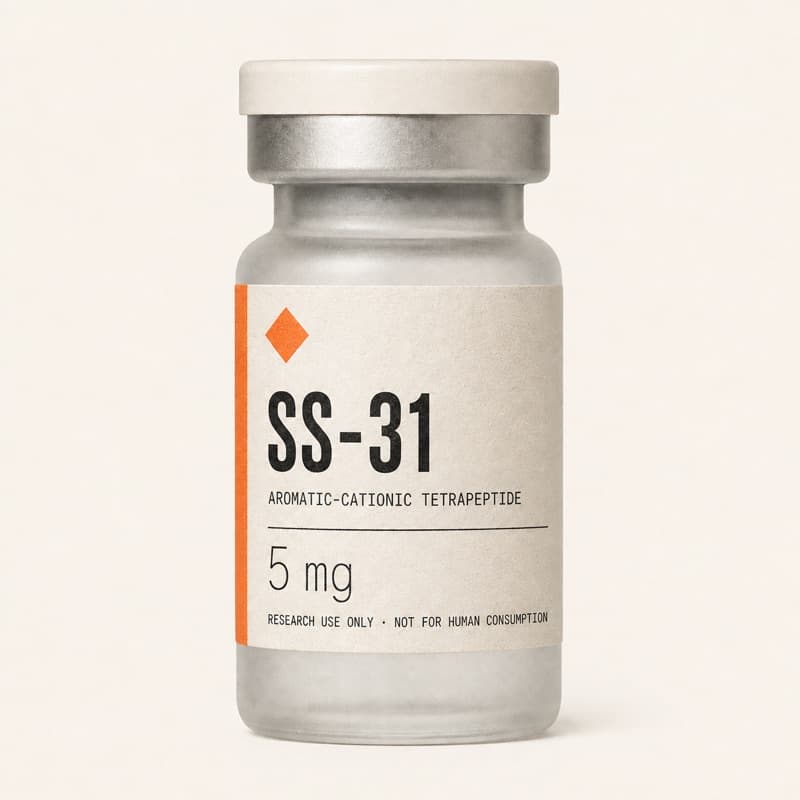
SS-31
Mitochondrial-Targeted Peptide · Cardiolipin Protector
Aromatic-cationic tetrapeptide that binds selectively to cardiolipin in the inner mitochondrial membrane. Lipid peroxidation is prevented and electron transport chain function optimized, raising cellular energy production.
Overview
Aromatic-cationic tetrapeptide that binds selectively to cardiolipin in the inner mitochondrial membrane. Lipid peroxidation is prevented and electron transport chain function optimized, raising cellular energy production.
Cardiolipin in the inner mitochondrial membrane is bound selectively, which prevents lipid peroxidation and optimizes electron transport chain function. ATP production improves on that basis, and oxidative damage at the mitochondrial level falls.
Research indications
What the compound has been studied for, grouped by body system. Effect size is the reported magnitude where it was measured — not a recommendation.
Electron transport chain function is optimized, and cellular energy improves.
Cardiolipin peroxidation is prevented, and mitochondrial oxidative damage reduced.
PMM patients improved significantly on the 6-minute walk test and on fatigue scores.
In surgical patients, cardiac injury markers fall and mitochondrial function improves.
Ischemia-reperfusion injury is reduced; cardiac function is supported.
Exercise capacity is enhanced, fatigue reduced.
In animal studies the decline of muscle function with age was reversed.
Models of Alzheimer's demonstrated neuroprotective effects.
Overall cellular health is supported by way of mitochondrial optimization.
- Class
- Aromatic-cationic tetrapeptide
- Research status
- Well studied
- Half-life
- ~2 h
- Typical dose
- 5–10 mg general support, 10–40 mg clinical/performance protocols
- Frequency
- Once daily (morning or pre-workout)
- Cycle length
- 4–12 weeks for therapeutic protocols
- Storage
- Reconstituted: 2-8°C in amber/dark vials, use within 30 days. Light sensitive
Molecular data
- Type
- Aromatic-cationic tetrapeptide
- Half-life
- 120 min
Levels in single-dose multiples. A shape, not a pharmacokinetic prediction.
Dosing reference
Doses reported in the literature and by suppliers. These are a record of what has been used in research — reference, never instruction.
| Context | Route | Amount | Frequency |
|---|---|---|---|
| General mitochondrial support | SubQ | 5-10mg | Once daily |
| Athletic performance | SubQ | 10-20mg | Once daily pre-workout |
| Clinical protocols | SubQ or IV | 40mg | Once daily |
| Acute cardioprotection | IV | 0.25mg/kg/hr | Continuous infusion |
| Skin anti-aging | Face, neck, hands | 0.5-1% cream/gel | Twice daily |
Interactions
Mitochondrial function is supported by each, along different mechanisms.
Two mitochondrial peptides whose mechanisms complement.
Together they may protect cellular function.
The mechanisms differ; nothing conflicts.
Tissue repair is BPC-157's focus; SS-31 acts on cellular energetics.
Cardioprotective each, by different pathways.
What to expect
Safety
Mechanistic flags — properties of the pathway, not observed adverse events.
- Clinical trials showed an excellent safety profile
- Current data put long-term use in the safe category
- Mild reactions possible where injected
- At therapeutic doses no significant side effects were reported
- Cardiovascular symptoms
- Rash or breathing difficulty, signalling allergic reaction
- Fatigue or weakness out of the ordinary, a paradoxical reaction
- Severe reactions at the injection site
- Severe headaches, or changes in vision
- A known peptide hypersensitivity
- Pregnancy or breastfeeding — data are limited
Quality checklist
What to confirm before trusting a batch of research material. A verification aid — not an endorsement of any supplier.
- Third-party Certificate of AnalysisIndependent lab · dated · lot-matched.
- HPLC purity ≥ 98%Reverse-phase trace included.
- Mass-spec identity confirmedMALDI-TOF or ESI-MS.
- Counterion stated (acetate ≫ TFA)TFA salts can confound bioassays.
- Endotoxin / sterility statementRelevant once reconstituted.
- Lyophilised · cold-chain shippedStored −20 °C, shipped on ice.
- Labelled “research use only”No therapeutic or dosing claims.
Recorded signals for this compound · 9
- ✓Certificate of Analysis available
- ✓Pharmaceutical grade — clinical applications require >98% purity
- ✓Cold chain kept properly
- ✓After reconstitution, solution clear and colorless
- !Light sensitive; amber vials protect against exposure
- !Solution pH in the physiological range of 6.5–7.5
- ×Improper storage conditions
- ×Degradation is indicated by yellow or brown discoloration
- ×A cloudy solution, or particles visible
FAQ
Is SS-31 light sensitive, and are amber vials genuinely needed?
Yes — the peptide is photosensitive and needs protection from light. Reconstituted solutions are stored at 2–8°C in amber vials or other dark containers. The aromatic-cationic structure is vulnerable to photodegradation, which can compromise effectiveness at mitochondrial binding.
How fast does exercise tolerance improve on SS-31?
Energy and fatigue improve first, inside 1–3 days, and exercise endurance is noticed to be better by week 1–2. Peak improvement in exercise capacity typically develops across 4–8 weeks as mitochondrial ATP production optimizes.
Do SS-31 and NAD+ boosters combine, and do they interact?
Yes: the two are synergistic, since mitochondrial function is the target of both through complementary mechanisms — cardiolipin is protected directly by SS-31, while electron transport chain enzymes are supported by NAD+. In combination, energy production may be enhanced beyond what either reaches alone.
How do clinical SS-31 doses of 40mg daily differ from athletic performance doses?
Athletic protocols run 10–20mg daily; clinical trials in mitochondrial disease ran 40mg daily. More significant mitochondrial dysfunction is what the higher clinical dose addresses, while performance benefit typically arrives at the lower doses with less scope for excessive metabolic stimulation.
References
- 1Novel Mitochondria-Targeting Peptide in Heart Failure Treatment (EMBRACE)Daubert, M.A., et al. · Circulation: Heart Failure · 2017
IV infusion in heart failure patients showed significant decrease in left ventricular end-diastolic volume (-18 mL, P=0.009) and end-systolic volume (-14 mL, P=0.005) at the highest dose.
Human RCTPubMed 29217757 ↗ - 2Randomized Dose-Escalation Trial of Elamipretide in Adults with Primary Mitochondrial Myopathy (MMPOWER)Karaa, A., et al. · Neurology · 2018
Phase I/II trial in 36 patients showed dose-dependent improvement in 6-minute walk test (64.5m vs 20.4m placebo at highest dose) after 5 days of treatment with excellent safety profile.
Human RCTPubMed 29500292 ↗ - 3Improving Mitochondrial Function with SS-31 Reverses Age-Related Redox Stress and Improves Exercise Tolerance in Aged MiceSiegel, M.P., et al. · Free Radical Biology and Medicine · 2019
8 weeks of SS-31 (3 mg/kg/day) in aged mice reversed age-related decline in mitochondrial ATP production, restored redox homeostasis, and significantly increased treadmill endurance.
Animal in vivoPubMed 30597195 ↗ - 4TAZPOWER: Phase 2/3 Randomized Clinical Trial of Elamipretide in Barth SyndromeThompson, W.R., et al. · Genetics in Medicine · 2021
40mg daily in Barth syndrome patients. Primary endpoints not met at 12 weeks, but open-label extension showed cumulative 96.1m improvement in 6MWT at 168 weeks (P=0.003) with sustained fatigue improvements.
Human RCTPubMed 33077895 ↗ - 5Efficacy and Safety of Elamipretide in Primary Mitochondrial Myopathy: The MMPOWER-3 Randomized Clinical TrialKaraa, A., et al. · JAMA Neurology · 2023
Phase 3 trial (218 patients) did not meet primary 6MWT endpoint overall, but post-hoc analysis showed improvement in patients with nuclear DNA variants. Well-tolerated with mild-to-moderate adverse events.
Human RCTPubMed 37268435 ↗ - 6Elamipretide: A Review of Its Structure, Mechanism of Action, and Therapeutic PotentialMachiraju, P., et al. · International Journal of Molecular Sciences · 2025
Comprehensive review covering PROGRESS-HF, TAZPOWER, MMPOWER-3, and ReCLAIM trials. Highlights elamipretide's unique cardiolipin-binding mechanism and broad therapeutic potential across mitochondrial diseases.
ReviewPubMed 39940712 ↗
Elamipretide, branded Forzinity, received accelerated approval from the FDA for patients with Barth syndrome weighing at least 30 kg, the first mitochondrial therapeutic aimed at cardiolipin.
The 168-week open-label extension of TAZPOWER in Barth syndrome reported durable gains on the 6-minute walk test (96.1 m cumulative, P=0.003), in fatigue scores, and in 3D left ventricular volumes.
ReCLAIM-2, a Phase II trial in age-related macular degeneration, assessed elamipretide against growth of geographic atrophy, visual function, and preservation of the ellipsoid zone.
Elamipretide improved function in cardiac and skeletal muscle during ageing, with epigenetic and transcriptomic tissue age left unchanged.