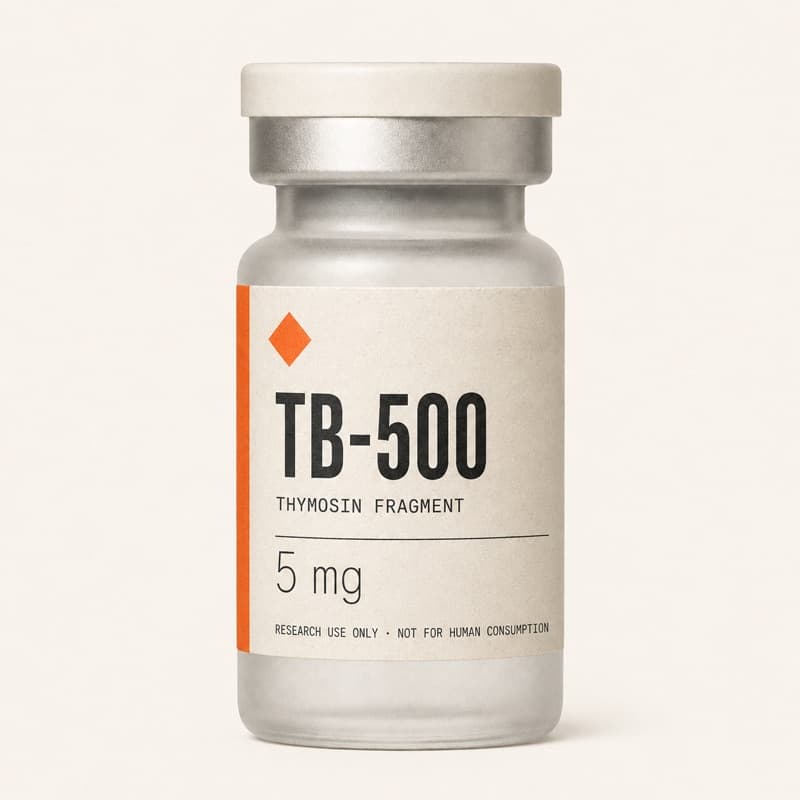
TB-500
Synthetic Fragment (17-23) of Thymosin Beta-4
Synthetic fragment of seven amino acids matching the actin-binding region of thymosin beta-4; equine use was the original application, and the tissue repair properties carried over. It serves as the principal actin-sequestering protein, regulating cell migration, driving angiogenesis, reducing inflammation, and activating stem cell differentiation.
Overview
Synthetic fragment of seven amino acids matching the actin-binding region of thymosin beta-4; equine use was the original application, and the tissue repair properties carried over. It serves as the principal actin-sequestering protein, regulating cell migration, driving angiogenesis, reducing inflammation, and activating stem cell differentiation.
Its role is that of the principal actin-sequestering protein: cell migration is regulated, angiogenesis promoted, inflammation reduced, and stem cell differentiation activated, which together make for comprehensive regenerative effects.
Research indications
What the compound has been studied for, grouped by body system. Effect size is the reported magnitude where it was measured — not a recommendation.
Repair of connective tissue, where scar formation falls and healing tissues gain biomechanical properties.
In acute and in chronic scenarios alike: dermal closure enhanced, angiogenesis improved, inflammation reduced.
Muscle fibers heal faster, recovery time falls, and repair is enhanced by cell migration and differentiation.
Recovery from intense training comes faster, muscle soreness falls, tissue repair improves.
Injury risk may fall where repair mechanisms are enhanced and tissues strengthened.
Muscle quality improves through pathways of enhanced regeneration and repair.
Various models show protection against neuronal damage.
Spinal injury models supply preclinical evidence of improved outcomes.
Potential effects on brain tissue, neuroprotective and regenerative.
- Class
- Thymosin fragment
- Research status
- Well studied
- Chain length
- 43 residues
- Molecular weight
- 4963.44 Da
- Half-life
- ~2 h
- Typical dose
- 2–5 mg per injection
- Frequency
- 2–3 times weekly
- Cycle length
- 6–8 weeks for active healing
- Storage
- Reconstituted: 2-8°C, use within 28 days
Molecular data
- Type
- Thymosin fragment
- Molecular weight
- 4963.44 Da
- Chain length
- 43 residues
- Half-life
- 120 min
Levels in single-dose multiples. A shape, not a pharmacokinetic prediction.
Dosing reference
Doses reported in the literature and by suppliers. These are a record of what has been used in research — reference, never instruction.
| Context | Route | Amount | Frequency |
|---|---|---|---|
| General tissue repair | SubQ or IM | 2-3mg | 2x weekly |
| Serious injury recovery | SubQ near injury site | 4-5mg | 3x weekly |
| Athletic enhancement | SubQ | 2-3mg | 2x weekly |
| Chronic conditions | SubQ or IM | 3-4mg | 2-3x weekly |
| Maintenance | SubQ | 2mg | 1-2x weekly |
| Post-surgical recovery | SubQ | 3-5mg | 3x weekly |
| Chronic wound healing | Topical application | 0.01-0.03% concentration | 1-2x daily |
| Dry eye treatment | Ophthalmic | Eye drops formulation | As directed |
Interactions
Healing mechanisms complement, and tissue repair increases in combination — the Wolverine Stack.
Sensitivity of tissue to the effects of growth hormone may rise.
Tissue repair combines with GH-releasing effects, toward comprehensive recovery.
Growth pathways complement, enhancing regeneration of muscle and tissue.
Nothing negative reported; recovery may be enhanced.
Receptor families differ, and the pathways do not overlap.
What to expect
Safety
Mechanistic flags — properties of the pathway, not observed adverse events.
- Side effects minimal overall
- Possible mild reactions where injected
- Transient fatigue for some users
- Severe allergic reactions
- Unexpected systemic symptoms
- Concerning health changes
- Infections at the injection site that persist or worsen
- Redness that is prolonged, or unusual swelling
- Pregnancy or breastfeeding
- Competitive athletes: prohibited under WADA
- Active cancer treatment, given the angiogenic effects
- Immunosuppressive medications, where a provider should be consulted
Quality checklist
What to confirm before trusting a batch of research material. A verification aid — not an endorsement of any supplier.
- Third-party Certificate of AnalysisIndependent lab · dated · lot-matched.
- HPLC purity ≥ 98%Reverse-phase trace included.
- Mass-spec confirms 4963.44 g/molMALDI-TOF or ESI-MS.
- Counterion stated (acetate ≫ TFA)TFA salts can confound bioassays.
- Endotoxin / sterility statementRelevant once reconstituted.
- Lyophilised · cold-chain shippedStored −20 °C, shipped on ice.
- Labelled “research use only”No therapeutic or dosing claims.
Recorded signals for this compound · 7
- ✓A fine white lyophilized powder, evenly distributed, light and fluffy in texture
- ✓Once reconstituted: a clear, colorless solution, free of particles
- ✓Vacuum seal proper and intact, rubber stopper secure
- !Slight clumping of the powder is acceptable where a gentle swirl dissolves it completely
- ×Powder that is crystalline or colored — yellow/brown indicates degradation
- ×Cloudiness that persists, particles floating, or precipitation
- ×A vial seal that is damaged, or signs of contamination
FAQ
Local injection near the injury, or systemic administration?
Both are available: injection near an injury, or systemic delivery. Concentrating the effect through a local injection near tendon or ligament injury may accelerate healing. Systemic SubQ or IM administration works through the circulation for comprehensive tissue repair, and is the more common of the two.
Once the protocol stops, how long do the benefits last?
After a 6–8 week cycle the healing benefits carry on for weeks to months, sustained by lasting improvements in tissue quality, angiogenesis, and stem cell mobilization. Chronic conditions that need ongoing support may still call for maintenance doses every 1–2 weeks.
What is the WADA status of TB-500, and on what grounds?
Prohibited. WADA bars it from competitive sport on the grounds that enhanced cellular regeneration and muscle repair confer an unfair athletic advantage. Athletes subject to anti-doping testing are advised against use.
How does the TB-500 fragment (Ac-LKKTETQ) differ from full TB-500?
Full TB-500 is thymosin beta-4 complete at 43 amino acids; the fragment is only the bioactive 7-amino-acid core (LKKTETQ). The two work in similar fashion. Being smaller, the fragment is more stable and potentially more economical, and it retains the core wound-healing and regenerative properties.
References
- 1Development of thymosin beta4 for treatment of patients with ischemic heart diseaseCrockford, D. · Annals of the New York Academy of Sciences · 2007
Synthetic thymosin beta-4 given intravenously was well tolerated with no dose-limiting toxicity; promotes cardiomyocyte migration and survival, and stimulates coronary vasculogenesis for cardiac ischemia treatment.
Human pilot · inferredPubMed 17947592 ↗ - 2Evaluation of skeletal and cardiac muscle function after chronic administration of thymosin beta-4 in the dystrophin deficient mouseSpurney, C.F., et al. · PLoS One · 2010
Chronic thymosin beta-4 administration increased the number of regenerating skeletal muscle fibers in exercised dystrophin-deficient (mdx) mice, showing potential for Duchenne muscular dystrophy treatment.
Animal in vivoPubMed 20126456 ↗ - 3The regenerative peptide thymosin beta-4 accelerates the rate of dermal healing in preclinical animal models and in patientsTreadwell, T., Kleinman, H.K., Crockford, D., Hardy, M.A., Guarnera, G.T., Goldstein, A.L. · Annals of the New York Academy of Sciences · 2012
In two Phase 2 clinical trials, thymosin beta-4 accelerated healing of chronic pressure ulcers and venous stasis ulcers by almost a month compared to placebo, with confirmed safety and tolerability.
Animal in vivo · inferredPubMed 23050815 ↗ - 4Thymosin beta-4 significantly improves signs and symptoms of severe dry eye in a phase 2 randomized trialSosne, G., Dunn, S.P., Kim, C. · Cornea · 2015
Phase 2 randomized trial in 9 severe dry eye patients showed RGN-259 (0.1% thymosin beta-4) eye drops achieved statistically significant improvements in both signs and symptoms, with effects lasting 28 days post-treatment.
Human RCTPubMed 25826322 ↗ - 5A first-in-human, randomized, double-blind, single- and multiple-dose, phase I study of recombinant human thymosin β4 in healthy Chinese volunteersWang X, Liu L, Qi L, et al. · Journal of Cellular and Molecular Medicine · 2021
Phase I trial in 54 healthy subjects demonstrated recombinant thymosin β4 was well tolerated and safe across ascending IV doses up to 25 μg/kg with no significant accumulation.
Human RCTPubMed 34346165 ↗ - 60.1% RGN-259 (Thymosin beta-4) Ophthalmic Solution Promotes Healing and Improves Comfort in Neurotrophic Keratopathy Patients in a Randomized, Placebo-Controlled, Double-Masked Phase III Clinical TrialSosne, G., Kleinman, H.K., Springs, C., Gross, R.H., Sung, J., Kang, S. · International Journal of Molecular Sciences · 2022
Phase III trial demonstrated thymosin beta-4 ophthalmic solution promotes corneal healing and improves comfort in neurotrophic keratopathy, advancing toward FDA approval.
Human RCTPubMed 36613994 ↗
A tandem-engineered thymosin beta-4 construct outperformed native TB4 on bioactivity and corneal wound healing, and could be produced at larger scale through bacterial fermentation.
A review from Bock-Marquette and colleagues examines how thymosin beta-4 may reverse ageing processes and speed organ regeneration by switching embryonic developmental programmes back on.
A review of thymosin beta-4 (TB-500) as a means of switching adult organs back toward embryonic developmental programmes, with effects on cell migration, mobilisation of stem cells, and tissue regeneration in an anti-ageing context.