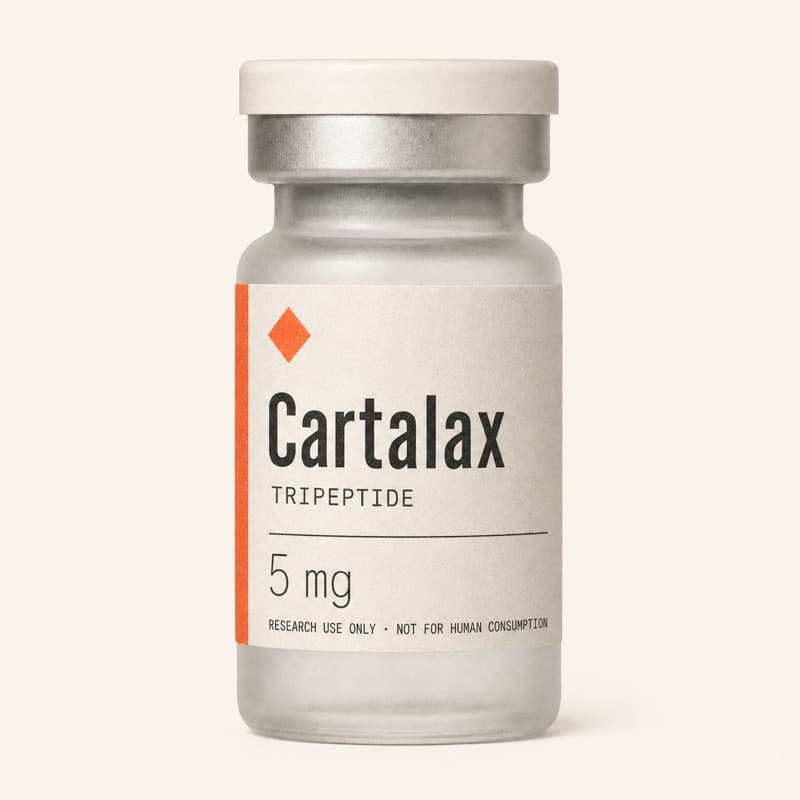
Cartalax
Bioregulatory Tripeptide · Cartilage & Connective Tissue Support
Tripeptide, synthetic, from Professor Vladimir Khavinson. Support for cartilage, connective tissue, and cellular regeneration runs through proliferation markers and modulation of apoptosis pathways.
Overview
Tripeptide, synthetic, from Professor Vladimir Khavinson. Support for cartilage, connective tissue, and cellular regeneration runs through proliferation markers and modulation of apoptosis pathways.
Cell proliferation is modulated, apoptosis suppressed, fibroblast activity altered, senescence markers reduced, and preservation of the extracellular matrix influenced.
Research indications
What the compound has been studied for, grouped by body system. Effect size is the reported magnitude where it was measured — not a recommendation.
Ki-67 expression rose while apoptosis was suppressed, in cells both young and aged.
Collagen synthesis within connective tissue increases.
MMP-9 synthesis was inhibited; integrity of the extracellular matrix held.
Treatment of osteochondrosis, osteoarthritis and osteoporosis showed clinical efficacy.
Joint function and the maintenance of cartilage are supported.
Healing of bone and of connective tissue is supported.
- Class
- Tripeptide
- Research status
- Emerging
- Chain length
- 3 residues
- Molecular weight
- 350 Da
- Typical dose
- 100–200 µg oral (1–2 capsules) or 700–1400 µg injectable
- Frequency
- 1–2 times daily with meals (oral) or once daily (injectable)
- Cycle length
- 1–3 months depending on application
- Storage
- Oral capsules: room temperature; Injectable lyophilized: 2-8°C; Reconstituted: 2-8°C refrigerated
Molecular data
- Type
- Tripeptide
- Molecular weight
- 350 Da
- Chain length
- 3 residues
Dosing reference
Doses reported in the literature and by suppliers. These are a record of what has been used in research — reference, never instruction.
| Context | Route | Amount | Frequency |
|---|---|---|---|
| Joint Support | Oral | 100-200mcg (1-2 capsules) | 1-2x daily with meals |
| Tissue Regeneration | SubQ | 700-1400mcg (10-20mcg/kg) | Daily |
| Skin Rejuvenation | Topical | 0.5-1ml solution | 2x daily |
Interactions
Separate mechanisms; no direct interaction.
Bioregulatory effects that complement, spanning organ systems.
Synthesis may be enhanced, with raw materials coming from the supplements.
Action pathways are distinct; the effects may complement.
Tissue growth is affected by both; watch for excessive proliferation.
Joint support mechanisms that complement.
What to expect
Safety
Mechanistic flags — properties of the pathway, not observed adverse events.
- Russian clinical use reports no side effects where administration is proper
- Elderly patients tolerate it well
- Allergic reactions
- Unexpected symptoms
- Digestive upset, rare when administration is proper
- Three months elapse without improvement
- Pregnancy and breastfeeding
- Active cancer — proliferation risk in theory
Quality checklist
What to confirm before trusting a batch of research material. A verification aid — not an endorsement of any supplier.
- Third-party Certificate of AnalysisIndependent lab · dated · lot-matched.
- HPLC purity ≥ 98%Reverse-phase trace included.
- Mass-spec confirms 350 g/molMALDI-TOF or ESI-MS.
- Counterion stated (acetate ≫ TFA)TFA salts can confound bioassays.
- Endotoxin / sterility statementRelevant once reconstituted.
- Lyophilised · cold-chain shippedStored −20 °C, shipped on ice.
- Labelled “research use only”No therapeutic or dosing claims.
Recorded signals for this compound · 7
- ✓Holographic seals on professional Russian packaging
- ✓Each capsule holds exactly 0.1mg (100µg) of AC-4 peptide complex
- ✓Russian/English instructions that clearly specify 'with meals'
- !Authenticity requires proper documentation
- !Verification of import needed
- ×No holographic seals, no professional packaging
- ×Dosing instructions that are unclear
FAQ
Cartilage has no blood vessels — how does Cartalax reach it?
The action is systemic, on fibroblasts and on gene expression. Once in circulation it reaches fibroblasts throughout connective tissue, where collagen production is stimulated and matrix-degrading enzymes such as MMP-9 are suppressed. Fibroblast activation of that systemic kind supports cartilage maintenance and collagen preservation even where the cartilage is avascular.
Does Cartalax reverse osteoarthritis, or only hold off progression?
Efficacy in treating established osteoarthritis, osteochondrosis and osteoporosis appears in Russian clinical studies. 'Reverse' overstates it, though: tissue repair is supported and degeneration slowed better than severely damaged cartilage is rebuilt. Moderate cartilage damage gives the best results, advanced damage the poorer ones.
When does joint pain start improving on Cartalax?
Weeks 1–2 set the baseline, with minimal noticeable change. Joint comfort improves gradually over weeks 3–4. Mobility improvement becomes noticeable in month 2, and therapeutic effect reaches its maximum in month 3. Repeat cycles make the results cumulative; annual repetition of 1–3 month cycles produces the best long-term joint health.
Does long-term Cartalax use carry cancer risk from cell proliferation?
Fibroblast proliferation increases and apoptosis is suppressed. Uncontrolled cell growth is a theoretical concern, but decades of Russian clinical practice document no malignancy risk. Use is avoided in active cancer; in healthy individuals, cyclic use — 1–3 months on, with breaks between — minimizes the theoretical proliferation risk.