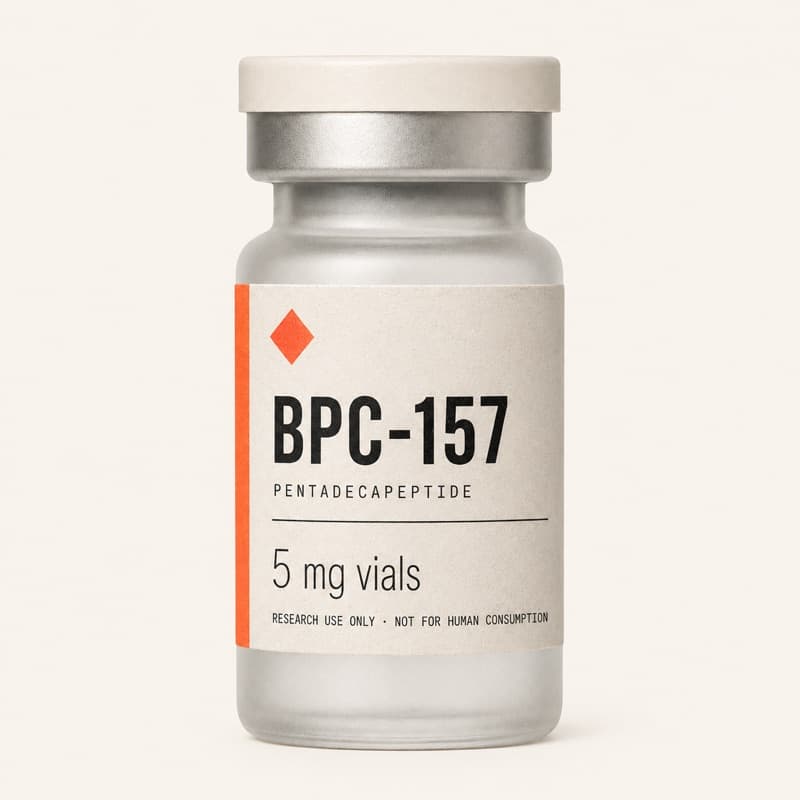
BPC-157
Body Protection Compound-157 · Pentadecapeptide
Synthetic peptide taken from a sequence in a gastric juice protein; the literature covers tissue repair, reduced inflammation, and gastrointestinal protection. Described actions are the formation of new blood vessels, increased collagen synthesis, altered growth-factor expression, and protection of tissue against damage, whether delivery is local or systemic.
Overview
BPC-157 is a synthetic 15-amino-acid peptide based on a sequence found in a protective protein in human gastric juice. It has been studied extensively in animal models for tissue repair, tendon and muscle healing, and gut protection, and is notable for stability in gastric acid. The evidence base is almost entirely preclinical: there are no completed human clinical trials, so all figures here are reported from animal or laboratory research, not clinical practice.
Across preclinical studies, BPC-157 is associated with promotion of angiogenesis (new blood-vessel formation), modulation of the nitric oxide system, upregulation of growth factors involved in repair (e.g., VEGF), and effects on cell-migration pathways. These mechanisms are described in published reviews; they are reported findings from animal and in-vitro work, not demonstrated clinical effects in humans.
Research indications
What the compound has been studied for, grouped by body system. Effect size is the reported magnitude where it was measured — not a recommendation.
Greater regrowth of peripheral nerve after injury, with better return of function.
Protection in models of ischemic brain injury, and against neurotoxic agents.
Spinal cord injury studies report better functional recovery and less tissue damage.
Improved barrier function of the mucosa, with faster epithelial regeneration.
Cytoprotective mechanisms guard against ulceration of the stomach and duodenum.
In IBD models, intestinal healing was faster and inflammatory markers lower.
Faster tendon-to-bone healing, with better biomechanical properties; the effect is greatest when the injection is localized.
Healing improved and recovery reduced after crush injury or surgery, with the tissue targeted directly.
Formation of blood vessels increases and vascularization improves under localized delivery.
- Class
- Pentadecapeptide
- Research status
- Extensively studied
- Chain length
- 15 residues
- Molecular weight
- 1419.53 Da
- Half-life
- ~30 min
- Typical dose
- 250–500 µg
- Frequency
- Once or twice daily
- Administration
- Subcutaneous injection
- Cycle length
- 4–12 weeks depending on injury
- Storage
- Lyophilized: freezer long-term. Reconstituted: 2-8°C for 4-6 weeks
Molecular data
- Type
- Pentadecapeptide
- Molecular weight
- 1419.53 Da
- Chain length
- 15 residues
- CAS number
- 137525-51-0
- Half-life
- 30 min
GEPPPGKPADDAGLVLevels in single-dose multiples. A shape, not a pharmacokinetic prediction.
Dosing reference
Doses reported in the literature and by suppliers. These are a record of what has been used in research — reference, never instruction.
| Context | Route | Amount | Frequency |
|---|---|---|---|
| Tendon/Joint healing | SubQ near injury | 250-500 mcg | 1-2x daily |
| Serious injury | SubQ near injury | 500-1000 mcg | 2x daily |
| General healing | SubQ or IM | 250-500 mcg | 1-2x daily |
| Maintenance | SubQ | 250 mcg | 1x daily |
| Gastric protection | Oral (empty stomach) | 500 mcg - 1 mg | 1-2x daily |
| General healing | Oral (empty stomach) | 1-2 mg | 1-2x daily |
| Ulcer prevention | Oral (empty stomach) | 500 mcg | 2x daily |
| Maintenance | Oral (empty stomach) | 500 mcg | 1x daily |
Interactions
Healing mechanisms complement; the pair is commonly run together as the Wolverine Stack.
No negative interactions on record.
GH receptor expression rises under BPC-157, amplifying the growth hormone benefit.
GH receptors are upregulated by BPC-157, raising effectiveness for tissue repair.
No interactions known; mechanisms and receptor targets differ.
A safe pairing on separate pathways; frequently seen in regenerative protocols.
What to expect
Safety
Mechanistic flags — properties of the pathway, not observed adverse events.
- Irritation at the injection site
- Mild redness where injected
- Mild digestive adjustment, possible with oral dosing
- Injection-site reactions that persist, or signs of infection
- Rash, or unusual swelling around the injected area
- Dizziness or severe headaches
- Allergic reaction
- Digestive problems that persist or worsen
- Active cancer, given the angiogenic effects
- Pregnancy or breastfeeding
- Blood thinners, where the angiogenic effect warrants a doctor's input first
- Competitive athletes: prohibited under WADA
Obtaining material
Listed for reference only. The reference indexes suppliers that publish independent analytics; inclusion is editorial. Nothing here is medical or purchasing advice.
Selected because each lot ships with a dated, third-party Certificate of Analysis — HPLC purity and mass-spec confirmation included — supplied as the acetate salt with documented cold-chain handling.
- U.S. lab tested
- Published CoAs
- U.S. based
Listed sizes · 5 mg vials
Phase Point Peptides is operated by the publisher of this reference. Research use only · not for human consumption · verify the Certificate of Analysis independently. Inclusion is editorial and does not affect the cited material above.
Quality checklist
What to confirm before trusting a batch of research material. A verification aid — not an endorsement of any supplier.
- Third-party Certificate of AnalysisIndependent lab · dated · lot-matched.
- HPLC purity ≥ 98%Reverse-phase trace included.
- Mass-spec confirms 1419.53 g/molMALDI-TOF or ESI-MS.
- Counterion stated (acetate ≫ TFA)TFA salts can confound bioassays.
- Endotoxin / sterility statementRelevant once reconstituted.
- Lyophilised · cold-chain shippedStored −20 °C, shipped on ice.
- Labelled “research use only”No therapeutic or dosing claims.
Recorded signals for this compound · 7
- ✓A white, fluffy lyophilized cake covering the bottom of the vial
- ✓Vacuum seal on the vial intact
- ✓Reconstituted solution crystal clear and free of particles
- !Slight clumping that dissolves on a gentle swirl; acceptable when it comes from shipping
- ×Powder collapsed, melted, or stuck to the sides of the vial, which indicates heat exposure
- ×After reconstitution: cloudiness, particles, or precipitate
- ×Powder discolored
FAQ
Local injection or systemic administration?
For direct tissue targeting, injection close to the injury is the most effective route. The peptide also acts systemically, so whole-body exposure comes from oral dosing on an empty stomach or from a subcutaneous injection away from the site. In serious tendon and joint injury, the protocol that maximizes effect combines a localized injection with oral dosing.
Is BPC-157 used alongside NSAIDs such as ibuprofen?
Research describes rescue of NSAID-cytotoxicity: intestinal permeability was stabilized and mucosal barrier function protected. The implication is a possible synergy, BPC-157 offsetting NSAID side effects while the NSAID suppresses acute inflammation. No clinical data cover timing or dosing of the combination.
How long is BPC-157 run, and does it call for cycling?
Reported courses run 4–12 weeks, scaled to injury severity. The half-life is under 30 minutes and the preclinical safety profile is clean, which points to longer use being likely safe, though no formal long-term human data exist. A 1–2 week on/off cycle is used on the reasoning that it prevents adaptation; continuous use has not shown problems.
Why are active cancer and anticoagulant use treated as contraindications?
Angiogenesis — the growth of new blood vessels — is one of the reported effects, and in theory a tumor's blood supply could be supported the same way. That is a potential risk in cancer patients even though no direct clinical data address it. Pro-angiogenic activity alongside blood thinners raises bleeding risk, which warrants medical supervision before use.
References
- 1Gastric pentadecapeptide BPC 157 accelerates healing of transected rat Achilles tendon and in vitro stimulates tendocytes growthStaresinic, M., et al. · Journal of Orthopaedic Research · 2003
Superior tendon healing with improved biomechanical properties (increased load of failure and Young's modulus), enhanced tendon-to-bone integration, and stimulated tendocyte growth in rat models.
Animal in vivoPubMed 14554208 ↗ - 2Effective therapy of transected quadriceps muscle in rat: Gastric pentadecapeptide BPC 157Staresinic, M., et al. · Journal of Orthopaedic Research · 2006
Accelerated quadriceps healing over 72-day period with improved biomechanics, walking recovery, muscle fiber regeneration with desmin positivity, and attenuated atrophy in rat models.
Animal in vivoPubMed 16609979 ↗ - 3The promoting effect of pentadecapeptide BPC 157 on tendon healingChang CH, Tsai WC, Lin MS · Journal of Applied Physiology · 2011
Tendon outgrowth, cell survival and migration via BPC-157.
Review · inferredPubMed 21030672 ↗ - 4Therapeutic potential of pro-angiogenic BPC157 is associated with VEGFR2 activation and up-regulationHsieh, M.J., et al. · Journal of Molecular Medicine · 2017
Pro-angiogenic effects via VEGFR2-Akt-eNOS signaling pathway activation, increased vessel density in vivo and in vitro, and accelerated blood flow recovery in ischemic rat hind limb model.
In vitro · inferredPubMed 27847966 ↗ - 5Stable gastric pentadecapeptide BPC 157 can improve the healing course of spinal cord injury and lead to functional recovery in ratsPerovic, D., et al. · Journal of Orthopaedic Surgery and Research · 2019
Significant functional recovery with improved motor function, resolved spasticity by day 15, and counteracted axonal necrosis, demyelination, and cyst formation across all stages of secondary injury.
Animal in vivo · inferredPubMed 31266512 ↗ - 6BPC 157 Rescued NSAID-cytotoxicity Via Stabilizing Intestinal Permeability and Enhancing CytoprotectionPark, J.M., Lee, H.J., Sikiric, P., Hahm, K.B. · Current Pharmaceutical Design · 2020
Cytoprotective effects against NSAID-induced gastric and intestinal damage by stabilizing intestinal permeability and protecting mucosal barrier function across multiple epithelia.
ReviewPubMed 32445447 ↗ - 7Preclinical safety evaluation of body protective compound-157, a potential drug for treating various woundsXu, C., et al. · Regulatory Toxicology and Pharmacology · 2020
Well tolerated in mice, rats, rabbits, and dogs with no serious toxicity in single-dose, repeated-dose, local tolerance, genetic, or embryo-fetal toxicity studies.
Animal in vivoPubMed 32334036 ↗ - 8Effect of BPC-157 on Symptoms in Patients with Interstitial Cystitis: A Pilot StudyLee, E., Walker, C., Ayadi, B. · Alternative Therapies in Health and Medicine · 2024
Pilot human trial in 12 women (ages 39-76) with interstitial cystitis showed BPC-157 as a potential treatment for this disabling condition with no effective existing therapies.
Human pilot · inferredPubMed 39325560 ↗ - 9Safety of Intravenous Infusion of BPC157 in Humans: A Pilot StudyLee, E., Burgess, K. · Alternative Therapies in Health and Medicine · 2025
First human IV safety data: infusions of up to 20 mg BPC-157 in 2 healthy adults showed no adverse effects on cardiac, hepatic, renal, thyroid, or glucose biomarkers.
Human pilot · inferredPubMed 40131143 ↗
This systematic review covered 36 reports published between 1993 and 2024, 35 preclinical and one clinical, in which BPC-157 raised GH receptor expression, drove angiogenesis, and lowered inflammatory cytokines after musculoskeletal injury.
Jozwiak and colleagues surveyed the literature and patents on BPC 157, covering its mechanisms, range of biological actions, and candidate uses across several organ systems, among them inflammatory bowel disease and tissue injury.
This pilot trial, the first to give BPC157 intravenously to people, reported no adverse effects in healthy adults dosed as high as 20 mg, setting an initial safety profile in humans.
Intramuscular bioavailability of BPC-157 measured 14-19% in rats and 45-51% in dogs, with a half-life under 30 minutes and rapid breakdown to small peptide fragments.