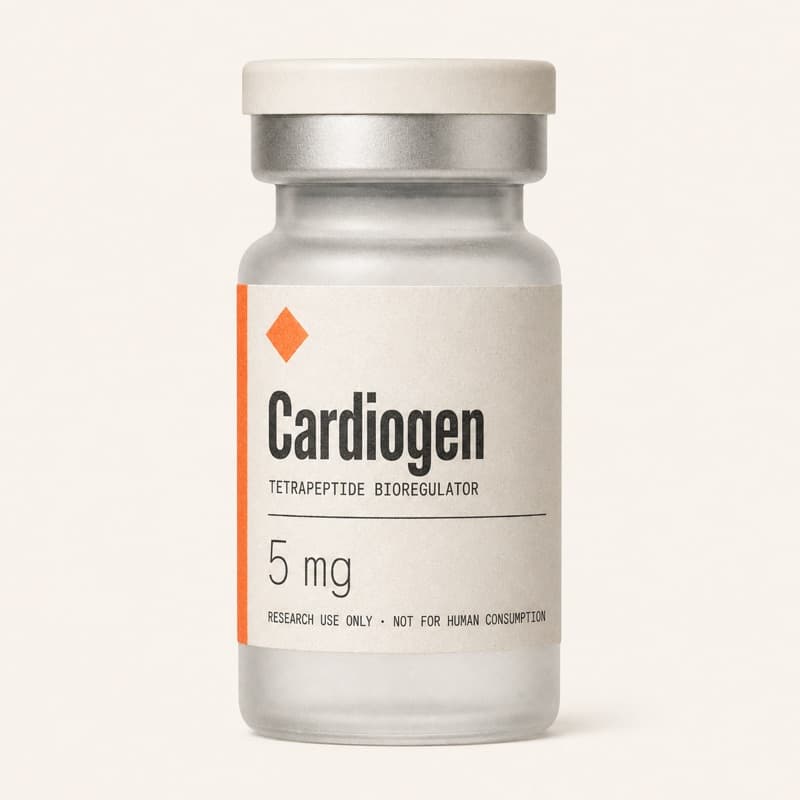
Cardiogen
AEDR · Cardiovascular Bioregulator Peptide
Khavinson bioregulator peptide of four amino acids, out of research on heart tissue. Larger peptides act at the cell surface; Cardiogen instead reaches the cell nucleus, where binding to specific DNA regions regulates gene expression. That epigenetic route supports tissue repair and improves cardiovascular function, with the heart and blood vessels benefiting in particular.
Overview
Khavinson bioregulator peptide of four amino acids, out of research on heart tissue. Larger peptides act at the cell surface; Cardiogen instead reaches the cell nucleus, where binding to specific DNA regions regulates gene expression. That epigenetic route supports tissue repair and improves cardiovascular function, with the heart and blood vessels benefiting in particular.
Epigenetic regulation is the route: cell nuclei are penetrated and specific DNA regions, histones and nucleosomes engaged. Which genes are activated or suppressed changes; the DNA sequence itself does not. Through that influence on gene expression in heart cells, cardiac tissue repair is supported, myocardial function strengthened, and cardiovascular tissue regeneration improved.
Research indications
What the compound has been studied for, grouped by body system. Effect size is the reported magnitude where it was measured — not a recommendation.
Repair of heart tissue is supported by gene expression regulation inside the nucleus.
Cardiac performance and myocardial function overall may improve.
Bioregulation aimed at age-related cardiovascular decline.
Gene expression is influenced in support of tissue repair, the DNA sequence unaltered.
Regeneration of cardiac tissue is promoted at cellular level.
- Class
- Tetrapeptide bioregulator
- Research status
- Moderate research
- Chain length
- 4 residues
- Molecular weight
- 460 Da
- Typical dose
- 10–20 mg daily
- Frequency
- Once daily for 10–20 consecutive days
- Cycle length
- 10–20 days per cycle
- Storage
- Capsules: room temperature; Injectable lyophilized: 2-8°C; Reconstituted: 2-8°C refrigerated
Molecular data
- Type
- Tetrapeptide bioregulator
- Molecular weight
- 460 Da
- Chain length
- 4 residues
AEDRDosing reference
Doses reported in the literature and by suppliers. These are a record of what has been used in research — reference, never instruction.
| Context | Route | Amount | Frequency |
|---|---|---|---|
| Standard protocol | Oral capsules | 10-20 mg | Daily for 10-20 days |
| Maintenance | Oral capsules | 10 mg | 2-3 cycles yearly |
| Research protocol | IM or SubQ | 10 mg | Daily for 10 days |
Interactions
Cardiovascular bioregulators that complement each other — Cardiogen covers the heart, Vesugen the vessels.
Comprehensive Khavinson anti-aging protocols often include both.
Organ targets differ; comprehensive bioregulator protocols can include both.
Belongs to the Khavinson bioregulator family, with a different tissue target.
What to expect
Safety
Mechanistic flags — properties of the pathway, not observed adverse events.
- Tolerated well overall
- Side effects reported as minimal
- Allergic reactions
- Unusual cardiac symptoms
- Active cardiac emergencies, which call for medical care
- Known hypersensitivity
- Pregnancy or breastfeeding
Quality checklist
What to confirm before trusting a batch of research material. A verification aid — not an endorsement of any supplier.
- Third-party Certificate of AnalysisIndependent lab · dated · lot-matched.
- HPLC purity ≥ 98%Reverse-phase trace included.
- Mass-spec confirms 460 g/molMALDI-TOF or ESI-MS.
- Counterion stated (acetate ≫ TFA)TFA salts can confound bioassays.
- Endotoxin / sterility statementRelevant once reconstituted.
- Lyophilised · cold-chain shippedStored −20 °C, shipped on ice.
- Labelled “research use only”No therapeutic or dosing claims.
Recorded signals for this compound · 7
- ✓White powder or capsules
- ✓If reconstituted, a clear solution
- ✓Packaging and labeling done properly
- !Source or purity unknown
- ×Discoloration
- ×Unusual odor
- ×Damaged packaging
FAQ
How can a peptide of just 4 amino acids improve cardiac function?
The tetrapeptide (AEDR) is short enough to enter cell nuclei directly, and there it regulates cardiac gene expression epigenetically. Four amino acids suffice for DNA binding and histone modulation, enough to influence which genes are activated in heart tissue, leaving the DNA sequence itself unaltered.
Does Cardiogen have a role following a heart attack or other cardiac event?
Recovery after a cardiac event is supported by the mechanism, which promotes cardiac tissue repair and improved myocardial function through modulation of gene expression. No human clinical data on cardiac event recovery exist, though. What stands is theory, resting on mechanism and on traditional use in Russian medicine.
How often is Cardiogen cycled for heart health maintenance?
The standard protocol runs 10–20 day cycles, 2–3 times a year, and the cardiovascular benefit is cumulative. Epigenetic changes keep effects in place between cycles. Cycling is seasonal for some users; others hold to 2–3 cycles a year for long-term cardiac tissue support and prevention of age-related decline.