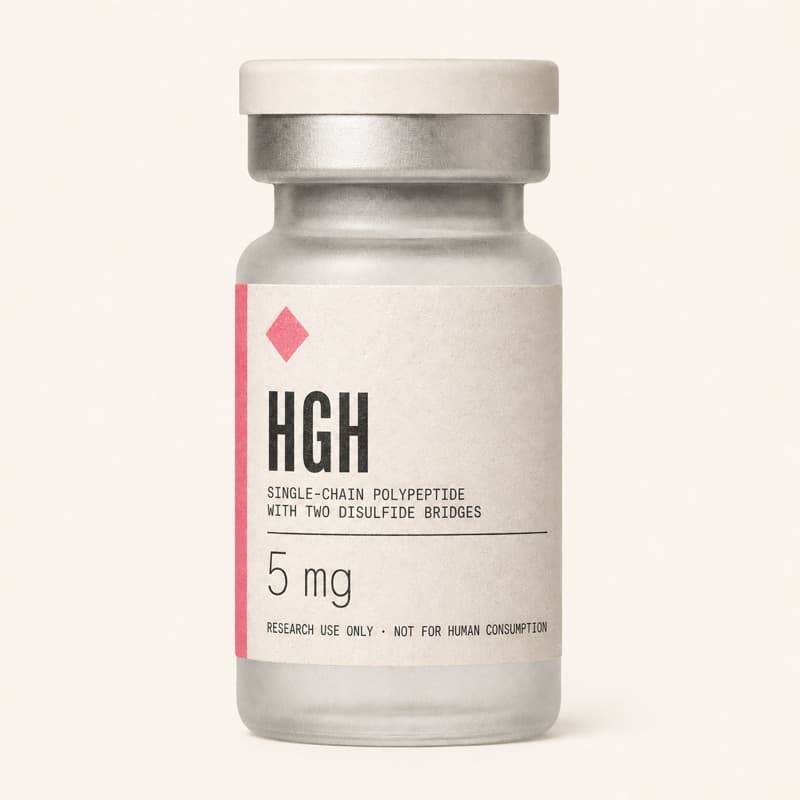
HGH
Human Growth Hormone · Somatropin
Polypeptide hormone of 191 amino acids, also called somatropin, with FDA approval covering growth hormone deficiency in children and adults, HIV-associated wasting, and other conditions. Anabolic effects arrive by two routes, direct and indirect through IGF-1.
Overview
Polypeptide hormone of 191 amino acids, also called somatropin, with FDA approval covering growth hormone deficiency in children and adults, HIV-associated wasting, and other conditions. Anabolic effects arrive by two routes, direct and indirect through IGF-1.
GH receptors on target tissues are the binding site, and the JAK2-STAT5 signaling pathway is triggered from there. Lipolysis, protein synthesis, and metabolic regulation are the direct effects. Growth and anabolism arrive indirectly, by way of IGF-1. Subcutaneously, half-life is ~3 hours.
Research indications
What the compound has been studied for, grouped by body system. Effect size is the reported magnitude where it was measured — not a recommendation.
Approved by the FDA in Turner syndrome, Noonan syndrome, Prader-Willi syndrome, SHOX deficiency, SGA, and idiopathic or organic causes.
FDA approval extends to causes of childhood or adult onset (pituitary tumors, surgery, radiation, trauma).
In cachexia, FDA-approved for gains in lean body mass and in body weight.
Fat loss is significant over 1–3 months, abdominal and visceral fat especially.
Muscle mass increases; body composition improves.
Recovery from exercise improves, and so does tissue healing.
Skin elasticity and texture improve, as does hair and nail growth.
Quality of life improves, along with energy and sleep.
- Class
- Single-chain polypeptide with two disulfide bridges
- Research status
- FDA approved
- Chain length
- 191 residues
- Molecular weight
- 22124 Da
- Half-life
- ~3.5 h
- Typical dose
- 1–4 IU daily (0.33–1.33 mg), titrated upward
- Frequency
- Once daily or split into 2 doses (morning and evening)
- Cycle length
- 3–6+ months or ongoing for medical GHD
- Storage
- Lyophilized: Room temperature. Reconstituted: 2-8°C, use within 14-28 days
Molecular data
- Type
- Single-chain polypeptide with two disulfide bridges
- Molecular weight
- 22124 Da
- Chain length
- 191 residues
- Half-life
- 210 min
Levels in single-dose multiples. A shape, not a pharmacokinetic prediction.
Dosing reference
Doses reported in the literature and by suppliers. These are a record of what has been used in research — reference, never instruction.
| Context | Route | Amount | Frequency |
|---|---|---|---|
| Medical GHD (Starting) | SubQ | 0.15-0.3mg/day (0.5-1 IU) | Once daily |
| Medical GHD (Maintenance) | SubQ | 0.4-0.8mg/day (1.2-2.4 IU) | Once daily |
| Anti-Aging/Wellness | SubQ | 1-2 IU/day (0.33-0.67mg) | Once daily |
| Body Recomposition | SubQ | 2-4 IU/day (0.67-1.33mg) | Once or twice daily |
| Performance (Higher Risk) | SubQ | 4-8 IU/day (1.33-2.67mg) | Split twice daily |
Interactions
Insulin sensitivity falls under HGH; diabetics may need their insulin doses raised.
Synergy, with a caveat: effects are greater, and so is the risk of hypoglycemia and side effects.
T4-to-T3 conversion rises; hypothyroidism is unmasked in 36–47% of patients.
A GHRH analog can add to the effect, though alongside exogenous HGH it may be redundant.
A ghrelin mimetic acting on a different pathway.
Natural pulsatile release is amplified.
Cortisol deficiency may be unmasked; replacement comes before HGH.
A common pairing within hormone replacement therapy.
Insulin resistance may be managed; IGF-1 levels may fall.
Insulin resistance during HGH therapy is helped by GLP-1 agonists.
What to expect
Safety
Mechanistic flags — properties of the pathway, not observed adverse events.
- Joint pain and stiffness
- Headaches
- Fluid accumulation and water retention
- Carpal tunnel syndrome, which usually clears when the dose is reduced
- Hands numb or tingling
- Signs of allergic reaction
- Carpal tunnel symptoms that are severe or worsening
- Signs pointing to diabetes: more thirst, frequent urination, blurred vision
- Edema that is severe — swelling of the face, hands, or feet
- Joint or muscle pain, severe, and not responding to dose reduction
- Lumps or masses that are new, or moles growing rapidly
- Gynecomastia — growth of breast tissue in males
- Symptoms of hypothyroidism — fatigue, weight gain, cold intolerance
- Severe headaches, or changes in vision
- Pregnancy/breastfeeding
- Active cancer, where tumor growth may be accelerated
- Acute critical illness — mortality is increased in ICU patients
- Children with closed epiphyses, where the aim is growth promotion
Quality checklist
What to confirm before trusting a batch of research material. A verification aid — not an endorsement of any supplier.
- Third-party Certificate of AnalysisIndependent lab · dated · lot-matched.
- HPLC purity ≥ 98%Reverse-phase trace included.
- Mass-spec confirms 22124 g/molMALDI-TOF or ESI-MS.
- Counterion stated (acetate ≫ TFA)TFA salts can confound bioassays.
- Endotoxin / sterility statementRelevant once reconstituted.
- Lyophilised · cold-chain shippedStored −20 °C, shipped on ice.
- Labelled “research use only”No therapeutic or dosing claims.
Recorded signals for this compound · 9
- ✓Lyophilized powder or solid cake, white to off-white, neither liquid nor collapsed
- ✓Once reconstituted, the solution is crystal clear and particle-free
- ✓Vacuum in the sealed vial intact — the needle meets resistance going in
- ✓Pharmaceutical grade, certificate of analysis included; Genotropin, Norditropin, and Humatrope preferred
- !Quality and potency swing widely across generic and underground lab products
- !Counterfeits are common; third-party testing is the recommendation
- ×Yellow/brown coloring
- ×Cloudiness, discoloration, or particles in view are signs of degradation
- ×Powder looking melted, or stuck to the vial — storage was improper
FAQ
Does HGH bring hidden thyroid problems to light?
Yes. Central hypothyroidism is unmasked in 36–47% of users, the mechanism being increased T4-to-T3 conversion. Baseline thyroid labs — TSH, free T4, free T3 — belong before the first dose, with a recheck at 6–8 weeks. T4 supplementation is needed by many users on HGH.
How common is carpal tunnel syndrome on HGH?
Carpal tunnel symptoms occur in 10–30% of users, usually at mild to moderate severity, and they generally clear once the dose comes down. The peak falls at 2–4 weeks, after which adaptation brings improvement. Risk is lower when the starting dose is low and titrated upward.
Is HGH run continuously, or cycled?
Effects are dose-dependent and reversible. The common pattern is 3–6 months on and 1–2 months off, which keeps sensitivity and lets natural GH production recover. Running it continuously is possible, though side effect risk may climb over time.
Is diabetes a risk with HGH?
Insulin sensitivity drops on HGH, which can unmask pre-diabetes or bring on diabetes in susceptible individuals. Fasting glucose and HbA1c warrant regular monitoring. A family history of diabetes calls for caution, and metformin support may be needed.
References
- 1Unmasking of Central Hypothyroidism Following Growth Hormone Replacement in Adult Hypopituitary PatientsAgha A, Walker D, Perry L, et al. · Clinical Endocrinology · 2007
In 84 apparently euthyroid patients, 30 (36%) developed hypothyroidism requiring T4 therapy after starting GH. Highest risk in patients with organic pituitary disease or multiple pituitary hormone deficiencies.
Human pilot · inferredPubMed 17201804 ↗ - 2Efficacy and Safety of Growth Hormone Treatment in Adults with Growth Hormone Deficiency: A Systematic Review of Studies on MorbidityDefined a, Sääf M, et al. · Clinical Endocrinology · 2014
Systematic review demonstrating positive effects of GH treatment on cardiovascular disease and fracture risk, improvements in body composition, muscle strength, quality of life, bone mass/density, and lipoprotein patterns.
ReviewPubMed 24750271 ↗ - 3Cardiovascular Risk in Growth Hormone Deficiency: Beneficial Effects of Growth Hormone Replacement TherapyGazzaruso C, Gola M, Karamouzis I, et al. · Endocrine · 2016
GH deficiency is associated with several cardiovascular risk factors that significantly increase cardiovascular morbidity and mortality. GH replacement improves cardiovascular risk factors.
ReviewPubMed 27241971 ↗ - 4Long-term Safety of Growth Hormone in Adults With Growth Hormone Deficiency: Overview of 15,809 GH-Treated PatientsStochholm K, Kiess W, Gianetti E, et al. · Journal of Clinical Endocrinology & Metabolism · 2022
15,809 patients from the KIMS database, mean 5.3 years follow-up. Adverse events in 51.2% of patients, treatment-related in 18.8%. No correlation between GH dose and adverse event rate. Supports long-term safety of GH replacement in adults with GHD.
Human observationalPubMed 35368070 ↗
An update on adult growth hormone deficiency covering diagnosis and treatment, with emphasis on weighing risk against benefit case by case; the evidence base runs to August 2024.
Somapacitan (Sogroya) became the first long-acting growth hormone approved for adults with growth hormone deficiency in the United States, Europe and Japan, and is dosed once weekly.