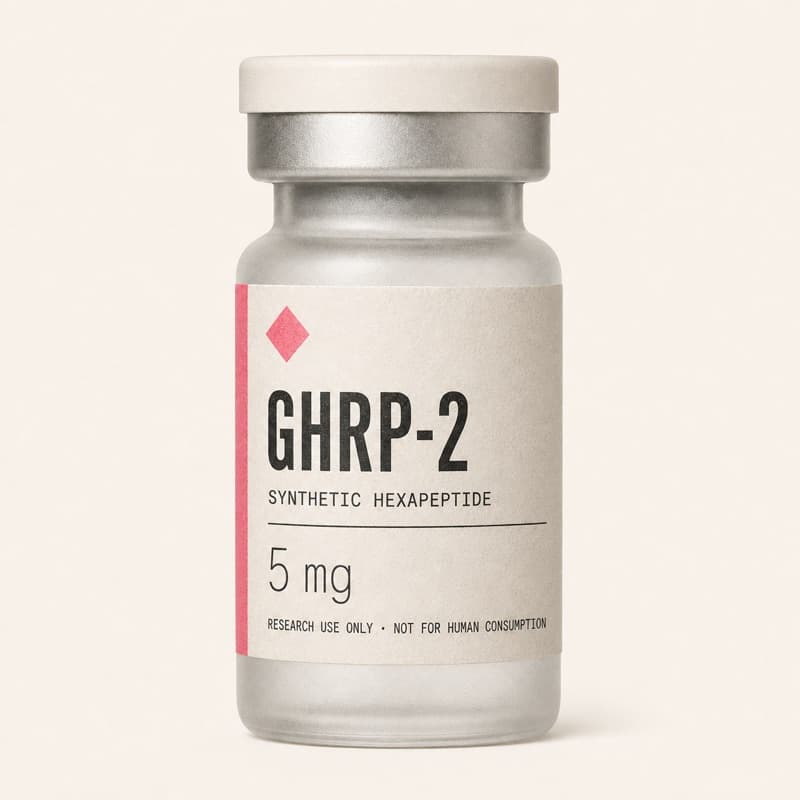
GHRP-2
Growth Hormone Releasing Peptide-2 · Pralmorelin
Synthetic growth hormone secretagogue that prompts the pituitary gland to release growth hormone. Among the GHRP family it ranks with the most potent, 2–3 times as effective as GHRP-6 at stimulating GH release. Its original role was diagnostic, for growth hormone deficiency; the mechanism is mimicry of ghrelin and binding at the GHS-R1a receptor.
Overview
Synthetic growth hormone secretagogue that prompts the pituitary gland to release growth hormone. Among the GHRP family it ranks with the most potent, 2–3 times as effective as GHRP-6 at stimulating GH release. Its original role was diagnostic, for growth hormone deficiency; the mechanism is mimicry of ghrelin and binding at the GHS-R1a receptor.
As a synthetic ghrelin agonist, GHRP-2 binds the growth hormone secretagogue receptor (GHS-R1a) across the hypothalamus and pituitary. cAMP production is stimulated from there, and endogenous growth hormone is released in pulses, with the natural feedback loops left unsuppressed. Paired with GHRH the effect is synergistic: GH secretion is amplified past what either peptide reaches alone.
Research indications
What the compound has been studied for, grouped by body system. Effect size is the reported magnitude where it was measured — not a recommendation.
Japan uses it diagnostically, in clinical settings, to assess deficiency of growth hormone.
Ghrelin receptor activation drives the release of endogenous growth hormone.
IGF-1 levels rise indirectly, on the back of greater GH secretion.
Growth hormone and IGF-1 levels rise, and muscle protein synthesis increases with them.
GH-mediated fat oxidation improves lipolysis and body composition.
Recovery from exercise is quicker and sleep quality better.
Stimulation of GHS-R1a is myoprotective in muscle atrophy models.
Cardiac tissue research has observed cytoprotective effects.
- Class
- Synthetic hexapeptide
- Research status
- Well studied
- Chain length
- 6 residues
- Molecular weight
- 817.9 Da
- Half-life
- ~30 min
- Typical dose
- 100–300 µg
- Frequency
- 2–3 times daily
- Cycle length
- 8–12 weeks
- Storage
- 2-8°C refrigerated
Molecular data
- Type
- Synthetic hexapeptide
- Molecular weight
- 817.9 Da
- Chain length
- 6 residues
- Half-life
- 30 min
Levels in single-dose multiples. A shape, not a pharmacokinetic prediction.
Dosing reference
Doses reported in the literature and by suppliers. These are a record of what has been used in research — reference, never instruction.
| Context | Route | Amount | Frequency |
|---|---|---|---|
| GH optimization | SubQ | 100-150 mcg | 2-3x daily |
| Enhanced results | SubQ | 200-300 mcg | 2-3x daily |
| With GHRH (synergy) | SubQ (combined) | 100 mcg each | 2-3x daily |
| Pre-sleep protocol | SubQ | 100-200 mcg | Before bed |
Interactions
Strong synergy: GH release is significantly amplified by the GHRH + GHRP combination.
The classic GHRP + GHRH stack, run for greater growth hormone release.
Both are GHRPs: alternation is possible, stacking the two together is not typical.
The mechanism is similar, though GHRP-2 has greater potency and stimulates appetite less.
Distinct mechanisms; nothing negative reported.
What to expect
Safety
Mechanistic flags — properties of the pathway, not observed adverse events.
- Mild water retention
- Mild headache
- Numbness or tingling in the extremities
- Post-injection tiredness or lethargy
- Appetite increased, though less than with GHRP-6
- Allergic reactions
- Headaches, severe or persistent
- Hands or feet swelling unusually
- Signs pointing to carpal tunnel syndrome
- Pregnancy or breastfeeding
- Pituitary disorders
- Diabetic retinopathy
- Cancer now active, or cancer in the past
- Competitive athletes: prohibited under WADA
Quality checklist
What to confirm before trusting a batch of research material. A verification aid — not an endorsement of any supplier.
- Third-party Certificate of AnalysisIndependent lab · dated · lot-matched.
- HPLC purity ≥ 98%Reverse-phase trace included.
- Mass-spec confirms 817.9 g/molMALDI-TOF or ESI-MS.
- Counterion stated (acetate ≫ TFA)TFA salts can confound bioassays.
- Endotoxin / sterility statementRelevant once reconstituted.
- Lyophilised · cold-chain shippedStored −20 °C, shipped on ice.
- Labelled “research use only”No therapeutic or dosing claims.
Recorded signals for this compound · 7
- ✓Vacuum seal on the vial intact
- ✓Lyophilized powder, white to off-white
- ✓Solution clear once reconstituted
- !Slight clumping, dissolving readily
- ×Powder discolored or yellow
- ×Solution carrying particles or precipitates
- ×Solution cloudy once reconstituted
FAQ
Does GHRP-2 stimulate growth hormone more strongly than GHRP-6?
Yes — at stimulating GH release GHRP-2 is 2–3 times as potent. Appetite stimulation is also lower than with GHRP-6, which makes GHRP-2 more tolerable where hunger effects are a problem. Strength against side effects is the trade-off, and GHRP-2 lands on the stronger side with fewer appetite issues.
What is the GHRP-2 dose, and why the empty-stomach requirement?
Standard dosing is 100–300 µg, given 2–3 times a day with the stomach completely empty — 2+ hours since eating. No food for 30 minutes after the injection, which optimizes GH release. The best times are on waking in the morning, post-workout, and at bedtime, natural GH being already elevated then.
Does GHRP-2 elevate cortisol, as some sources suggest?
Significant cortisol elevation is rare at the recommended 100–300 µg. Very high doses, above 300 µg, or frequent dosing can raise it. The bulk of side effects are manageable water retention and appetite; cortisol elevation is mainly a concern once dosing escalates beyond therapeutic ranges.
Is GHRP-2 usable in diabetes or glucose sensitivity?
Glucose metabolism can be modestly affected, by way of GH's insulin-antagonistic effects. Diabetic users need careful monitoring and possibly an insulin adjustment. Where glucose sensitivity is present, blood sugar is checked before, during, and after use. Medical supervision is recommended, insulin-dependent diabetes above all.