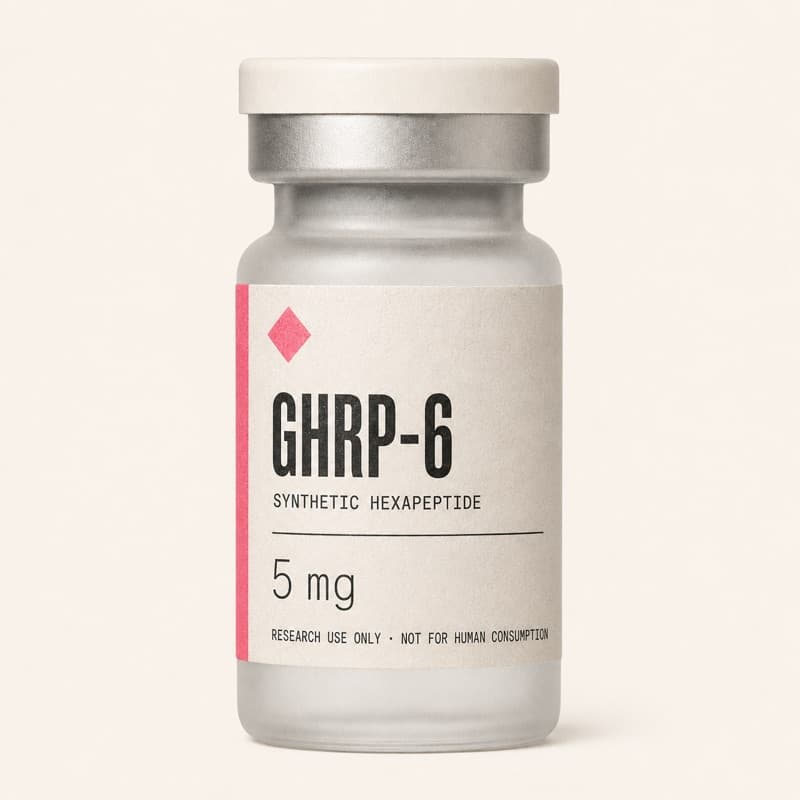
GHRP-6
Growth Hormone Releasing Peptide-6 · Hexapeptide GHS
Synthetic growth hormone secretagogue that prompts the pituitary gland to release growth hormone. It was among the first GHRPs developed and binds the ghrelin receptor (GHS-R1a). Rather than supply GH directly as an injection would, it raises the body's own GH production while negative feedback mechanisms stay balanced. Appetite stimulation is its noted potent effect.
Overview
Synthetic growth hormone secretagogue that prompts the pituitary gland to release growth hormone. It was among the first GHRPs developed and binds the ghrelin receptor (GHS-R1a). Rather than supply GH directly as an injection would, it raises the body's own GH production while negative feedback mechanisms stay balanced. Appetite stimulation is its noted potent effect.
The binding target is the growth hormone secretagogue receptor (GHS-R1a) — the receptor ghrelin itself activates. A signaling cascade opens in the hypothalamus and pituitary gland, and a rapid pulse of natural GH secretion follows. That released GH signals the liver to secrete IGF-1, and muscle growth and fat metabolism are promoted by it. Ghrelin release is stimulated as well, which produces a significant increase in appetite.
Research indications
What the compound has been studied for, grouped by body system. Effect size is the reported magnitude where it was measured — not a recommendation.
Activation of the ghrelin receptor stimulates endogenous growth hormone release potently.
Greater GH secretion from the pituitary raises IGF-1 levels indirectly.
Growth hormone and IGF-1 levels rise, and muscle protein synthesis increases with them.
Activation of the ghrelin pathway increases hunger significantly, a benefit where weight gain is needed.
Exercise recovery comes faster and tissue repair improves.
Cardiac tissue is protected independently of GH release, per the research.
Systemic cytoprotection with anti-inflammatory properties has been observed in the liver and other organs.
Reactive oxygen species are attenuated and antioxidant defenses preserved.
- Class
- Synthetic hexapeptide
- Research status
- Well studied
- Chain length
- 6 residues
- Molecular weight
- 873 Da
- Half-life
- ~38 min
- Typical dose
- 100–300 µg per injection
- Frequency
- 2–3 times daily
- Cycle length
- 8–12 weeks
- Storage
- Lyophilized: 2-8°C refrigerated; Reconstituted: 2-8°C refrigerated, use within 28 days
Molecular data
- Type
- Synthetic hexapeptide
- Molecular weight
- 873 Da
- Chain length
- 6 residues
- Half-life
- 38 min
Levels in single-dose multiples. A shape, not a pharmacokinetic prediction.
Dosing reference
Doses reported in the literature and by suppliers. These are a record of what has been used in research — reference, never instruction.
| Context | Route | Amount | Frequency |
|---|---|---|---|
| GH optimization | SubQ | 100 mcg | 2-3x daily |
| Enhanced results | SubQ | 200-300 mcg | 2-3x daily |
| With GHRH (synergy) | SubQ (combined) | 100 mcg each | 2-3x daily |
| Appetite/bulking | SubQ | 100-200 mcg | Before meals |
Interactions
The GHRH + GHRP combination gives synergistic GH release, significantly above either alone.
A classic stack: GHRP-6's effect on growth hormone release is amplified by GHRH.
The mechanism is similar, though GHRP-2 has greater potency and stimulates appetite less.
Both are GHRPs, though Ipamorelin carries fewer side effects and less potency.
No negative interactions known; a frequent pairing in recovery protocols.
GH response may rise when the two are given at once, though carb consumption blunts GH release.
What to expect
Safety
Mechanistic flags — properties of the pathway, not observed adverse events.
- Water retention
- Mild headache
- Intense hunger / increased appetite, the side effect most notable
- Numbness or tingling in the extremities
- Post-injection tiredness or lethargy
- Allergic reactions
- Hypoglycemia symptoms
- Headaches, severe or persistent
- Hands or feet swelling unusually
- Signs pointing to carpal tunnel syndrome
- Pregnancy or breastfeeding
- Pituitary disorders
- Diabetes, where caution is warranted
- Cancer now active, or cancer in the past
- Competitive athletes: prohibited under WADA
Quality checklist
What to confirm before trusting a batch of research material. A verification aid — not an endorsement of any supplier.
- Third-party Certificate of AnalysisIndependent lab · dated · lot-matched.
- HPLC purity ≥ 98%Reverse-phase trace included.
- Mass-spec confirms 873 g/molMALDI-TOF or ESI-MS.
- Counterion stated (acetate ≫ TFA)TFA salts can confound bioassays.
- Endotoxin / sterility statementRelevant once reconstituted.
- Lyophilised · cold-chain shippedStored −20 °C, shipped on ice.
- Labelled “research use only”No therapeutic or dosing claims.
Recorded signals for this compound · 7
- ✓Vacuum seal on the vial intact
- ✓Lyophilized powder, white to off-white
- ✓Solution clear once reconstituted
- !Slight clumping that a gentle swirl dissolves
- ×Powder discolored or yellow
- ×Solution carrying particles or precipitates
- ×Solution cloudy once reconstituted
FAQ
What accounts for intense hunger on GHRP-6 but not on GHRP-2?
Alongside GH stimulation, GHRP-6 potently stimulates the release of ghrelin — the 'hunger hormone' — where GHRP-2 stays more selective for GH and elevates ghrelin minimally. That difference in receptor selectivity is why appetite rises profoundly 15–20 minutes after a GHRP-6 injection, while GHRP-2 is significantly less orexigenic.
How soon after a GHRP-6 injection does hunger set in?
Onset is typically 15–20 minutes after a subcutaneous injection, with the peak around 30–45 minutes. Intensity can be considerable, which makes meal timing matter. Eating 20–30 minutes post-injection lines the appetite peak up with the eating window.
Does stacking GHRP-6 with CJC-1295 maximize GH release?
Yes — the pairing is strongly synergistic, since a GHRH + GHRP combination releases significantly more GH than either alone. It is the classic 'stack' for maximizing growth hormone, and it demands careful dosing to keep IGF-1 elevation from running excessive, plus management of the combined side effects, water retention and joint stress among them.