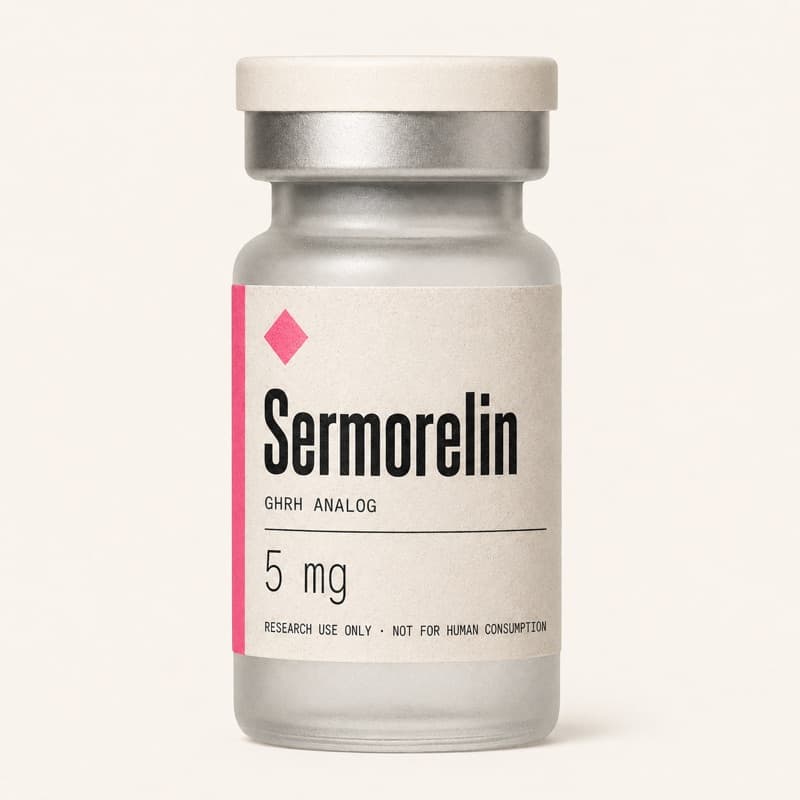
Sermorelin
GHRH Analog · Growth Hormone Releasing Hormone
Analog of human growth hormone-releasing hormone, synthetic, 29 amino acids long. Growth hormone production rises naturally under it while the physiological pulsatile pattern holds. The FDA approved it in 1997 for GH deficiency in children; discontinuation followed in 2008, for manufacturing reasons and not safety concerns.
Overview
Analog of human growth hormone-releasing hormone, synthetic, 29 amino acids long. Growth hormone production rises naturally under it while the physiological pulsatile pattern holds. The FDA approved it in 1997 for GH deficiency in children; discontinuation followed in 2008, for manufacturing reasons and not safety concerns.
Bioavailability is optimal by subcutaneous injection: GHRH receptors are bound, pulsatile GH release follows, and the hypothalamic-pituitary axis keeps its integrity with natural somatostatin negative feedback left in place.
Research indications
What the compound has been studied for, grouped by body system. Effect size is the reported magnitude where it was measured — not a recommendation.
Physiological patterns of GH release are maintained.
Natural axis function is preserved, and not suppressed.
Protein synthesis and muscle growth follow from endogenous IGF-1 stimulation.
Recovery is enhanced by physiological GH stimulation.
In elderly men a 1.26kg gain in lean mass was documented, alongside improved muscle strength tests.
Over 6 weeks in elderly subjects, 12-hour GH release doubled.
Adiposity falls; lean mass distribution improves.
Skin thickness and quality both improve.
- Class
- GHRH analog
- Research status
- Well studied
- Chain length
- 29 residues
- Molecular weight
- 3358 Da
- Half-life
- ~11 min
- Typical dose
- 200–300 µg per dose (up to 500 µg for athletic performance)
- Frequency
- Once daily at bedtime
- Cycle length
- 3–6 months continuous
- Storage
- Reconstituted: 2-8°C, use within 10-30 days
Molecular data
- Type
- GHRH analog
- Molecular weight
- 3358 Da
- Chain length
- 29 residues
- Half-life
- 11 min
Levels in single-dose multiples. A shape, not a pharmacokinetic prediction.
Dosing reference
Doses reported in the literature and by suppliers. These are a record of what has been used in research — reference, never instruction.
| Context | Route | Amount | Frequency |
|---|---|---|---|
| Anti-aging/Longevity | SubQ | 200-300mcg | Once at bedtime |
| Athletic Performance | SubQ | 300-500mcg | Once at bedtime |
| Body Composition | SubQ | 200mcg | 5 days weekly |
| Combination Therapy | SubQ co-injection | 200mcg + GHRP | Once daily |
| Nasal administration | Nasal spray | 30+ mcg/kg | Once daily at bedtime |
Interactions
An excellent pairing: GH release rises 3–5 fold.
Highly effective together — release is sustained 6–8 days by CJC-1295, while sermorelin brings immediate pulsatile effects.
GHRH+GHRP-2 in combination gives a 54-fold GH increase, against 20-fold for GHRH alone.
GH release is blocked directly by somatostatin analogs, which activate inhibitory receptors.
Pituitary GH release is suppressed by high-dose glucocorticoids, and GHRH receptor sensitivity falls.
Insulin action is antagonized by GH; the combination warrants close monitoring.
An essential pairing: a response to sermorelin is prevented where hypothyroidism goes untreated.
What to expect
Safety
Mechanistic flags — properties of the pathway, not observed adverse events.
- Reactions at the injection site, in 16.7% of patients and generally mild
- Irritation of the nose, by the intranasal route
- Pituitary tumor growth indicated by headaches or vision changes
- Severe reactions at the injection site, or generalized allergic responses
- Diabetes that is uncontrolled, or significant glucose intolerance
- Malignancy symptoms newly arising or worsening
- Active malignancy
- Pituitary tumors
- Pregnancy
Quality checklist
What to confirm before trusting a batch of research material. A verification aid — not an endorsement of any supplier.
- Third-party Certificate of AnalysisIndependent lab · dated · lot-matched.
- HPLC purity ≥ 98%Reverse-phase trace included.
- Mass-spec confirms 3358 g/molMALDI-TOF or ESI-MS.
- Counterion stated (acetate ≫ TFA)TFA salts can confound bioassays.
- Endotoxin / sterility statementRelevant once reconstituted.
- Lyophilised · cold-chain shippedStored −20 °C, shipped on ice.
- Labelled “research use only”No therapeutic or dosing claims.
Recorded signals for this compound · 8
- ✓Solution completely clear and colorless, with no particles, cloudiness, or precipitation
- ✓Peptide purity above 98% against USP standards
- ✓Lyophilized powder, sterile and nonpyrogenic
- ✓Held at 2–8°C for the whole of transport
- ✓Made under cGMP in FDA-registered facilities
- !Room temperature exposure is acceptable briefly, up to 72 hours, with prompt refrigeration after
- ×Cloudiness, particles, a change of color, or precipitation all indicate degradation
- ×Molecular weight is exactly 3,358 daltons as free base, or 3,418 daltons as acetate salt
FAQ
What led to sermorelin's discontinuation despite FDA approval and a safe record?
The 2008 discontinuation was a manufacturing matter, not a safety one. Approval came in 1997 and the safety record was solid; production simply stopped at the manufacturer. A gap in the market followed, and sermorelin is now reached through research or compounded sources rather than as a branded pharmaceutical.
How does sermorelin hold natural GH patterns better than GH given directly?
The pituitary is stimulated to release GH on its natural pulsatile pattern, high at night and low during the day. Injected GH instead creates constant levels, which suppresses the natural axis. Sermorelin leaves the hypothalamic-pituitary-axis (HPA) feedback loop intact, so natural regulation is retained in place of dependence on external hormones.
Why is food withheld for 2+ hours before a sermorelin injection?
GH release is suppressed by carbohydrates and high blood sugar. Eating beforehand blunts the GH response by 50–80% and the injection is left ineffective. Administration at bedtime on an empty stomach secures maximum GH secretion from the natural nocturnal pulse the body is primed to produce.
Does adding GHRP-2 to sermorelin produce larger GH increases still?
Yes, and highly effective. The GHRH + GHRP-2 combination gives a 54-fold GH increase where GHRH alone gives 20-fold. A cautious start is called for, watching for joint pain and water retention. Body composition benefits from the synergy, though dose management is more demanding than with either alone.
References
- 1The effects of intranasal insufflation of growth hormone releasing factor analogue GRF 1-29 NH2 on growth hormone secretion in children with short statureLaron, Z., et al. · Clinical Endocrinology · 1988
Intranasal GRF 1-29 at 100mcg/kg induced prompt GH release in prepubertal children with peak values at 15 minutes. Demonstrated feasibility of nasal delivery with minimal side effects.
Review · inferredPubMed 2877535 ↗ - 2Growth hormone (GH)-releasing hormone-(1-29) twice daily reverses the decreased GH and insulin-like growth factor-I levels in old menCorpas, E., et al. · Journal of Clinical Endocrinology & Metabolism · 1992
Landmark study in healthy old men (68 +/- 6.2 yr). High-dose GHRH(1-29) twice daily for 14 days reversed age-related decreases in GH and IGF-I to levels not significantly different from young men.
Human RCTPubMed 1379256 ↗ - 3Once daily subcutaneous growth hormone-releasing hormone therapy accelerates growth in growth hormone-deficient children during the first year of therapyGeref International Study Group · Journal of Clinical Endocrinology & Metabolism · 1996
Pivotal multicenter trial with 110 prepubertal GH-deficient children. Sermorelin 30mcg/kg/day at bedtime increased height velocity from 4.1 to 8.0 cm/year at 6 months, with 74% achieving good response.
Human pilotPubMed 8772599 ↗ - 4Endocrine and metabolic effects of long-term administration of [Nle27]growth hormone-releasing hormone-(1-29)-NH2 in age-advanced men and womenVittone, J., et al. · Journal of Clinical Endocrinology & Metabolism · 1997
5-month single-blind RCT in 19 adults (55-71 yr). Nightly GHRH analog for 4 months activated somatotropic axis. Men showed increased lean body mass, insulin sensitivity, and well-being. Skin thickness improved in both genders.
Human RCTPubMed 9141536 ↗ - 5Sermorelin: a better approach to management of adult-onset growth hormone insufficiency?Walker, R.F. · Clinical Interventions in Aging · 2006
Review arguing sermorelin preserves pituitary function and physiological GH pulsatility, offering a safer alternative to exogenous GH for adult-onset GH insufficiency.
Review · inferredPubMed 18046908 ↗
This review surveys growth hormone-releasing hormone and its analogues across neuroprotection, metabolic disease, regenerative medicine and oncology, and argues for GHRH agonists as candidate clinical therapies.