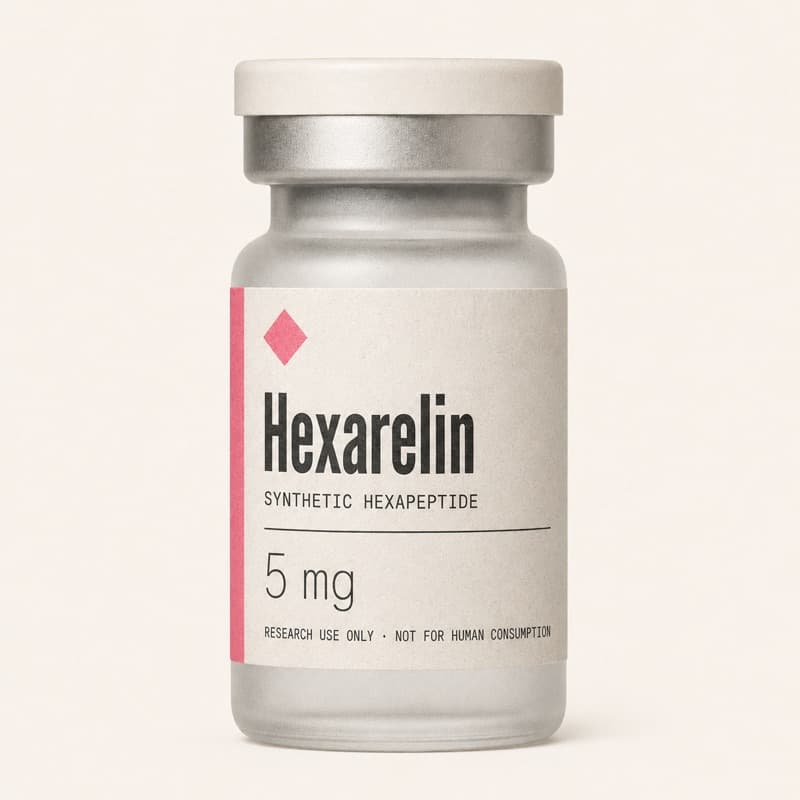
Hexarelin
Examorelin · Synthetic Growth Hormone Secretagogue
Among synthetic growth hormone secretagogues, one of the most potent available. Binding at the GHS-R1a receptor of the hypothalamus and pituitary mimics ghrelin and releases GH. With GHRH the effect is synergistic: the GH response comes out greater than the arithmetic sum of the two given separately. Cardioprotective properties unique to it are mediated by the CD36 receptor.
Overview
Among synthetic growth hormone secretagogues, one of the most potent available. Binding at the GHS-R1a receptor of the hypothalamus and pituitary mimics ghrelin and releases GH. With GHRH the effect is synergistic: the GH response comes out greater than the arithmetic sum of the two given separately. Cardioprotective properties unique to it are mediated by the CD36 receptor.
The target is the growth hormone secretagogue receptor 1a (GHS-R1a), found in the brain and in the pituitary gland. Occupancy sets off a signaling cascade, and somatotroph cells of the anterior pituitary respond by producing and releasing growth hormone. Slight dose-dependent effects on the release of prolactin, ACTH, and cortisol also occur. Cardioprotection is mediated by activation of the CD36 receptor together with modulation of calcium channels in cardiomyocytes.
Research indications
What the compound has been studied for, grouped by body system. Effect size is the reported magnitude where it was measured — not a recommendation.
The most potent GHRP where the endpoint is endogenous growth hormone release from the pituitary.
Combined with GHRH, GH release is synergistic and exceeds the sum of the separate effects.
IGF-1 levels rise significantly on the back of increased GH secretion.
Cardiac tissue is protected, by way of CD36 receptor activation.
Cardiomyocyte apoptosis falls, and the cardiac action potential is controlled.
Cardiotropic effects follow from raised Ca2+ influx across voltage-gated calcium channels.
In non-obese insulin-resistant models, lipid metabolism benefits via the CD36 receptor.
Lean-mass-to-fat ratio improves as GH and IGF-1 rise.
- Class
- Synthetic hexapeptide
- Research status
- Well studied
- Chain length
- 6 residues
- Molecular weight
- 887 Da
- Half-life
- ~1.5 h
- Typical dose
- 100–200 µg per injection
- Frequency
- 2–3 times daily
- Cycle length
- 8–12 weeks
- Storage
- Lyophilized: Room temperature. Reconstituted: 2-8°C, use within 28 days
Molecular data
- Type
- Synthetic hexapeptide
- Molecular weight
- 887 Da
- Chain length
- 6 residues
- Half-life
- 90 min
Levels in single-dose multiples. A shape, not a pharmacokinetic prediction.
Dosing reference
Doses reported in the literature and by suppliers. These are a record of what has been used in research — reference, never instruction.
| Context | Route | Amount | Frequency |
|---|---|---|---|
| GH optimization | SubQ or IM | 100 mcg | 2-3x daily |
| Enhanced results | SubQ or IM | 200 mcg | 2-3x daily |
| With GHRH (synergy) | SubQ (combined) | 100 mcg each | 2-3x daily |
| Cardioprotection | SubQ | 100-200 mcg | 1-2x daily |
Interactions
Strong synergy — the GH response to the pair exceeds the sum of what each produces alone.
Synergistic GH release on co-administration is confirmed in research.
Mechanisms overlap; the two are rarely stacked, though they can be alternated.
Shared receptor target; Hexarelin brings more potency and less appetite stimulation.
Two GHRPs; Hexarelin has the greater potency, possibly at the cost of more side effects.
What to expect
Safety
Mechanistic flags — properties of the pathway, not observed adverse events.
- Water retention
- Tingling or numbness
- Mild headache
- Post-injection tiredness
- Appetite increased, though less than with GHRP-6
- Unusual swelling
- Allergic reactions
- Headaches, severe or persistent
- Signs pointing to carpal tunnel syndrome
- Active cancer or history of cancer
- Pregnancy or breastfeeding
- Pituitary disorders
- WADA prohibited for competitive athletes
Quality checklist
What to confirm before trusting a batch of research material. A verification aid — not an endorsement of any supplier.
- Third-party Certificate of AnalysisIndependent lab · dated · lot-matched.
- HPLC purity ≥ 98%Reverse-phase trace included.
- Mass-spec confirms 887 g/molMALDI-TOF or ESI-MS.
- Counterion stated (acetate ≫ TFA)TFA salts can confound bioassays.
- Endotoxin / sterility statementRelevant once reconstituted.
- Lyophilised · cold-chain shippedStored −20 °C, shipped on ice.
- Labelled “research use only”No therapeutic or dosing claims.
Recorded signals for this compound · 7
- ✓Vacuum seal on the vial intact
- ✓Lyophilized powder, white to off-white
- ✓Solution clear once reconstituted
- !Slight clumping, dissolving readily
- ×Powder discolored or yellow
- ×Solution carrying particles or precipitates
- ×Solution cloudy once reconstituted
FAQ
What is the duration of hexarelin's effect?
Half-life is roughly 75 minutes to 2 hours. A GH spike arrives 15–30 minutes after injection, peaks at around 30–60 minutes, then falls back toward baseline. Holding GH elevated across the day therefore takes several injections daily.
Is appetite stimulation from hexarelin comparable to GHRP-6?
No. GH release is significantly more potent under hexarelin, and appetite stimulation is lower than with GHRP-6. That makes it the preferred option where strong GH effects are wanted without the intense hunger GHRP-6 typically triggers.
Is hexarelin taken on an empty stomach?
Yes, and that is the recommended practice. Effect is greatest when the injection lands on an empty stomach, ideally 30–60 minutes ahead of a meal. Food can get in the way of GH release by raising insulin and suppressing ghrelin signaling.