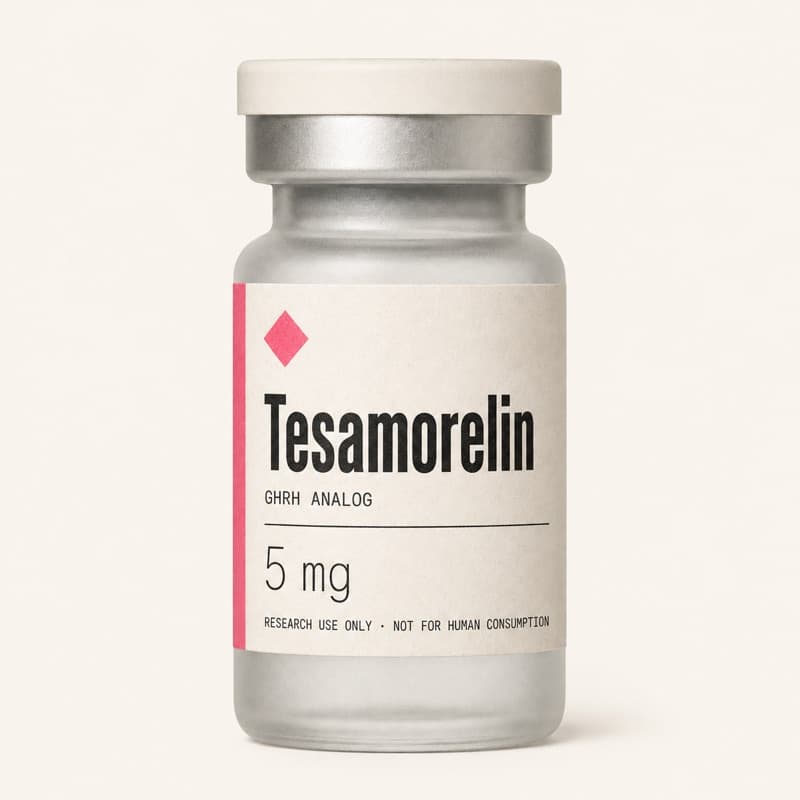
Tesamorelin
GHRH Analog · Visceral Fat Reduction
Synthetic GHRH analog with FDA approval, designed for HIV-associated lipodystrophy. Visceral fat is targeted selectively — clinical trials record 15–20% visceral fat reduction — while subcutaneous fat is preserved.
Overview
Synthetic GHRH analog with FDA approval, designed for HIV-associated lipodystrophy. Visceral fat is targeted selectively — clinical trials record 15–20% visceral fat reduction — while subcutaneous fat is preserved.
Bioavailability is optimal by subcutaneous injection, which serves GHRH receptor binding and stimulation of pulsatile GH release; visceral adipose tissue is targeted selectively and subcutaneous fat is spared.
Research indications
What the compound has been studied for, grouped by body system. Effect size is the reported magnitude where it was measured — not a recommendation.
The FDA-approved indication, with visceral fat down 15–20% in clinical trials.
Clinical studies held weight loss over 52+ weeks of continuous treatment.
A unique mechanism: dangerous visceral fat falls, subcutaneous fat is spared.
Triglyceride levels down 12.3%.
Cholesterol markers improved by 7.2%.
Liver fat down 37% across 12 months.
Lean muscle mass is preserved while fat is lost.
IGF-1 levels up 26%.
- Class
- GHRH analog
- Research status
- FDA approved
- Chain length
- 44 residues
- Molecular weight
- 5135.9 Da
- Half-life
- ~32 min
- Typical dose
- 1.4–2 mg daily (FDA-approved: 2 mg for HIV lipodystrophy)
- Frequency
- Once daily (evening)
- Cycle length
- Continuous therapy
- Storage
- Powder: 20-25°C. Egrifta SV: use immediately. Egrifta WR: room temp up to 7 days
Molecular data
- Type
- GHRH analog
- Molecular weight
- 5135.9 Da
- Chain length
- 44 residues
- Half-life
- 32 min
HADGIFTNSYRKVLGQLSARKLLQDIMSRQQGESNQERGARARLLevels in single-dose multiples. A shape, not a pharmacokinetic prediction.
Dosing reference
Doses reported in the literature and by suppliers. These are a record of what has been used in research — reference, never instruction.
| Context | Route | Amount | Frequency |
|---|---|---|---|
| HIV Lipodystrophy (FDA-approved) | SubQ | 1.4mg | Once daily |
| Visceral Fat Reduction | SubQ | 2mg | Once daily |
| Anti-aging/Body Composition | SubQ | 1-2mg | 5-7x weekly |
| NAFLD Treatment | SubQ | 2mg | Once daily (12 months) |
| Cognitive Enhancement | SubQ | 1mg | Once daily (20 weeks) |
Interactions
GH stimulation is synergistic; IGF-1 levels warrant monitoring.
Used together, IGF-1 may be driven supraphysiologically high.
The mechanism is similar; at higher doses, effects risk being excessive.
Diabetes risk rises 3.3-fold; close glucose monitoring applies.
Glucose intolerance that comes with tesamorelin may be mitigated.
Corticosteroid effectiveness falls.
GH release is blocked, negating what tesamorelin does.
Redundant, with acromegaly-like effects a risk.
What to expect
Safety
Mechanistic flags — properties of the pathway, not observed adverse events.
- Injection site reactions (17%)
- Joint pain (13%)
- Water retention
- Signs of malignancy
- Severe hypersensitivity reactions
- Onset of diabetes, or glucose intolerance that is severe (HbA1c ≥6.5%)
- IGF-1 elevated excessively (>2 SD above normal) alongside acromegaly symptoms
- Active malignancy
- Pituitary disorders
- Pregnancy
Quality checklist
What to confirm before trusting a batch of research material. A verification aid — not an endorsement of any supplier.
- Third-party Certificate of AnalysisIndependent lab · dated · lot-matched.
- HPLC purity ≥ 98%Reverse-phase trace included.
- Mass-spec confirms 5135.9 g/molMALDI-TOF or ESI-MS.
- Counterion stated (acetate ≫ TFA)TFA salts can confound bioassays.
- Endotoxin / sterility statementRelevant once reconstituted.
- Lyophilised · cold-chain shippedStored −20 °C, shipped on ice.
- Labelled “research use only”No therapeutic or dosing claims.
Recorded signals for this compound · 7
- ✓Formulations with FDA approval — Egrifta SV/WR, from a licensed pharmacy
- ✓Crystalline powder, white, uniform and cake-like
- ✓Reconstituted solution clear, colorless, without particles
- ✓Packaging proper: vials sealed, stoppers intact
- !Variability in quality and potency is possible in compounded formulations
- ×Particles or precipitate visible
- ×Solution cloudy or discolored — yellow/brown indicates degradation
FAQ
Does tesamorelin target visceral fat specifically, or reduce overall body fat?
Visceral (deep abdominal) fat is targeted uniquely, and subcutaneous fat spared. That selectivity is the basis of FDA approval specifically for HIV-associated lipodystrophy: visceral fat falls 15–20% without proportional subcutaneous fat loss, metabolic health improves, and cardiovascular risk drops.
Where does cognitive function sit — a primary effect of tesamorelin, or a side benefit?
Not a primary effect. A Phase 2 trial in 152 older adults (55–87 years) did show favorable effects on cognition, executive function in particular (P=0.005), with IGF-1 increases of 117%. Anti-aging brain benefits are suggested by that, though confirmation needs larger trials.
Is diabetes risk raised by tesamorelin, as with other GH therapies?
Yes — a 3.3-fold rise in diabetes risk against placebo is documented. Glucose must be monitored closely, most of all in patients who are pre-diabetic. The risk may be mitigated by metformin co-treatment, and medication adjustment in diabetics has to be careful.
What separates tesamorelin from semaglutide for visceral fat loss?
Subcutaneous fat is spared uniquely by tesamorelin while visceral fat is targeted, which suits patients wanting to preserve healthy fat deposits. Semaglutide drives general weight loss across all fat depots. Selective visceral fat reduction in metabolically healthy individuals points to tesamorelin; comprehensive weight loss points to semaglutide.
References
- 1Metabolic effects of a growth hormone-releasing factor in patients with HIVFalutz J, Allas S, Blot K, et al. · New England Journal of Medicine · 2007
Landmark RCT in 412 HIV patients: tesamorelin 2 mg daily for 26 weeks reduced visceral fat by 10.9% vs 0.6% placebo, improved lipid profiles with no change in subcutaneous fat.
Human RCTPubMed 18057338 ↗ - 2Effects of Tesamorelin in HIV-Infected Patients with Abdominal Fat Accumulation: Randomized Placebo-Controlled Trial with Safety Extension (CTR-1011)Falutz, J., et al. · Journal of Acquired Immune Deficiency Syndromes · 2010
404 HIV patients treated for up to 12 months. 69% achieved ≥8% VAT reduction vs 33% placebo. VAT benefits were lost upon discontinuation, confirming need for continuous therapy.
Human RCTPubMed 20101189 ↗ - 3Effects of Growth Hormone-Releasing Hormone on Cognitive Function in Adults with MCI and Healthy Older AdultsBaker, L.D., et al. · Archives of Neurology · 2012
152 adults (ages 55-87) treated with tesamorelin 1mg daily for 20 weeks. Favorable effect on cognition (P=0.03), with particular benefit on executive function (P=0.005) and IGF-1 increase of 117%.
Human RCTPubMed 22869065 ↗ - 4Effects of Tesamorelin on Non-Alcoholic Fatty Liver Disease in HIV: A Randomised, Double-Blind, Multicentre TrialStanley, T.L., et al. · Lancet HIV · 2019
61 HIV patients with NAFLD randomized to tesamorelin 2mg vs placebo for 12 months. 37% relative reduction in hepatic fat fraction (P=0.02), with prevention of fibrosis progression on liver biopsy.
Human RCTPubMed 31611038 ↗ - 5Body Composition, Hepatic Fat, Metabolic, and Safety Outcomes of Tesamorelin: A Meta-Analysis of Randomized Controlled TrialsElgenidy, A., et al. · HIV Medicine · 2025
Meta-analysis of 5 RCTs showing significant VAT reduction (MD=-27.71 cm², P<0.001), increased lean body mass (MD=1.42 kg, P<0.001), and improved hepatic fat and IGF-1 levels without serious safety concerns.
Meta-analysisPubMed 41545261 ↗
An open-label Phase 2 trial enrolled 73 people with HIV and abdominal obesity; tesamorelin produced a larger median waist reduction of 2.7 cm than standard of care and a non-significant trend toward better neurocognition.
The first data set addressing tesamorelin in people with HIV receiving INSTI-based regimens showed favourable body composition changes and no worsening of glycaemic control.