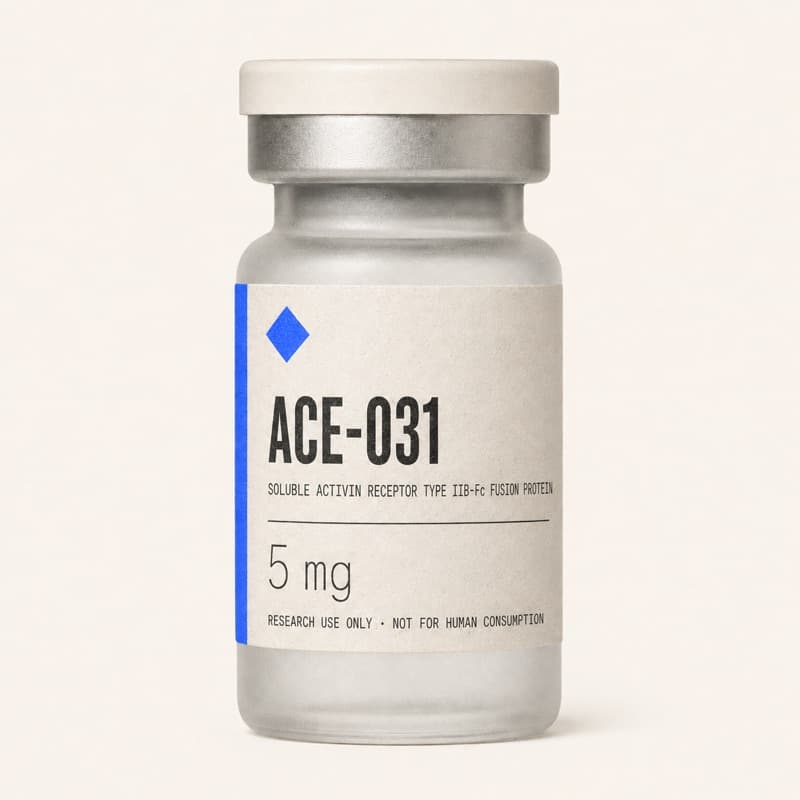
ACE-031
Myostatin Inhibitor · Experimental Muscle Growth
Soluble form of the activin type IIB receptor (ActRIIB) fused to an IgG1 Fc domain. As a decoy receptor it binds and neutralizes myostatin along with other TGF-beta superfamily members that ordinarily limit muscle growth. Acceleron Pharma developed it for Duchenne muscular dystrophy (DMD) and took it to Phase 2 clinical trials, where vascular side effects — nosebleeds and telangiectasia among them — halted development. A single dose in healthy volunteers produced significant gains in lean mass and drops in fat mass within 29 days.
Overview
Soluble form of the activin type IIB receptor (ActRIIB) fused to an IgG1 Fc domain. As a decoy receptor it binds and neutralizes myostatin along with other TGF-beta superfamily members that ordinarily limit muscle growth. Acceleron Pharma developed it for Duchenne muscular dystrophy (DMD) and took it to Phase 2 clinical trials, where vascular side effects — nosebleeds and telangiectasia among them — halted development. A single dose in healthy volunteers produced significant gains in lean mass and drops in fat mass within 29 days.
Members of the TGF-beta superfamily are trapped by ACE-031, which functions as a ligand decoy. It copies the extracellular domain of the ActRIIB receptor, and in doing so catches myostatin (GDF-8), activin A, activin B and GDF-11 ahead of any binding to cell-surface receptors or activation of Smad2/3 signaling. With that pathway blocked, the natural brake on muscle protein synthesis and satellite cell proliferation comes off, and skeletal muscle hypertrophy follows rapidly. Circulating half-life is extended by the Fc fusion domain through FcRn-mediated recycling, which also supplies bivalent ligand binding.
Research indications
What the compound has been studied for, grouped by body system. Effect size is the reported magnitude where it was measured — not a recommendation.
Healthy postmenopausal women given a single IV dose showed statistically significant lean mass increases, averaging +1.7%, in phase 1 data.
In preclinical models, inhibition of the myostatin pathway prevents muscle loss robustly across disease states.
In DMD patients, a phase 2 trial found lean body mass and bone mineral density improved, but was halted over vascular adverse events.
Subjects in the phase 1 trial cut fat mass at the same time as gaining lean mass, which suggests favorable nutrient partitioning.
Bone mineral density rose in the DMD trial data, in line with what ActRIIB pathway modulation is known to do to bone metabolism.
- Class
- Soluble activin receptor type IIB-Fc fusion protein
- Research status
- Emerging
- Half-life
- ~324 h
- Typical dose
- 0.5–3 mg/kg IV every 2 weeks (clinical research doses only)
- Frequency
- Every 2 weeks
- Cycle length
- Clinical trials used 4–12 week treatment periods
- Storage
- 2-8°C; protect from light. Not commercially available.
Molecular data
- Type
- Soluble activin receptor type IIB-Fc fusion protein
- Half-life
- 19440 min
Levels in single-dose multiples. A shape, not a pharmacokinetic prediction.
Dosing reference
Doses reported in the literature and by suppliers. These are a record of what has been used in research — reference, never instruction.
| Context | Route | Amount | Frequency |
|---|---|---|---|
| Phase 1 Research Protocol (Healthy Volunteers) | IV infusion | 0.1-3 mg/kg | Single IV dose |
| Phase 2 Research Protocol (DMD) | IV or SubQ | 0.5-2.5 mg/kg | Every 2 weeks |
Interactions
Myostatin is inhibited by both, by different mechanisms — ligand trapping against direct binding. The synergy is conceptual; clinical data on combined use is absent.
The myostatin pathway is the shared target. YK-11 inhibits myostatin by a different mechanism. Combining them could suppress the pathway excessively, with unpredictable effects.
What to expect
Safety
Mechanistic flags — properties of the pathway, not observed adverse events.
- Gum bleeding
- Skin erythema (redness)
- Nosebleeds (epistaxis), the adverse event reported most often
- Telangiectasia — small blood vessels dilated and visible on the skin
- Minor reactions at the injection site
- Nosebleeds that recur or are severe
- Development of telangiectasia that is new or worsening
- Bleeding from any site, unexplained
- Any sign of a syndrome resembling hereditary hemorrhagic telangiectasia
- Widespread erythema, or severe skin reactions
- Pregnancy or breastfeeding
- Approval for human use was never granted, and clinical development has been discontinued
- A history of vascular malformations or bleeding disorders
- Antiplatelet or anticoagulant therapy taken concurrently
- Hypersensitivity to Fc fusion proteins, where known
Quality checklist
What to confirm before trusting a batch of research material. A verification aid — not an endorsement of any supplier.
- Third-party Certificate of AnalysisIndependent lab · dated · lot-matched.
- HPLC purity ≥ 98%Reverse-phase trace included.
- Mass-spec identity confirmedMALDI-TOF or ESI-MS.
- Counterion stated (acetate ≫ TFA)TFA salts can confound bioassays.
- Endotoxin / sterility statementRelevant once reconstituted.
- Lyophilised · cold-chain shippedStored −20 °C, shipped on ice.
- Labelled “research use only”No therapeutic or dosing claims.
Recorded signals for this compound · 11
- ✓Made under GMP conditions for use in clinical trials
- ✓Characterization by mass spectrometry and SDS-PAGE
- ✓Sterility verified, endotoxin tested
- ✓Storage at 2–8 °C, cold chain documented
- !Development in the clinic is halted, and there is no commercial manufacture
- !A legitimate commercial source does not exist
- !Anything sold under the name ACE-031 has unknown origin and unknown quality
- !The structure of the fusion protein is degradation-sensitive
- ×Trials were discontinued over vascular side effects; nosebleeds and telangiectasia proved dose-limiting
- ×Beyond myostatin inhibition, broad ligand trapping may bring unintended effects
- ×Nothing is known of the long-term safety profile
FAQ
If the muscle gains were that large, what stopped ACE-031 development?
The halt came during Phase 2 clinical trials, over serious vascular side effects: recurrent nosebleeds, gum bleeding, and telangiectasia — small blood vessels dilated and visible on the skin. Those dose-limiting adverse events pointed to off-target action on vascular homeostasis, weighing heavier than the muscle-building benefits and leaving further development unsafe.
What quantity of muscle does ACE-031 build in humans?
In healthy postmenopausal women, one IV dose produced within 29 days statistically significant increases in lean mass (+1.7%) and in thigh muscle volume (+5.1%); that is the phase 1 data. Development never reached Phase 3, so long-term safety, and efficacy at therapeutic doses in the real world, stay unproven across larger populations.
Does ACE-031 remain usable as a research chemical where it can be found?
Human use was never approved and clinical development was discontinued. Whatever is sold under the name carries unknown origin and unknown quality. Being a complex fusion protein sensitive to degradation, the compound makes DIY sourcing extremely risky, with contamination likely.
Is the mechanism of ACE-031 different from myostatin inhibitors such as follistatin?
No. As a soluble activin receptor, ACE-031 works as a ligand trap; follistatin binds myostatin directly. Myostatin signaling ends up inhibited either way, though by different mechanisms. Combined use might be synergistic in theory, but no clinical data on combinations exists.
References
- 1Myostatin inhibition in health and diseaseLee SJ · Annual Review of Cell and Developmental Biology · 2004
Comprehensive review establishing myostatin as a key negative regulator of skeletal muscle mass. Demonstrated that myostatin-null mice exhibit dramatic increases in muscle mass, providing the biological rationale for therapeutic myostatin inhibition strategies including soluble receptor approaches.
ReviewPubMed 15473835 ↗ - 2A soluble activin receptor type IIB (ACE-031) increases lean body mass and muscle strength in healthy postmenopausal womenAttie KM, Borgstein NG, Yang Y, Condon CH, Wilson DM, Pearsall AE, Kumar R, Willins DA, Seehra JS, Sherman ML · Journal of Clinical Endocrinology & Metabolism · 2013
Single ascending-dose Phase 1 trial in 48 postmenopausal women. ACE-031 produced statistically significant increases in total body lean mass (+1.7%) and thigh muscle volume (+5.1%) by day 29, with concurrent decreases in fat mass and leptin.
Review · inferredPubMed 23539721 ↗ - 3Pharmacokinetic, pharmacodynamic, and safety results from a first-in-human study of ACE-031, a novel activin receptor type IIB/Fc fusion proteinBhatt RS, Goss A, Wilson DM, Borgstein NG, Sherman ML · Journal of Clinical Pharmacology · 2014
ACE-031 demonstrated a half-life of approximately 12 days with dose-proportional pharmacokinetics. The compound suppressed circulating FSH levels, consistent with activin A neutralization, and showed a dose-dependent increase in lean mass biomarkers.
In vitroPubMed 24691811 ↗ - 4A phase 2 trial of ACE-031, a soluble activin receptor type IIB, in boys with Duchenne muscular dystrophyCampbell C, McMillan HJ, Mah JK, Tarnopolsky M, Selby K, McClure T, Wilson DM, Sherman ML, Bhatt SA, Trachtenberg FL, Kunkel LM, Bhatt RS · Neuromuscular Disorders · 2017
Phase 2 study in 12 DMD boys showed increases in lean body mass and bone mineral density. Trial was halted due to safety concerns including epistaxis, telangiectasia, and erythema. Preliminary efficacy signals were observed but could not be fully evaluated.
Review · inferredPubMed 28131562 ↗