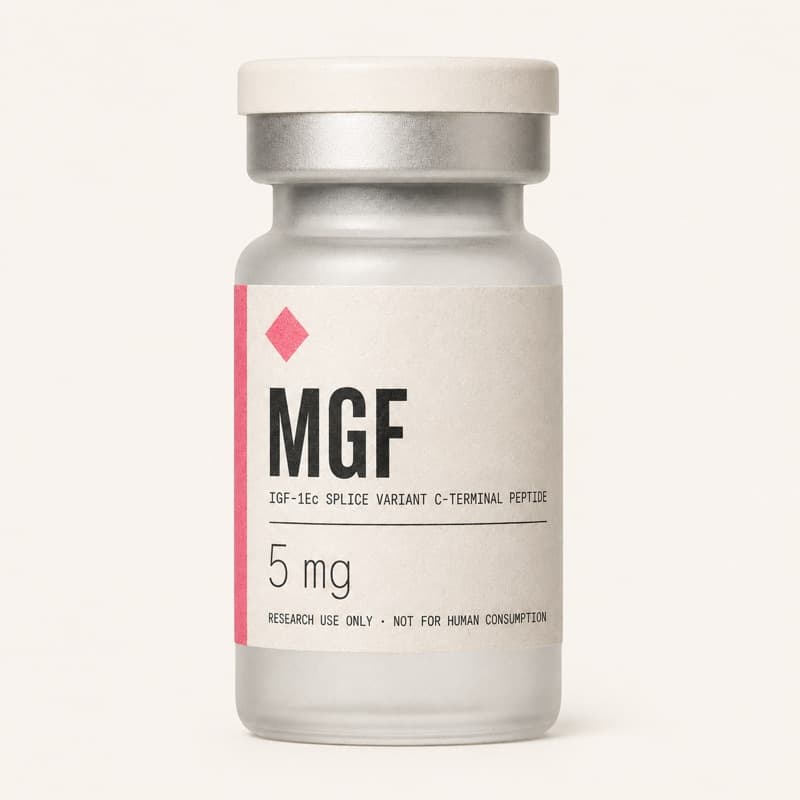
MGF
Mechano Growth Factor · IGF-1 Splice Variant
IGF-1 splice variant without pegylation, produced locally in muscle tissue after mechanical stress. Its half-life is very short next to PEG-MGF, so administration must be more frequent, or localized by injection.
Overview
IGF-1 splice variant without pegylation, produced locally in muscle tissue after mechanical stress. Its half-life is very short next to PEG-MGF, so administration must be more frequent, or localized by injection.
Receptor binding activates muscle satellite stem cells and sets off MAPK/ERK signaling. Protein synthesis rises and muscle fiber repair is promoted. Activity of the E-peptide domain is distinct from that of mature IGF-1.
Research indications
What the compound has been studied for, grouped by body system. Effect size is the reported magnitude where it was measured — not a recommendation.
Dormant muscle satellite cells are activated as the primary mechanism; those cells fuse to damaged fibers.
Because the half-life is short, effects stay concentrated at the injection site.
Mechanical stress upregulates it naturally; repair processes are enhanced by supplementation.
Local application improves outcomes in tendon injury, animal studies suggest.
Research points to potential bone healing by way of osteoblast regulation.
- Class
- IGF-1Ec splice variant C-terminal peptide
- Research status
- Limited research
- Chain length
- 24 residues
- Molecular weight
- 2888 Da
- Half-life
- ~6 min
- Typical dose
- 100–300 µg per injection
- Frequency
- Daily, immediately post-workout
- Cycle length
- 8–12 weeks
- Storage
- Refrigerate at 2-8°C; use within 30 days
Molecular data
- Type
- IGF-1Ec splice variant C-terminal peptide
- Molecular weight
- 2888 Da
- Chain length
- 24 residues
- Half-life
- 6 min
Levels in single-dose multiples. A shape, not a pharmacokinetic prediction.
Dosing reference
Doses reported in the literature and by suppliers. These are a record of what has been used in research — reference, never instruction.
| Context | Route | Amount | Frequency |
|---|---|---|---|
| Standard Protocol | IM into target muscle | 100-300mcg | Daily, post-workout |
| Progressive Titration | IM bilateral | 100mcg → 300mcg | Daily, increasing weekly |
| Localized Recovery | IM into worked muscle groups | 200-300mcg | Immediately post-workout |
Interactions
The active peptide is the same; the half-lives differ. Combining is redundant — one or the other, according to protocol preference.
IGF-1 pathways are targeted by both, and combining risks overstimulating the receptor.
Mechanisms complement: angiogenesis from BPC-157, satellite-cell activation from MGF.
Inflammation falls and cell migration is promoted by TB-500; muscle stem cells are activated by MGF.
What to expect
Safety
Mechanistic flags — properties of the pathway, not observed adverse events.
- Mild fatigue
- Soreness where injected
- Signs of hypoglycemia
- Severe reactions at the injection site
- Unusual growths or lumps, or tissue that changes rapidly
- Headaches that persist, or changes in vision
- Pregnancy or breastfeeding
- Uncontrolled diabetes
- Any past cancer or neoplastic disease
Quality checklist
What to confirm before trusting a batch of research material. A verification aid — not an endorsement of any supplier.
- Third-party Certificate of AnalysisIndependent lab · dated · lot-matched.
- HPLC purity ≥ 98%Reverse-phase trace included.
- Mass-spec confirms 2888 g/molMALDI-TOF or ESI-MS.
- Counterion stated (acetate ≫ TFA)TFA salts can confound bioassays.
- Endotoxin / sterility statementRelevant once reconstituted.
- Lyophilised · cold-chain shippedStored −20 °C, shipped on ice.
- Labelled “research use only”No therapeutic or dosing claims.
Recorded signals for this compound · 6
- ✓Fluffy cake, white or off-white in appearance
- ✓Solution crystal clear once reconstituted
- ✓Certificate of Analysis reporting HPLC purity >98%
- !Minor clumping, so long as gentle swirling dissolves it
- ×Collapsed or discolored powder
- ×Cloudiness that persists, or visible particles
FAQ
What is the rationale for injecting MGF directly into muscle post-workout?
A half-life of 5–7 minutes confines MGF to the injection site, where satellite stem cells are activated locally. Post-workout timing is critical: the muscle is primed for growth and recovery at that point. Intramuscular injection keeps the effect inside the trained muscle group being developed.
Where does MGF differ from PEG-MGF?
Daily injections are required by standard MGF, whose half-life runs 5–7 minutes. Pegylation stretches PEG-MGF much longer, into hours. Selection follows protocol preference: localized doses given frequently (MGF), or fewer injections at higher dose (PEG-MGF). Effects are similar; administration is what differs.
Is hypoglycemia a risk with MGF?
Possibly, though the risk sits below that of IGF-1 LR3, given the very short half-life and localized action of MGF. The post-workout window and direct muscle injection make hypoglycemia unlikely regardless. Monitoring early use and taking carbohydrate after injection remain precautions.
How long does MGF take to produce muscle growth?
Soreness in the targeted muscles drops across weeks 1–2. By weeks 4–8, size and recovery capacity in the trained muscle improve noticeably. Cycles of 8–12 weeks with equal time off are what most users run. Structural gains driven by satellite cell activation may hold after discontinuation.