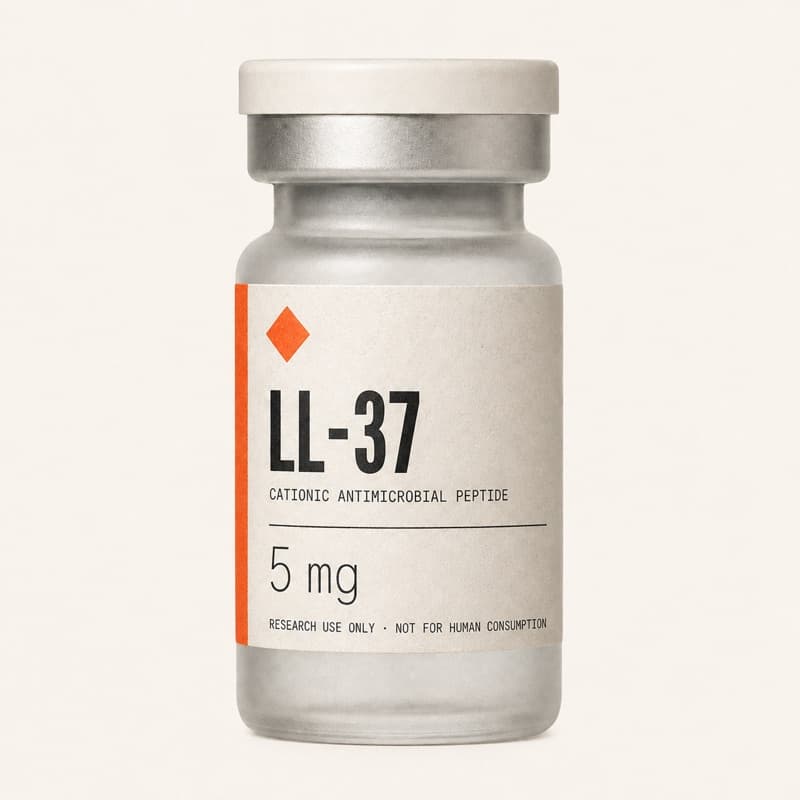
LL-37
Human Cathelicidin · Antimicrobial Peptide
The one human cathelicidin antimicrobial peptide: 37 amino acids, cationic, derived from hCAP18. Antimicrobial activity is broad-spectrum across bacteria, viruses, and fungi, and immune responses are modulated alongside it.
Overview
The one human cathelicidin antimicrobial peptide: 37 amino acids, cationic, derived from hCAP18. Antimicrobial activity is broad-spectrum across bacteria, viruses, and fungi, and immune responses are modulated alongside it.
Membrane disruption gives direct antimicrobial activity; wound healing is promoted through enhanced keratinocyte migration and angiogenesis; and immune responses are modulated with no systemic exposure where the route is topical.
Research indications
What the compound has been studied for, grouped by body system. Effect size is the reported magnitude where it was measured — not a recommendation.
Granulation tissue formation was enhanced, wound closure with it.
Animal models demonstrated accelerated healing.
Clinical trials demonstrated ulcer area down 68% at a concentration of 0.5 mg/mL.
Against pathogens, natural immune defenses are boosted.
MRSA and multi-drug resistant bacteria are both susceptible; biofilms showed >4 log reduction.
Immune responses are balanced, and immunosuppression does not follow.
Growth and regeneration of skin cells are stimulated.
Formation of new blood vessels for tissue repair is promoted.
Production of collagen is supported, for wound healing.
- Class
- Cationic antimicrobial peptide
- Research status
- Well studied
- Chain length
- 37 residues
- Typical dose
- 0.5–1.6 mg/mL topical gel or 100–150 µg injectable
- Frequency
- Topical: daily to twice weekly on wounds; injectable: once daily subcutaneous
- Cycle length
- 2–8 weeks depending on wound healing progress
- Storage
- Lyophilized: 2-8°C. Reconstituted: 2-8°C, maintain sterility
Molecular data
- Type
- Cationic antimicrobial peptide
- Chain length
- 37 residues
Dosing reference
Doses reported in the literature and by suppliers. These are a record of what has been used in research — reference, never instruction.
| Context | Route | Amount | Frequency |
|---|---|---|---|
| Wound healing - Standard | Direct wound application | 0.5mg/mL gel/cream | Daily to twice weekly |
| Wound healing - Intensive | Direct wound application | 1.6mg/mL gel/cream | Daily |
| Systemic immune support | SubQ | 100-150mcg | Once daily |
Interactions
Complementary mechanisms, and greater wound healing as a result.
Anti-inflammatory action and healing effects, in combination.
In combination against resistant bacteria, FICI values run 0.25–0.5.
A cofactor for production of endogenous LL-37.
Combined use is safe; no negative interactions.
Antimicrobial activity may fall where salt concentrations are high.
Incompatible physically, IV formulations especially.
What to expect
Safety
- Irritation locally where applied (topical)
- Tolerated well overall
- Mild reactions at the injection site (injectable)
- Injection site reactions, severe, with inflammation spreading
- Persistent flu-like symptoms
- Allergic reaction signalled by rash, by difficulty breathing, by swelling
- Wound infection signs — redness increased, warmth, drainage
- Wound condition worsening, or healing delayed
- Pain or irritation, unusual, at the application site
- Pre-existing hypersensitivity to peptides
- Non-sterile wound environments
- Immune status compromised (a relative contraindication)
Quality checklist
What to confirm before trusting a batch of research material. A verification aid — not an endorsement of any supplier.
- Third-party Certificate of AnalysisIndependent lab · dated · lot-matched.
- HPLC purity ≥ 98%Reverse-phase trace included.
- Mass-spec identity confirmedMALDI-TOF or ESI-MS.
- Counterion stated (acetate ≫ TFA)TFA salts can confound bioassays.
- Endotoxin / sterility statementRelevant once reconstituted.
- Lyophilised · cold-chain shippedStored −20 °C, shipped on ice.
- Labelled “research use only”No therapeutic or dosing claims.
Recorded signals for this compound · 13
- ✓Sterile, clear formulation
- ✓≥98% purity by HPLC
- ✓Clinical-grade concentrations (0.5-1.6mg/mL)
- ✓Cold chain maintained properly (2–8°C)
- ✓A gel base that suits, compatible with peptide activity
- ✓Lyophilized powder, white to off-white
- !Short exposure to room temperature is acceptable where refrigeration follows promptly
- !Sterility may be lacking in homemade topical formulations
- ×Discolored or cloudy solutions
- ×Non-sterile preparations
- ×Microbial contamination
- ×Visible particles, or yellow discoloration
- ×Liquid formulations sold pre-mixed (LL-37 is unstable long-term)
FAQ
By how much does LL-37 speed wound healing over standard care?
At 0.5 mg/mL, chronic venous leg ulcer area fell 68% in clinical trials. Weeks 2–4 are where the acceleration is most dramatic: granulation tissue formation and epithelial migration increase visibly against untreated wounds.
Does LL-37 work on antibiotic-resistant bacteria?
Yes. MRSA biofilms showed >4 log reduction against conventional antibiotics. The antimicrobial activity is broad-spectrum and runs through membrane disruption, which bypasses resistance mechanisms. Resistant gram-positive and gram-negative bacteria are both covered.
Do systemic effects follow topical LL-37?
No. Systemic absorption is minimal when the peptide is applied to wounds. Effects stay local to the wound site, where the antimicrobial and healing benefit is direct. Application to a specific wound is therefore safe, with no systemic side effects.
References
A review covering LL-37's range of functions, from infection defence through to cancer immunity.