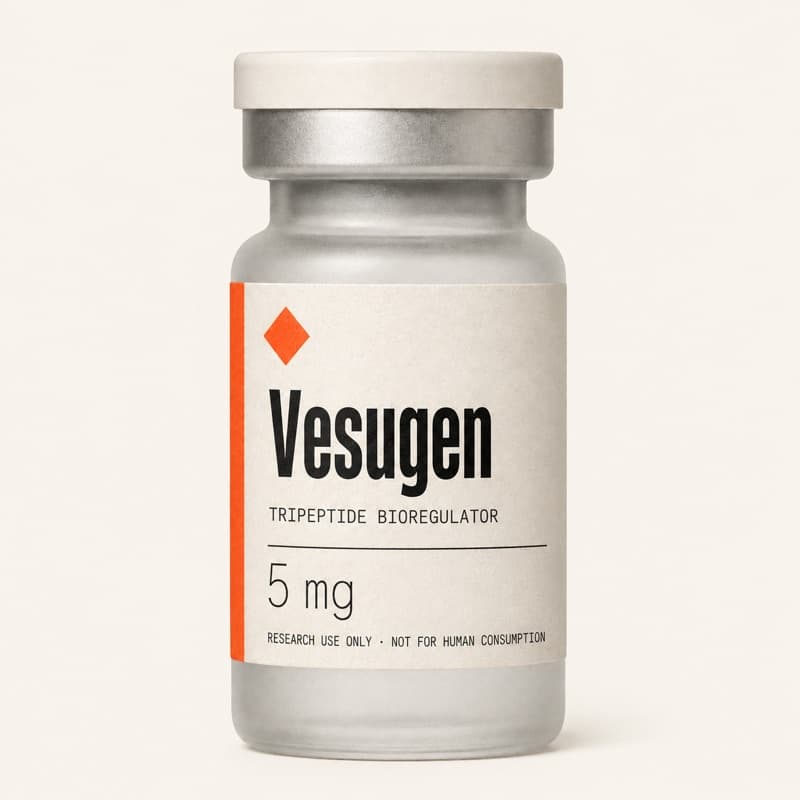
Vesugen
KED · Vascular Bioregulator Peptide
Khavinson bioregulator tripeptide from Russia's St. Petersburg Institute of Bioregulation and Gerontology. Three amino acids make it up — lysine, glutamic acid, aspartic acid — and its target is the vascular system, protecting blood vessels against age-related decline. Research shows atherosclerosis development limited, endothelial dysfunction decreased, and stem cells activated. As with the other short Khavinson peptides, it reaches the nucleus and influences gene expression.
Overview
Khavinson bioregulator tripeptide from Russia's St. Petersburg Institute of Bioregulation and Gerontology. Three amino acids make it up — lysine, glutamic acid, aspartic acid — and its target is the vascular system, protecting blood vessels against age-related decline. Research shows atherosclerosis development limited, endothelial dysfunction decreased, and stem cells activated. As with the other short Khavinson peptides, it reaches the nucleus and influences gene expression.
Epigenetic regulation is the route: interaction with DNA promoter regions, and in particular an effect on Ki-67 gene expression, which governs cell division. A prominent role is played in regulating levels of the sirtuin 1 (SIRT1) protein, the key anti-aging protein that calorie restriction activates. Proliferation of mesenchymal stem cells is enhanced, senescence markers fall, cell differentiation improves, and the Senescence-Associated Secretory Phenotype (SASP) implicated in age-related cardiovascular disease may be reversed.
Research indications
What the compound has been studied for, grouped by body system. Effect size is the reported magnitude where it was measured — not a recommendation.
Gene expression regulation shields blood vessels against deterioration with age.
Endothelial dysfunction, a contributor to cardiovascular disease, decreases.
Atherosclerotic plaque development in blood vessels is limited.
Sirtuin 1 levels are regulated, which mimics some of what calorie restriction delivers.
Mesenchymal stem cell proliferation rises; senescence falls.
In aging cells, the senescence-associated secretory phenotype is reversed.
- Class
- Tripeptide bioregulator
- Research status
- Moderate research
- Chain length
- 3 residues
- Molecular weight
- 390 Da
- Typical dose
- 10–20 mg daily (oral capsules) or 10 mg (injectable)
- Frequency
- Daily for 10–20 consecutive days (Khavinson bioregulator cycle)
- Cycle length
- 10–20 day cycle
- Storage
- Oral capsules: room temperature; Lyophilized powder/reconstituted: 2-8°C refrigerated
Molecular data
- Type
- Tripeptide bioregulator
- Molecular weight
- 390 Da
- Chain length
- 3 residues
KEDDosing reference
Doses reported in the literature and by suppliers. These are a record of what has been used in research — reference, never instruction.
| Context | Route | Amount | Frequency |
|---|---|---|---|
| Standard protocol | Oral capsules | 10-20 mg | Daily for 10-20 days |
| Maintenance | Oral capsules | 10 mg | 2-3 cycles yearly |
| Research protocol | IM or SubQ | 10 mg | Daily for 10 days |
Interactions
Cardiovascular bioregulators that complement: vessels fall to Vesugen, heart tissue to Cardiogen.
Comprehensive Khavinson anti-aging protocols often include both.
Organ targets differ; comprehensive bioregulator protocols can include both.
Belongs to the Khavinson bioregulator family, with a different tissue target.
What to expect
Safety
Mechanistic flags — properties of the pathway, not observed adverse events.
- Tolerated well overall
- Side effects reported as minimal
- Allergic reactions
- Unusual cardiovascular symptoms
- Known hypersensitivity
- Pregnancy or breastfeeding
- Cardiovascular emergencies in progress, which call for medical care
Quality checklist
What to confirm before trusting a batch of research material. A verification aid — not an endorsement of any supplier.
- Third-party Certificate of AnalysisIndependent lab · dated · lot-matched.
- HPLC purity ≥ 98%Reverse-phase trace included.
- Mass-spec confirms 390 g/molMALDI-TOF or ESI-MS.
- Counterion stated (acetate ≫ TFA)TFA salts can confound bioassays.
- Endotoxin / sterility statementRelevant once reconstituted.
- Lyophilised · cold-chain shippedStored −20 °C, shipped on ice.
- Labelled “research use only”No therapeutic or dosing claims.
Recorded signals for this compound · 7
- ✓White powder or capsules
- ✓If reconstituted, a clear solution
- ✓Packaging and labeling done properly
- !Source or purity unknown
- ×Discoloration
- ×Unusual odor
- ×Damaged packaging
FAQ
Does Vesugen activate SIRT1 the way calorie restriction does, and does it pair with fasting?
Yes. SIRT1 (sirtuin 1) protein levels are regulated, which mimics some of the benefits of calorie restriction without any dietary restriction being required. Pairing it with intermittent fasting or calorie restriction could in theory give synergistic SIRT1 activation and stronger anti-aging effects, though that combination has not been formally studied.
By what route does Vesugen prevent atherosclerosis, and does it touch existing plaques?
Development of atherosclerosis is limited through reduced endothelial dysfunction and activation of SIRT1 anti-aging pathways in vascular tissue. The focus is preventive rather than the reversal of plaque. Prevention early beats treatment of advanced disease, which puts the peptide's greatest value in cardiovascular health maintenance.
Does Vesugen combine with other Khavinson bioregulators such as Epitalon?
Yes. Within comprehensive anti-aging protocols the two are synergistic: vascular aging is Vesugen's target, pineal and endocrine aging is Epitalon's, and running them together gives multi-system rejuvenation. Khavinson anti-aging programs often add Thymalin or Vilon to the pair for enhanced effects.
Is the senescent cell burden reduced, or is only new senescence prevented?
Stem cell activation and epigenetic regulation drive down senescence markers and turn back the Senescence-Associated Secretory Phenotype (SASP) that aging cells carry. Reduction of senescent cells already present is therefore suggested, but prevention and restoration remain the primary mechanism, not elimination of aged cells.