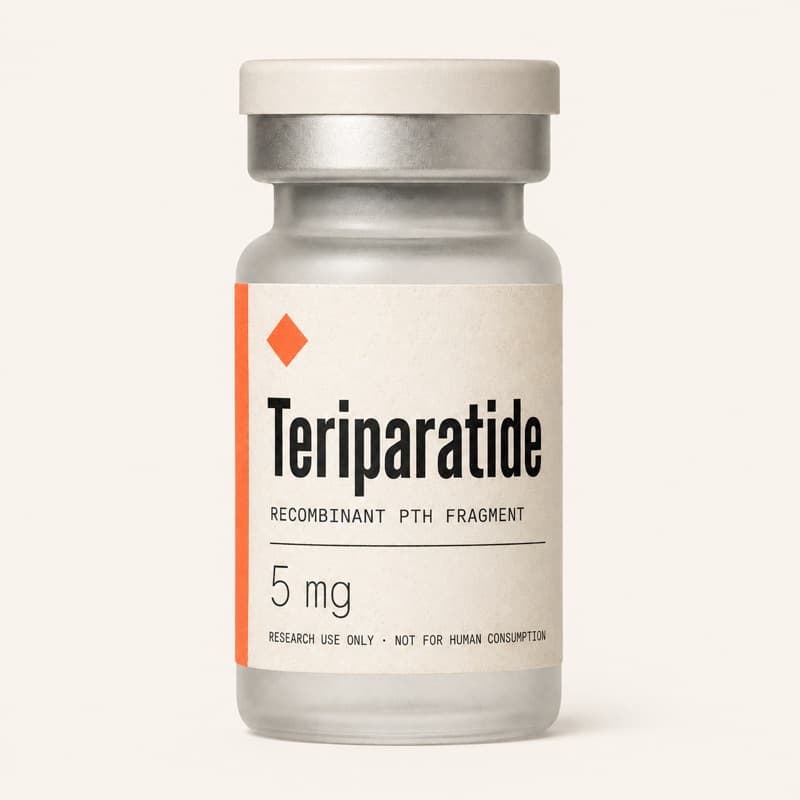
Teriparatide
PTH(1-34) · Bone-Building Anabolic Peptide
Anabolic bone-building agent with FDA approval, consisting of the first 34 amino acids of parathyroid hormone. Antiresorptive osteoporosis drugs slow bone loss; teriparatide instead stimulates new bone formation actively. Intermittent exposure is the key to the mechanism — continuous PTH drives resorption, whereas daily injections stimulate osteoblasts more than osteoclasts, and net bone formation results. Clinical trials show spine bone density up 8% and vertebral fractures down 65%.
Overview
Anabolic bone-building agent with FDA approval, consisting of the first 34 amino acids of parathyroid hormone. Antiresorptive osteoporosis drugs slow bone loss; teriparatide instead stimulates new bone formation actively. Intermittent exposure is the key to the mechanism — continuous PTH drives resorption, whereas daily injections stimulate osteoblasts more than osteoclasts, and net bone formation results. Clinical trials show spine bone density up 8% and vertebral fractures down 65%.
Binding is to PTH type 1 receptors — G-protein coupled receptors carried by osteoblasts, osteocytes, and renal tubular cells. PKA and PKC signaling pathways are activated in turn, and osteoblast activity is promoted. Dosed daily and intermittently, the peptide opens an 'anabolic window' in which formation of bone outpaces resorption. Expression of IGF-1 and FGF2 is upregulated, bone formation is stimulated on trabecular and cortical surfaces, and bone mineral density rises as osteoblasts are preferentially stimulated.
Research indications
What the compound has been studied for, grouped by body system. Effect size is the reported magnitude where it was measured — not a recommendation.
Carries FDA approval in women whose osteoporosis puts them at high fracture risk.
Carries FDA approval in men at high risk with primary or hypogonadal osteoporosis.
FDA approval extends to men and women whose osteoporosis follows sustained corticosteroid use.
Fracture healing and bone repair, accelerated: an area of research interest.
Under investigation in dental applications for regeneration of jawbone.
- Class
- Recombinant PTH fragment
- Research status
- Extensively studied
- Chain length
- 34 residues
- Molecular weight
- 4118 Da
- Half-life
- ~1 h
- Typical dose
- 20 µg daily (FDA-approved dose)
- Frequency
- Once daily at same time each day
- Cycle length
- Maximum 2 years lifetime treatment
- Storage
- Pen: 2-8°C refrigerated, do not freeze. Discard after 28 days
Molecular data
- Type
- Recombinant PTH fragment
- Molecular weight
- 4118 Da
- Chain length
- 34 residues
- Half-life
- 60 min
Levels in single-dose multiples. A shape, not a pharmacokinetic prediction.
Dosing reference
Doses reported in the literature and by suppliers. These are a record of what has been used in research — reference, never instruction.
| Context | Route | Amount | Frequency |
|---|---|---|---|
| Osteoporosis treatment | SubQ (thigh or abdomen) | 20 mcg | Once daily |
Interactions
To hold bone gains after teriparatide, antiresorptive agents are often needed. Sequential use is workable.
Calcium and vitamin D intake should be adequate over the course of teriparatide therapy.
Unrelated mechanisms; no interaction known.
Mechanisms differ; no interactions known.
What to expect
Safety
Mechanistic flags — properties of the pathway, not observed adverse events.
- Injection site reactions
- Nausea
- Headache
- Leg cramps
- Dizziness
- Joint pain
- Allergic reactions
- Bone pain that persists
- Hypercalcemia signs — confusion, fatigue, nausea
- Paget's disease of bone
- Prior skeletal radiation therapy
- History of skeletal malignancies
- Pre-existing hypercalcemia
- Pregnancy
- Metabolic bone diseases besides osteoporosis
Quality checklist
What to confirm before trusting a batch of research material. A verification aid — not an endorsement of any supplier.
- Third-party Certificate of AnalysisIndependent lab · dated · lot-matched.
- HPLC purity ≥ 98%Reverse-phase trace included.
- Mass-spec confirms 4118 g/molMALDI-TOF or ESI-MS.
- Counterion stated (acetate ≫ TFA)TFA salts can confound bioassays.
- Endotoxin / sterility statementRelevant once reconstituted.
- Lyophilised · cold-chain shippedStored −20 °C, shipped on ice.
- Labelled “research use only”No therapeutic or dosing claims.
Recorded signals for this compound · 9
- ✓Clear, colorless solution
- ✓Pharmaceutical grade (Forteo)
- ✓Intact pen device
- ✓Cold chain properly maintained
- !FDA oversight does not cover research-grade products
- !Potency may be affected by temperature excursions
- ×Visible particulates
- ×Exposure to freezing, or to high temperatures
- ×Solution cloudy or discolored
FAQ
What lies behind the 2-year limit on teriparatide, given how effectively it builds bone?
The cap traces to a theoretical osteosarcoma risk that rat studies observed under very high doses sustained over long periods. That risk has not appeared in human clinical trials, yet a lifetime limit of 2 years is maintained by the FDA as a precautionary measure. Past 2 years, the bone gains are maintained by antiresorptive therapy.
Does teriparatide reverse osteoporosis, or only slow bone loss?
Reversal: new bone is built, where antiresorptive drugs only slow the loss. Spine bone density rises 5–9% in clinical trials and fracture risk falls 65%, which makes the drug uniquely anabolic rather than protective.
Is teriparatide taken alongside calcium and vitamin D?
Yes — adequate intake of both is essential during therapy. Bone formation is stimulated by the peptide, and that calls for sufficient mineral substrate. Where calcium or vitamin D runs deficient, teriparatide's effects can be blunted and bone quality potentially impaired despite the density gains.
By what route does teriparatide open an 'anabolic window' for bone formation?
Daily intermittent PTH exposure stimulates osteoblasts (the bone-forming cells) more strongly than osteoclasts (which remove bone), and in that window formation outruns resorption. Continuous PTH does the reverse, causing net bone loss. Timing of the daily injection is critical to holding the anabolic advantage.