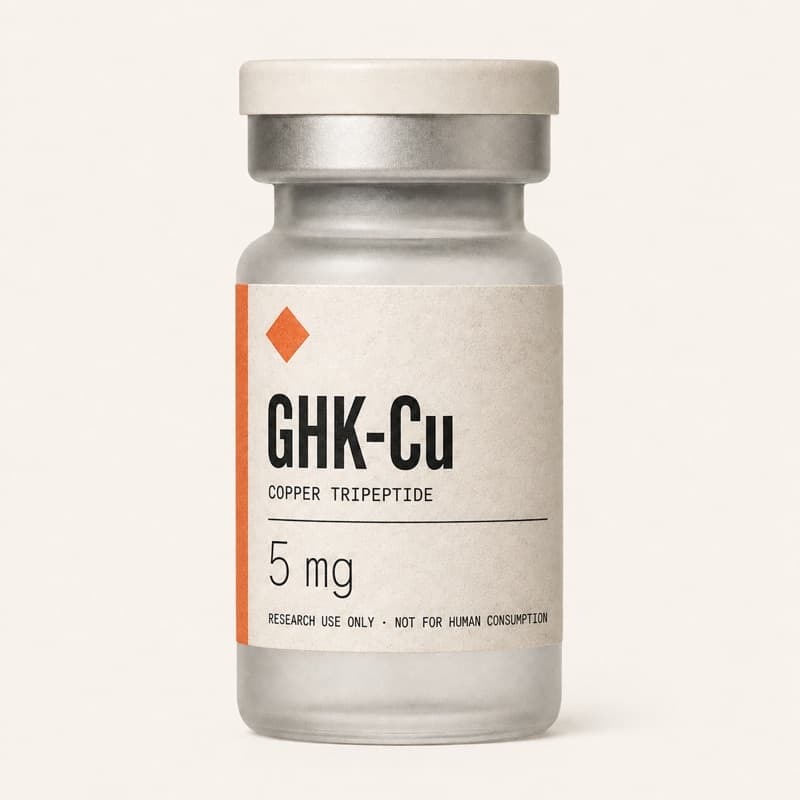
GHK-Cu
Copper Peptide · Skin Regeneration & Anti-Aging Compound
Copper tripeptide, naturally occurring, present in human plasma, saliva, and urine. It affects 31.2% of human genes, and its level drops significantly with age: roughly 200 ng/ml at age 20 against roughly 80 ng/ml at age 60. Skin regeneration, wound healing, and anti-aging properties are what it is known for.
Overview
Copper tripeptide, naturally occurring, present in human plasma, saliva, and urine. It affects 31.2% of human genes, and its level drops significantly with age: roughly 200 ng/ml at age 20 against roughly 80 ng/ml at age 60. Skin regeneration, wound healing, and anti-aging properties are what it is known for.
Skin layers are penetrated, fibroblasts activated, collagen and elastin synthesis stimulated, angiogenesis promoted, and inflammatory responses modulated. Enzyme cofactor activity in the tissue repair processes depends on the copper ion.
Research indications
What the compound has been studied for, grouped by body system. Effect size is the reported magnitude where it was measured — not a recommendation.
Hair follicles enlarge and the anagen (growth) phase runs longer.
Scalp circulation improves; inflammation falls.
Production of type I and III collagen rises by as much as 70% in human dermal fibroblasts.
Elastin synthesis is stimulated, which improves skin elasticity and resilience.
The protective barrier is strengthened and moisture retention improves.
Inflammatory cytokine production is regulated.
Tissue is protected against oxidative stress and damage.
- Class
- Copper tripeptide
- Research status
- Well studied
- Chain length
- 3 residues
- Molecular weight
- 404.96 Da
- Half-life
- ~1.25 h
- Typical dose
- 0.5–2% topical or 1–3 mg injectable
- Frequency
- 1–2 times daily
- Cycle length
- 8–16 weeks
- Storage
- Room temperature (topical) or 2-8°C (injectable)
Molecular data
- Type
- Copper tripeptide
- Molecular weight
- 404.96 Da
- Chain length
- 3 residues
- Half-life
- 75 min
GHKLevels in single-dose multiples. A shape, not a pharmacokinetic prediction.
Dosing reference
Doses reported in the literature and by suppliers. These are a record of what has been used in research — reference, never instruction.
| Context | Route | Amount | Frequency |
|---|---|---|---|
| Anti-aging skincare | Topical application | 0.5-1% cream | 1-2x daily |
| Hair growth stimulation | Scalp massage | 1-2% solution | 1x daily |
| Wound healing | Direct application | 1-2% gel | 2-3x daily |
| General skin health | Face and neck | 0.5% serum | 1x daily |
| Intensive repair | Targeted areas | 2% cream | 1x daily |
| Systemic anti-aging | SubQ | 1-2mg | 1x daily |
| Enhanced regeneration | SubQ | 2-3mg | 1-2x daily |
Interactions
Pathways for tissue healing and regeneration that complement.
Combined, wound healing and tissue repair both increase.
Melanin production is affected by each; caution applies to the combination.
Copper toxicity is a risk — combining with oral copper supplements is ruled out.
No interactions known.
Copper absorption and activity may be affected.
What to expect
Safety
Mechanistic flags — properties of the pathway, not observed adverse events.
- Increased photosensitivity
- Mild skin irritation at first, which usually resolves
- Allergic reactions such as rash, swelling, or difficulty breathing
- Severe irritation of the skin, burning, or persistent redness
- Atypical discoloration or staining of the skin
- Metallic taste that persists (injectable)
- Skin condition that worsens past 4–6 weeks
- Pregnancy or breastfeeding (injectable)
- Known sensitivity to copper, or Wilson's disease
- Active infection of the skin at the application site
Quality checklist
What to confirm before trusting a batch of research material. A verification aid — not an endorsement of any supplier.
- Third-party Certificate of AnalysisIndependent lab · dated · lot-matched.
- HPLC purity ≥ 98%Reverse-phase trace included.
- Mass-spec confirms 404.96 g/molMALDI-TOF or ESI-MS.
- Counterion stated (acetate ≫ TFA)TFA salts can confound bioassays.
- Endotoxin / sterility statementRelevant once reconstituted.
- Lyophilised · cold-chain shippedStored −20 °C, shipped on ice.
- Labelled “research use only”No therapeutic or dosing claims.
Recorded signals for this compound · 8
- ✓Smooth texture, non-gritty
- ✓A light blue tint, from the copper content
- ✓A stable formulation, free of separation or crystallization
- ✓Professional packaging that provides UV protection
- !Within the blue spectrum, slight color variation is acceptable
- ×Discoloration to green or dark (oxidation/contamination)
- ×Texture that is grainy (poor formulation or crystallization)
- ×Components separating or settling
FAQ
What is the scale of the age-related GHK-Cu decline, and its consequence?
The peptide measures ~200 ng/ml around age 20 and ~80 ng/ml around age 60 — a steep drop of 60%. GHK-Cu affects 31.2% of human genes, so that decline is a significant contributor to aging phenotypes. Supplementation aims at restoring youthful peptide levels, and possibly at reversing gene expression changes that come with age.
Does topical GHK-Cu work, or does it have to be injected?
For skin applications the topical form — creams and serums at 0.5–2% — is effective, with visible improvement in collagen, elastin, fine lines, and skin texture. Injectable forms at 1–3 mg SubQ deliver systemic benefit but hold no FDA approval. Skin-focused anti-aging is served by the topical route, which is convenient and well-researched; systemic effects favor injection, which is more bioavailable.
Can topical GHK-Cu be combined safely with retinoids?
Combination with retinoids is possible, though skin sensitivity and irritation may increase, so introduction has to be careful. The approach starts at a lower GHK-Cu concentration (0.5%) and alternates the retinoid, or separates the two across different days. Patch testing is essential before the combination goes on the full face.
When do visible skin improvements appear on GHK-Cu?
The topical timeline runs: hydration improves over weeks 1–2, fine lines reduce by weeks 3–4, elasticity improves noticeably by weeks 6–8, and anti-aging effects peak by weeks 8–12. Hair growth lags behind that — initial follicle stimulation effects typically take 6–12 weeks.
References
- 1The human tripeptide GHK-Cu in prevention of oxidative stress and degenerative conditions of aging: implications for cognitive healthPickart, L., Vasquez-Soltero, J.M., Margolina, A. · Oxidative Medicine and Cellular Longevity · 2012
GHK possesses antioxidant, anti-inflammatory, and wound healing properties; regulates genes critical for neuronal development and maintenance; implications for cognitive health in aging.
ReviewPubMed 22666519 ↗ - 2GHK Peptide as a Natural Modulator of Multiple Cellular Pathways in Skin RegenerationPickart, L., Vasquez-Soltero, J.M., Margolina, A. · BioMed Research International · 2015
GHK-Cu stimulates synthesis of collagen, dermatan sulfate, chondroitin sulfate, and decorin; tightens loose skin, improves elasticity, density, and firmness; reduces fine lines, wrinkles, and photodamage.
ReviewPubMed 26236730 ↗ - 3Regenerative and Protective Actions of the GHK-Cu Peptide in the Light of the New Gene DataPickart, L., Margolina, A. · International Journal of Molecular Sciences · 2018
Broad regenerative potential demonstrated across skin, lung, bone, liver, and stomach tissue; cell protective actions including anti-cancer, anti-inflammatory, DNA repair, and proteasome activation via gene modulation.
ReviewPubMed 29986520 ↗ - 4Tripeptides GHK and GHK-Cu-modified silver nanoparticles for enhanced antibacterial and wound healing activitiesIslam, R., Bilal, H., Wang, X., Zhang, L. · Colloids and Surfaces B: Biointerfaces · 2024
GHK and GHK-Cu modified silver nanoparticles demonstrated enhanced antibacterial activity and accelerated wound healing through improved delivery and bioactivity.
Review · inferredPubMed 38387323 ↗ - 5Topically applied GHK as an anti-wrinkle peptide: Advantages, problems and prospectiveMortazavi, S.M., Mohammadi Vadoud, S.A., Moghimi, H.R. · BioImpacts · 2024
Comprehensive review confirming GHK and Pal-GHK effectiveness as anti-wrinkle ingredients; skin permeability can be enhanced via metal complexation, chemical modification, and cell-penetrating peptides.
ReviewPubMed 39963574 ↗
GHK-Cu produced therapeutic benefit in an experimental model of colitis, extending its documented activity from skin into gastrointestinal inflammation.
This review supports the anti-wrinkle activity of topically applied GHK at the cellular level but identifies skin penetration as the limiting factor, surveying enhancement approaches such as microneedles and nanocarriers.