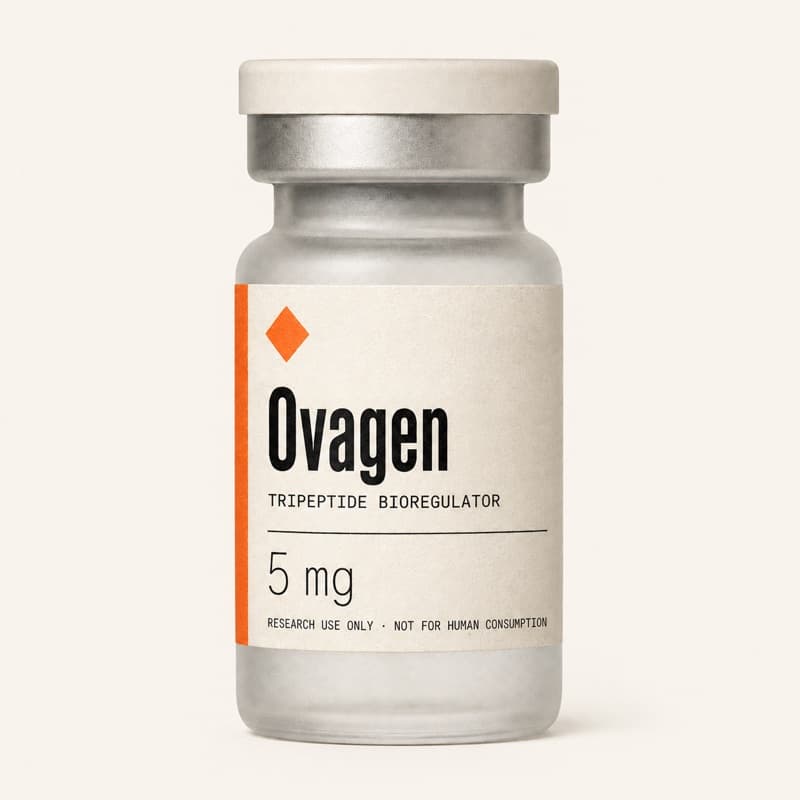
Ovagen
EDL Tripeptide · Liver & GI Bioregulator
Tripeptide bioregulator (EDL) of the Khavinson series, acting mainly on the gastrointestinal tract and the liver. Dr. Vladimir Khavinson developed it at the St. Petersburg Institute of Bioregulation and Gerontology. Long-term liver fibrosis is reduced, and the GI mucosal layer is shielded against chemotherapy, environmental toxins, and antibiotics. Like the other bioregulators it passes through cell and nuclear membranes, regulating DNA transcription patterns directly, with effects specific to tissue.
Overview
Tripeptide bioregulator (EDL) of the Khavinson series, acting mainly on the gastrointestinal tract and the liver. Dr. Vladimir Khavinson developed it at the St. Petersburg Institute of Bioregulation and Gerontology. Long-term liver fibrosis is reduced, and the GI mucosal layer is shielded against chemotherapy, environmental toxins, and antibiotics. Like the other bioregulators it passes through cell and nuclear membranes, regulating DNA transcription patterns directly, with effects specific to tissue.
Epigenetic regulation is the mechanism: Ovagen crosses cell and nuclear membranes to act directly on DNA structure and transcription patterns. Entry into the cell runs through POT family transporters (PEPT1, PEPT2), which handle di- and tripeptides specifically — hence the precision of its tissue targeting. Effects are tissue-specific to liver and GI tract, with fibrosis reduced and mucosal integrity protected.
Research indications
What the compound has been studied for, grouped by body system. Effect size is the reported magnitude where it was measured — not a recommendation.
Fibrosis development in liver tissue falls over the long term.
Regulation of gene expression protects the liver.
Assists in protecting the GI mucosal layer against various insults.
The GI tract may be protected against antibiotic-induced damage.
Protection extends to environmental toxin effects on the GI tract.
Bioregulation addresses age-related changes in the liver.
GI tract function is supported through aging.
- Class
- Tripeptide bioregulator
- Research status
- Moderate research
- Chain length
- 3 residues
- Molecular weight
- 375 Da
- Typical dose
- 10–20 mg daily
- Frequency
- Daily for 10–20 days per cycle
- Cycle length
- 10–20 days
- Storage
- Capsules at room temperature; reconstituted injectable at 2-8°C refrigerated
Molecular data
- Type
- Tripeptide bioregulator
- Molecular weight
- 375 Da
- Chain length
- 3 residues
EDLDosing reference
Doses reported in the literature and by suppliers. These are a record of what has been used in research — reference, never instruction.
| Context | Route | Amount | Frequency |
|---|---|---|---|
| Standard protocol | Oral capsules | 10-20 mg | Daily for 10-20 days |
| Maintenance | Oral capsules | 10 mg | 2-3 cycles yearly |
| Research protocol | IM or SubQ | 10 mg | Daily for 10 days |
Interactions
Liver bioregulators that complement, sequences and mechanisms differing.
Liver health is supported by both, along different pathways.
Comprehensive Khavinson anti-aging protocols often include both.
Each supports GI health, by a different mechanism.
What to expect
Safety
Mechanistic flags — properties of the pathway, not observed adverse events.
- Tolerated well overall
- Side effects reported as minimal
- Allergic reactions
- Unusual symptoms, GI or liver
- Known hypersensitivity
- Pregnancy or breastfeeding
- Liver emergencies in progress — seek medical care
Quality checklist
What to confirm before trusting a batch of research material. A verification aid — not an endorsement of any supplier.
- Third-party Certificate of AnalysisIndependent lab · dated · lot-matched.
- HPLC purity ≥ 98%Reverse-phase trace included.
- Mass-spec confirms 375 g/molMALDI-TOF or ESI-MS.
- Counterion stated (acetate ≫ TFA)TFA salts can confound bioassays.
- Endotoxin / sterility statementRelevant once reconstituted.
- Lyophilised · cold-chain shippedStored −20 °C, shipped on ice.
- Labelled “research use only”No therapeutic or dosing claims.
Recorded signals for this compound · 8
- ✓White powder or capsules
- ✓If reconstituted, a clear solution
- ✓Packaging and labeling done properly
- !Not to be confused with the FSH derivative sharing this name
- !Source or purity unknown
- ×Discoloration
- ×Unusual odor
- ×Damaged packaging
FAQ
How does Ovagen protect the gut from antibiotic damage?
Ovagen (the EDL tripeptide) protects the GI mucosal layer against antibiotic-induced damage. Transport by PEPT1/PEPT2 carries the peptide directly to gut tissue, where gene expression is regulated to strengthen mucosal integrity. Taken during and after a course of antibiotics, it may help preserve the microbiome.
Does Ovagen combine with other Khavinson bioregulators?
Yes. Synergy holds with Livagen, Epitalon and other Khavinson peptides, which target different tissues. Multiple bioregulators run together in many anti-aging protocols — Ovagen for liver and GI, Epitalon for telomeres, and so on. Recommended cycling protocols are followed to avoid overstimulation.
Over what period does Ovagen reduce liver fibrosis?
Results are cumulative. Gene expression changes start immediately within a 10–20 day cycle, while visible improvement in liver fibrosis arrives over weeks to months across periodic cycles. Maintenance runs 2–3 cycles yearly, which implies ongoing use for fibrosis reduction over the long term.
Capsule or injection — which form of Ovagen is better?
Both routes work. Oral capsules are the more convenient for daily dosing and store at room temperature. Injectable forms absorb directly but need refrigeration and reconstitution. The choice runs between convenience (capsules) and guaranteed absorption (injection).