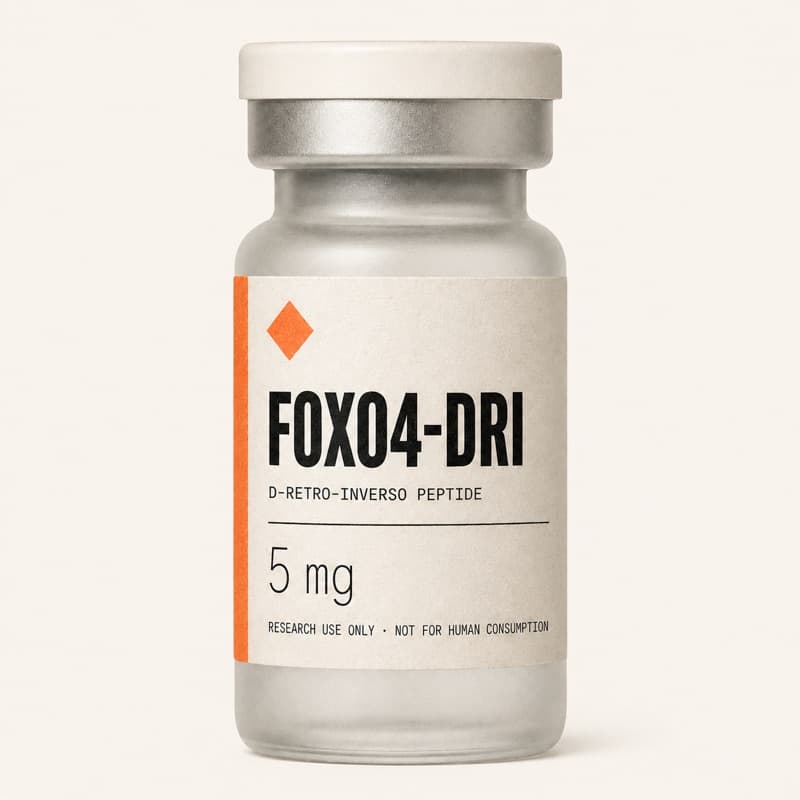
FOXO4-DRI
Senolytic Peptide · p53-FOXO4 Disruptor
Senolytic peptide built to clear senescent 'zombie' cells selectively, which accumulate with age and contribute to tissue dysfunction. The route is disruption of the FOXO4-p53 interaction that keeps those cells alive. Its 'DRI' modification (D-retro-inverso) uses reversed D-amino acids, raising potency and stability. In aged mice, preclinical research reports fur density, fitness, and organ function restored.
Overview
Senolytic peptide built to clear senescent 'zombie' cells selectively, which accumulate with age and contribute to tissue dysfunction. The route is disruption of the FOXO4-p53 interaction that keeps those cells alive. Its 'DRI' modification (D-retro-inverso) uses reversed D-amino acids, raising potency and stability. In aged mice, preclinical research reports fur density, fitness, and organ function restored.
Binding to p53 is contested: FOXO4-DRI competes with FOXO4 and breaks the protective interaction the two maintain inside senescent cells. p53 is then excluded from the nucleus, and cell-intrinsic apoptosis — programmed cell death — follows. Selectivity is the crux here. The FOXO4-p53 interaction is a vulnerability specific to senescent cells, and FOXO4 is expressed only minimally in healthy tissue, so functional cells are left largely unharmed.
Research indications
What the compound has been studied for, grouped by body system. Effect size is the reported magnitude where it was measured — not a recommendation.
Apoptosis is induced selectively in senescent cells, and healthy tissue is spared.
In naturally aged animal models, tissue homeostasis and function are restored.
Aged mice gained fitness and mobility, and their physical appearance improved.
In mouse models both aged and fast-aging, renal function was restored.
The testicular microenvironment and testosterone secretion both improved in aged mice.
Senescent chondrocytes are cleared, with possible benefit to joint health.
Clearing treatment-induced senescent cells neutralizes doxorubicin-induced chemotoxicity.
- Class
- D-retro-inverso peptide
- Research status
- Emerging
- Chain length
- 45 residues
- Molecular weight
- 4800 Da
- Typical dose
- 25–33 mg per injection (based on mouse study 5 mg/kg)
- Frequency
- 3 doses total, every other day (days 1, 3, 5)
- Cycle length
- 6 days (3 doses total = 75–100 mg per treatment cycle)
- Storage
- Lyophilized: -20°C frozen; Reconstituted: 2-8°C refrigerated, use immediately or within short term; avoid freeze-thaw cycles
Molecular data
- Type
- D-retro-inverso peptide
- Molecular weight
- 4800 Da
- Chain length
- 45 residues
Dosing reference
Doses reported in the literature and by suppliers. These are a record of what has been used in research — reference, never instruction.
| Context | Route | Amount | Frequency |
|---|---|---|---|
| Standard senolytic protocol | SubQ or IV | 25-33 mg | 3 doses, every other day (6 days total) |
| Mouse study equivalent | IP (original study) | 5 mg/kg (translates to ~25 mg for 60kg human) | 3 doses on alternate days |
Interactions
Senescent cell clearance may be additive where other senolytics are involved.
Senolytic mechanisms differ, and sequential use is one option.
The mechanisms differ: healthy cells are protected by Humanin, senescent ones cleared by FOXO4-DRI.
What to expect
Safety
Mechanistic flags — properties of the pathway, not observed adverse events.
- Available human data is limited
- Tolerated well overall in animal studies
- Allergic reactions
- Unexpected adverse effects
- Pregnancy or breastfeeding
- Human use is not yet approved
- Safety in immunocompromised individuals is unknown
- Active cancer; theoretical, with oncologist consultation indicated
Quality checklist
What to confirm before trusting a batch of research material. A verification aid — not an endorsement of any supplier.
- Third-party Certificate of AnalysisIndependent lab · dated · lot-matched.
- HPLC purity ≥ 98%Reverse-phase trace included.
- Mass-spec confirms 4800 g/molMALDI-TOF or ESI-MS.
- Counterion stated (acetate ≫ TFA)TFA salts can confound bioassays.
- Endotoxin / sterility statementRelevant once reconstituted.
- Lyophilised · cold-chain shippedStored −20 °C, shipped on ice.
- Labelled “research use only”No therapeutic or dosing claims.
Recorded signals for this compound · 8
- ✓White lyophilized powder
- ✓High purity (>95%)
- ✓Storage at -20°C or colder
- ✓Solution clear once reconstituted
- !Potency may be affected by temperature excursions
- ×Discoloration
- ×Repeated freeze-thaw cycles
- ×Extended periods at room temperature
FAQ
Where does FOXO4-DRI depart from other anti-aging approaches?
It is the first senolytic peptide to selectively eliminate the 'zombie' senescent cells that accumulate with age; most anti-aging approaches aim instead at symptoms or at regeneration. Apoptosis is triggered by disrupting the FOXO4-p53 interaction inside senescent cells, so damaged cells are removed rather than healthy ones merely supported.
Is FOXO4-DRI safe with a history of cancer?
Modulation of the p53 pathway makes active cancer a theoretical contraindication, though the mechanism — disruption of the FOXO4-p53 interaction — is not that of therapies acting on healthy p53. A cancer history calls for careful medical consideration. Consulting an oncologist beforehand is what most sources recommend, active malignancy above all.
How does the mouse dosing of FOXO4-DRI translate to humans?
In the original 2017 mouse study the dose was 5 mg/kg IP, given 3 times on alternate days. Scaled to a 60 kg human that comes to roughly 25 mg per dose, taken as 3 doses every other day, or 75–100 mg across a cycle. Human pharmacokinetics differ significantly from those of mice, which leaves any such translation speculative.
Which changes were visible in aged mice given FOXO4-DRI?
Fur density was restored in the treated aged mice, physical fitness improved, organ function — the kidneys in particular — was enhanced, and testosterone levels improved. Improvements on that scale suggest senescent cell clearance genuinely restored tissue homeostasis, while any human result stays theoretical.
References
- 1An Example of Senolytic Self-Experimentation with FOXO4-DRIFight Aging! · 2017
Self-experimenters have translated the mouse protocol to ~25 mg per injection subcutaneously, 3 doses every other day, for 75-100 mg total per treatment cycle.
Animal in vivo · inferredSource ↗