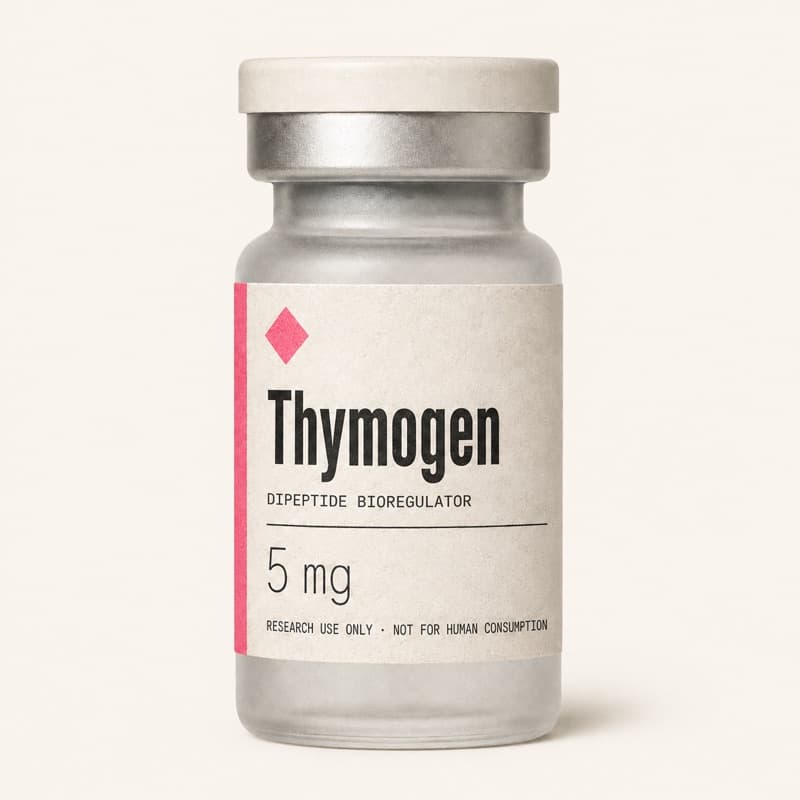
Thymogen
EW Dipeptide · Thymus Immune Bioregulator
Khavinson bioregulator made of glutamic acid and tryptophan — the EW dipeptide — first isolated in the late 1980s from Thymalin, an extract of calf thymus. Professor Vladimir Khavinson developed it; Russia has had it registered since 1990, in an injectable solution, a nasal spray, and a topical cream. Immunity is modulated on both the humoral and the cellular side, T-cell differentiation is activated, and research studies have shown antitumor and geroprotective (anti-aging) activities.
Overview
Khavinson bioregulator made of glutamic acid and tryptophan — the EW dipeptide — first isolated in the late 1980s from Thymalin, an extract of calf thymus. Professor Vladimir Khavinson developed it; Russia has had it registered since 1990, in an injectable solution, a nasal spray, and a topical cream. Immunity is modulated on both the humoral and the cellular side, T-cell differentiation is activated, and research studies have shown antitumor and geroprotective (anti-aging) activities.
Several immunomodulatory mechanisms are in play: (1) T-cell differentiation is activated, along with T-cell recognition of peptide-MHC complexes, (2) the intracellular composition of cyclic nucleotides is changed, (3) neutrophilic chemotaxis and phagocytosis are activated, (4) T-lymphocyte concentrations and ratios are normalized (CD3+, CD4+, CD8+), (5) immunoglobulin production is stimulated (IgA, IgG, IgE, IgM), and (6) expression of lymphocyte differentiation receptors is enhanced. A specific interaction with the AACG DNA sequence, affecting gene expression, is suggested by research. Distribution is rapid — thymus, lymph nodes, liver, adrenals, kidneys.
Research indications
What the compound has been studied for, grouped by body system. Effect size is the reported magnitude where it was measured — not a recommendation.
T-cell differentiation is activated; CD3+, CD4+ and CD8+ populations normalize.
Antibody production is stimulated across IgA, IgG, IgE and IgM.
Immune support as a route to better surgical outcomes has been studied.
Humoral and cellular immune responses are both modulated, which balances immunity.
Aging research has demonstrated geroprotector activity.
Animal models pairing it with pineal peptides showed significant increases in mean lifespan.
Spontaneous carcinogenesis is inhibited, and research shows robust antitumor effects.
Russian studies covered regulation of the immune response in oncology patients.
Cardiovascular applications draw research interest.
Investigated in diabetes for its immune and metabolic aspects.
- Class
- Dipeptide bioregulator
- Research status
- Well studied
- Chain length
- 2 residues
- Molecular weight
- 333 Da
- Typical dose
- 10–20 mg daily during cycle
- Frequency
- Daily for 10–20 days, then break
- Cycle length
- 10–20 day cycles (bioregulator protocol)
- Storage
- Injectable: 2-8°C. Nasal/topical: per product directions. Powder: room temp
Molecular data
- Type
- Dipeptide bioregulator
- Molecular weight
- 333 Da
- Chain length
- 2 residues
Dosing reference
Doses reported in the literature and by suppliers. These are a record of what has been used in research — reference, never instruction.
| Context | Route | Amount | Frequency |
|---|---|---|---|
| Standard immune support | IM or SubQ | 10-20 mg | Daily for 10-20 days |
| Maintenance protocol | IM or SubQ | 20 mg | 2-3 cycles per year |
| Nasal administration | Intranasal spray | As per product directions | Daily during cycle |
| Topical use | Topical cream | Apply thin layer | As directed |
Interactions
Research on the combination showed lifespan increasing significantly, with robust antitumor activity.
Isolated from Thymalin originally, Thymogen shares complementary thymus-supporting mechanisms with it.
Two Khavinson thymus dipeptides, frequently paired in comprehensive immune protocols.
Thymic peptides that differ, with immune mechanisms that complement.
Structures and mechanisms differ; the two can be used together.
What to expect
Safety
Mechanistic flags — properties of the pathway, not observed adverse events.
- Mild reactions where injected
- Tolerated well overall
- Clinical use reports minimal side effects
- Signs of allergic reaction
- Unusual immune symptoms
- Severe reactions at the injection site
- Pregnancy or breastfeeding
- Recipients of an organ transplant, on immunosuppression
- Active autoimmune disease, where caution applies
- Hypersensitivity known to any component amino acid
Quality checklist
What to confirm before trusting a batch of research material. A verification aid — not an endorsement of any supplier.
- Third-party Certificate of AnalysisIndependent lab · dated · lot-matched.
- HPLC purity ≥ 98%Reverse-phase trace included.
- Mass-spec confirms 333 g/molMALDI-TOF or ESI-MS.
- Counterion stated (acetate ≫ TFA)TFA salts can confound bioassays.
- Endotoxin / sterility statementRelevant once reconstituted.
- Lyophilised · cold-chain shippedStored −20 °C, shipped on ice.
- Labelled “research use only”No therapeutic or dosing claims.
Recorded signals for this compound · 8
- ✓Packaging and labeling done properly
- ✓Lyophilized powder, white to off-white
- ✓Solution clear once reconstituted
- ✓A certificate of analysis verifying purity
- !Source unknown, or purity never verified
- ×Powder discolored
- ×Solution cloudy or with particles
- ×Packaging damaged, or the seal broken
FAQ
How does Thymogen (EW dipeptide) differ from Thymalin (extract mixture)?
Thymogen is one pure dipeptide, Glu-Trp, isolated out of Thymalin extracts. Thymalin is the whole mixture, holding multiple peptides (KE, EW, EDP). Standardized dosing and stability come from Thymogen; from Thymalin, broader synergistic effects. The two are compatible, and are sometimes used together.
Is Thymogen taken orally, or does it have to be injected?
Several forms exist: capsules taken orally, an injectable solution, a nasal spray, and a topical cream — all of them registered in Russia. Its small size as a dipeptide allows reasonable oral bioavailability by capsule, more convenient than bioregulators available only as injections.
Thymogen against Epitalon for anti-aging and lifespan extension: how do they compare?
Both are Khavinson anti-aging peptides aimed at different targets. Immune rejuvenation and tumor suppression are Thymogen's focus; pineal and endocrine aging are Epitalon's. Research models of combined use showed robust lifespan increases and antitumor activity, so the two are synergistic rather than redundant.
References
- 1Natural and synthetic thymic peptides as therapeutics for immune dysfunctionJournal of Immunopharmacology · 1997
Review of thymic peptide therapeutics including Thymogen for immune modulation.
Review · inferredPubMed 9637345 ↗ - 2Immunomodulatory synthetic dipeptide L-Glu-L-Trp slows down aging and inhibits spontaneous carcinogenesis in ratsKhavinson VKh, Morozov VG · Biogerontology · 2001
Thymogen demonstrated geroprotector activity and inhibited spontaneous carcinogenesis in aging rat models.
Animal in vivoPubMed 11707921 ↗