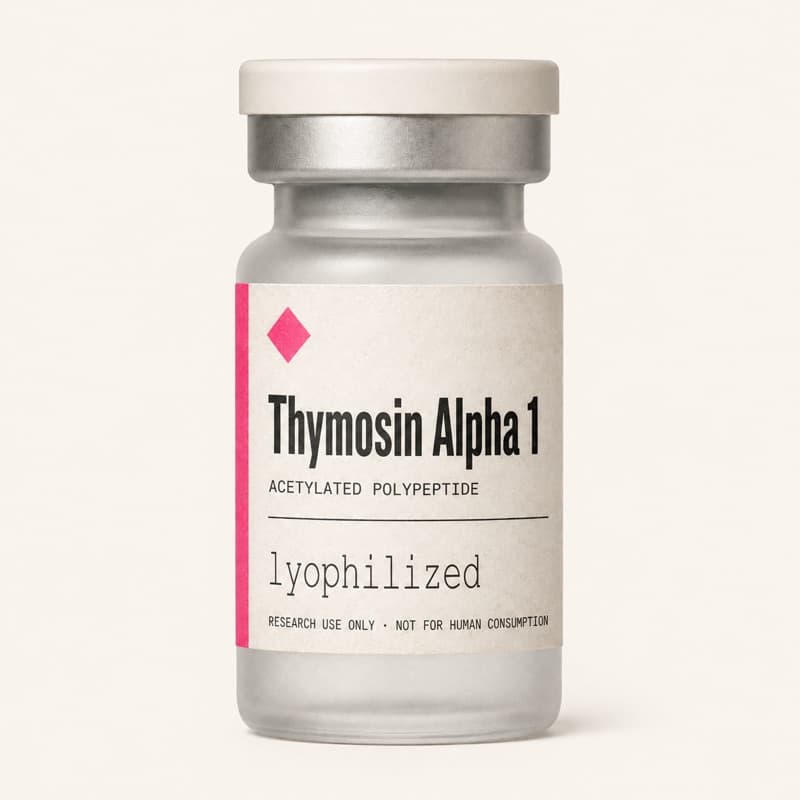
Thymosin Alpha 1
Synthetic Thymic Hormone · Immune System Modulator
Synthetic 28-amino acid peptide identical to the thymic hormone that occurs naturally. More than 11,000 patients across upwards of 30 clinical trials have been studied, with serious adverse events under 1%. Immune modulation is the approved use, in more than 35 countries.
Overview
Synthetic 28-amino acid peptide identical to the thymic hormone that occurs naturally. More than 11,000 patients across upwards of 30 clinical trials have been studied, with serious adverse events under 1%. Immune modulation is the approved use, in more than 35 countries.
TLR pathways are activated, T-cell maturation enhanced, NK cells stimulated, and dendritic cell function modulated, all by way of the systemic circulation. By the injectable route bioavailability reaches 90–95%, and the peak arrives at 2 hours.
Research indications
What the compound has been studied for, grouped by body system. Effect size is the reported magnitude where it was measured — not a recommendation.
Holds FDA orphan designation in DiGeorge syndrome; T-cell function is restored.
CD4+ counts are restored and opportunistic infections reduced.
Elderly patients and those on hemodialysis showed improved antibody responses (H1N1, COVID-19).
The pro-inflammatory cytokines TNF-α, IL-1β and IL-6 fall 40–60%.
Antiviral efficacy is enhanced in combination with interferon.
Aids the management of inflammatory autoimmune conditions.
Immune function is restored following surgical stress.
Immune suppression arising from intense training is managed.
Thymus gland function is supported as age advances.
In elderly populations, age-related immune decline is delayed.
- Class
- Acetylated polypeptide
- Research status
- Well studied
- Chain length
- 28 residues
- Molecular weight
- 3108 Da
- Half-life
- ~2 h
- Typical dose
- 1.6 mg per injection (standard dose across all protocols)
- Frequency
- Twice weekly
- Administration
- Subcutaneous injection
- Cycle length
- 6 months continuous for therapeutic protocols
- Storage
- Use immediately after reconstitution or refrigerate up to 2 hours
Molecular data
- Type
- Acetylated polypeptide
- Molecular weight
- 3108 Da
- Chain length
- 28 residues
- Half-life
- 120 min
Levels in single-dose multiples. A shape, not a pharmacokinetic prediction.
Dosing reference
Doses reported in the literature and by suppliers. These are a record of what has been used in research — reference, never instruction.
| Context | Route | Amount | Frequency |
|---|---|---|---|
| Standard immune support | SubQ | 1.6mg | 2x weekly |
| Acute conditions (sepsis) | SubQ/IM | 1.6mg | 2x daily for 5 days, then daily |
| Cancer/hepatitis support | SubQ | 1.6mg | 2x weekly |
| Maintenance/prevention | SubQ | 1.6mg | 2x weekly |
| General support | Nasal spray | 500mcg per nostril | 2x daily |
| Enhanced support | Nasal spray | 1000mcg per nostril | 2x daily |
| Maintenance | Nasal spray | 500mcg per nostril | 1x daily |
Interactions
Contraindicated in transplant patients: the graft rejection risk is fatal.
Antagonism at the pharmacodynamic level is possible.
In the treatment of hepatitis, antiviral efficacy rises.
Immunogenicity of vaccines rises.
Offers protection from bone marrow damage.
What to expect
Safety
Mechanistic flags — properties of the pathway, not observed adverse events.
- Mild reactions where injected (<10% incidence)
- Tolerated well in general, with an exceptional safety record
- Unusual immune system hyperactivity
- Injection-site reactions that persist, or signs of an infection
- In transplant recipients, signs of graft rejection
- Severe allergic reactions (rare)
- Pregnancy and breastfeeding
- Organ transplant recipients, where graft rejection is a risk
Quality checklist
What to confirm before trusting a batch of research material. A verification aid — not an endorsement of any supplier.
- Third-party Certificate of AnalysisIndependent lab · dated · lot-matched.
- HPLC purity ≥ 98%Reverse-phase trace included.
- Mass-spec confirms 3108 g/molMALDI-TOF or ESI-MS.
- Counterion stated (acetate ≫ TFA)TFA salts can confound bioassays.
- Endotoxin / sterility statementRelevant once reconstituted.
- Lyophilised · cold-chain shippedStored −20 °C, shipped on ice.
- Labelled “research use only”No therapeutic or dosing claims.
Recorded signals for this compound · 7
- ✓Lyophilized powder, white and fluffy, filling the bottom of the vial
- ✓Solution crystal clear once reconstituted, with no particles or cloudiness
- ✓Pharmaceutical labeling done professionally, carrying batch numbers and expiration
- !Powder compacted slightly in shipping — acceptable where it dissolves cleanly
- ×Powder yellow, brown, or collapsed — degradation from heat or moisture
- ×Cloudiness or particles that persist after reconstitution
- ×Sourcing that is not professional, or labeling that is unclear
FAQ
Does Thymosin Alpha-1 pair with coronavirus vaccines to raise protection?
Yes — antibody responses to vaccines are enhanced in elderly and immunocompromised patients. Improved vaccine immunogenicity under co-administration is shown in clinical trials, which is particularly relevant for high-risk groups seeking enhanced vaccine protection.
In COVID-19, does Thymosin Alpha-1 do more than reduce symptoms?
A clinical trial found mortality in severe COVID-19 significantly reduced (11.11% against 30% untreated, P=0.044), by way of restored CD4+ and CD8+ T-cell numbers and reversal of T-cell exhaustion. The route is immune restoration rather than direct antiviral activity.
With such an extensive body of study behind it, why does Thymosin Alpha-1 remain less popular than other immune peptides?
Commercial availability is limited, even with 11,000+ patients across 30+ trials and excellent safety — serious adverse events under 1%. FDA approval does not extend to most indications; only DiGeorge syndrome carries orphan status. Prescription access is therefore difficult anywhere outside research settings or particular countries.
Does intranasal Thymosin Alpha-1 match the injectable route?
Bioavailability is 90–95% by injection, against 40–60% for nasal spray. The injectable route is the primary one studied by the FDA, and carries most of the clinical validation. Nasal spray may serve local immune effects but requires compounding pharmacy preparation and shows lower systemic absorption; maximum efficacy comes from injection.
References
- 1Thymosin Alpha 1: A Historical OverviewGaraci E · Annals of the New York Academy of Sciences · 2007
Comprehensive overview of thymosin alpha 1 from discovery to clinical application. Evidence for combined treatments with interferon or IL-2 restoring immune responses depressed by tumor growth and/or cytostatic drugs.
Review · inferredPubMed 17567941 ↗ - 2Thymosin Alpha 1 Reduces the Mortality of Severe Coronavirus Disease 2019 by Restoration of Lymphocytopenia and Reversion of Exhausted T CellsLiu Y, Pang Y, Hu Z, et al. · Clinical Infectious Diseases · 2020
Mortality significantly reduced in severe COVID-19: 11.11% with thymosin alpha 1 vs 30.00% untreated (P=0.044). Restored CD4+ and CD8+ T-cell numbers and reversed T-cell exhaustion markers PD-1 and Tim-3.
Review · inferredPubMed 32442287 ↗ - 3Comprehensive Review of the Safety and Efficacy of Thymosin Alpha 1 in Human Clinical TrialsJohnson EK, et al. · Expert Opinion on Drug Safety · 2024
Narrative review of 11,000+ patients across 30+ clinical trials. Exceptional safety profile with <1% serious adverse events. Applications in COVID-19, autoimmune conditions, hepatitis, and cancer.
ReviewPubMed 38308608 ↗ - 4The Efficacy and Safety of Thymosin Alpha 1 for Sepsis (TESTS): Multicentre, Double-Blinded, Randomised, Placebo-Controlled, Phase 3 TrialLiu J, Li J, He L, et al. · BMJ · 2025
1,106 adults with sepsis across 22 centres. 28-day mortality: 23.4% thymosin alpha 1 vs 24.1% placebo (HR 0.99, P=0.93). No overall benefit, but prespecified subgroup analysis showed potential benefit in elderly and diabetic patients.
Human RCTPubMed 39814420 ↗
Thymosin alpha 1 reversed the M2 polarisation of tumour-associated macrophages induced by oncolytic adenovirus, shifting them to an antitumoral state and altering the tumour microenvironment in favour of antitumour immunity.
Thymosin alpha 1 was added to concurrent chemoradiotherapy and consolidative immunotherapy in unresectable, locally advanced NSCLC; the preliminary analysis points to a strengthened immune response.