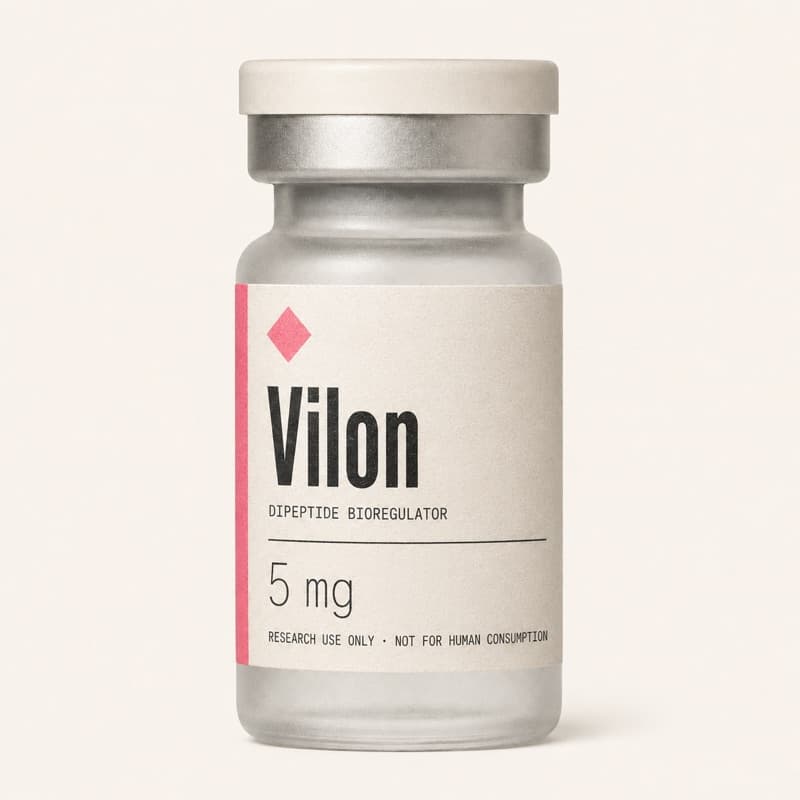
Vilon
KE Dipeptide · Thymus Immune Bioregulator
Khavinson bioregulator dipeptide (KE) of lysine and glutamic acid, isolated originally from thymus gland extracts. Professor Vladimir Khavinson developed it at the St. Petersburg Institute of Bioregulation and Gerontology; it works as a molecular signaling compound, restoring normal gene expression and protein synthesis in immune and epithelial cells. Animal studies record mean lifespan raised by 20–40% and tumor development suppressed.
Overview
Khavinson bioregulator dipeptide (KE) of lysine and glutamic acid, isolated originally from thymus gland extracts. Professor Vladimir Khavinson developed it at the St. Petersburg Institute of Bioregulation and Gerontology; it works as a molecular signaling compound, restoring normal gene expression and protein synthesis in immune and epithelial cells. Animal studies record mean lifespan raised by 20–40% and tumor development suppressed.
The mechanism is epigenetic modulation, with chromatin structure and gene expression in immune cells restored. Thymocyte proliferation is stimulated, T-helper cells are activated, and the proliferative index in thymus tissue rises — from 26% to 37% across studies. Tyrosine phosphorylation of mitogen-activated cytoplasmic kinases is modulated, and aged immune systems are rejuvenated as proper gene expression patterns return.
Research indications
What the compound has been studied for, grouped by body system. Effect size is the reported magnitude where it was measured — not a recommendation.
Thymocyte proliferation is stimulated and thymic lobules enlarge.
T-helper cells are activated; the immune response improves.
In aged lymphocytes, chromatin structure and gene expression are restored.
Rodent studies put mean lifespan up 20–40% under long-term treatment.
Development of tumors, spontaneous and induced, is suppressed.
Tissues exposed to radiation damage recover more readily.
Brush border membrane enzyme levels return in aged animals.
Intestinal barrier function improves in aged rats.
- Class
- Dipeptide bioregulator
- Research status
- Moderate research
- Chain length
- 2 residues
- Molecular weight
- 275 Da
- Typical dose
- 10–20 mg daily (oral capsules) or 10 mg (injectable)
- Frequency
- Daily for 10–20 consecutive days (Khavinson bioregulator cycle)
- Cycle length
- 10–20 day cycle (typical 10 days in research)
- Storage
- Oral capsules: room temperature; Lyophilized powder/reconstituted: 2-8°C refrigerated
Molecular data
- Type
- Dipeptide bioregulator
- Molecular weight
- 275 Da
- Chain length
- 2 residues
KEDosing reference
Doses reported in the literature and by suppliers. These are a record of what has been used in research — reference, never instruction.
| Context | Route | Amount | Frequency |
|---|---|---|---|
| Standard protocol | Oral capsules | 10-20 mg | Daily for 10-20 days |
| Maintenance | Oral capsules | 10 mg | 2-3 cycles yearly |
| Research protocol | IM or SubQ | 10 mg | Daily for 10 days |
Interactions
Thymus and immune system are the shared target; mechanisms complement.
Comprehensive Khavinson anti-aging protocols often include both.
Immunoprotecting properties on both sides, by different mechanisms.
Immune peptides that are related, usable within comprehensive protocols.
What to expect
Safety
Mechanistic flags — properties of the pathway, not observed adverse events.
- Tolerated well overall
- Side effects reported as minimal
- Allergic reactions
- Unusual immune symptoms
- Known hypersensitivity
- Pregnancy or breastfeeding
- Autoimmune flares that are active — consult a physician
Quality checklist
What to confirm before trusting a batch of research material. A verification aid — not an endorsement of any supplier.
- Third-party Certificate of AnalysisIndependent lab · dated · lot-matched.
- HPLC purity ≥ 98%Reverse-phase trace included.
- Mass-spec confirms 275 g/molMALDI-TOF or ESI-MS.
- Counterion stated (acetate ≫ TFA)TFA salts can confound bioassays.
- Endotoxin / sterility statementRelevant once reconstituted.
- Lyophilised · cold-chain shippedStored −20 °C, shipped on ice.
- Labelled “research use only”No therapeutic or dosing claims.
Recorded signals for this compound · 7
- ✓White powder or capsules
- ✓If reconstituted, a clear solution
- ✓Packaging and labeling done properly
- !Source or purity unknown
- ×Discoloration
- ×Unusual odor
- ×Damaged packaging
FAQ
Vilon's 20–40% lifespan extension: how significant, and is there human proof?
Mean lifespan rose 20–40% in animal studies under long-term treatment, with tumor suppression alongside. The preclinical findings are compelling but have no replication in human longevity trials; lifespan extension is theorized from mechanisms and animal models rather than shown clinically. Human effects are likely more modest.
Is continuous use viable, or is the 10–20 day cycling protocol required?
Khavinson bioregulator cycling applies: 10–20 days on, then off, repeated 2–3 times a year. The break lets natural feedback mechanisms hold homeostasis and heads off tolerance. Continuous use is not recommended and may blunt epigenetic effects by feedback inhibition.
Is intestinal health improved, and does that extend to digestive complaints?
Yes. Brush border membrane enzyme levels are restored and intestinal barrier function improves in aged animals, which points to possible benefit for age-related digestive decline and GI barrier integrity. Direct clinical data on specific digestive conditions remain limited, so the benefits are inferred from mechanisms.
Does Vilon hold the record for shortest bioregulator peptide, and does length affect absorption?
Yes. At just 2 amino acids it is the shortest Khavinson peptide, and oral absorption is excellent as a result. Capsule administration is convenient at that dipeptide size and GI bioavailability is good, which makes it more practical than longer peptide bioregulators requiring injection.