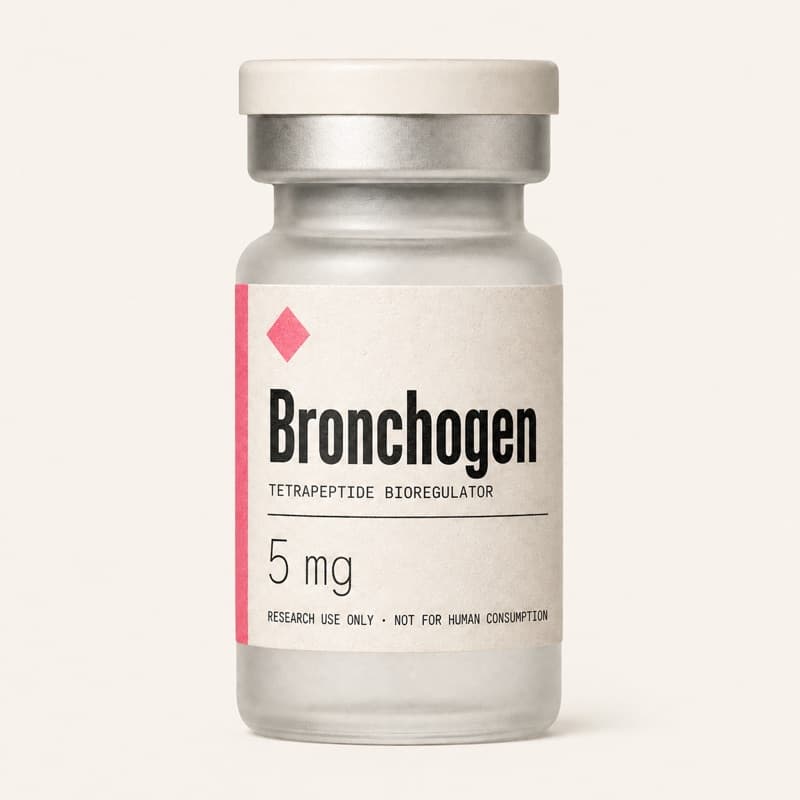
Bronchogen
AEDL Tetrapeptide · Bronchial Bioregulator
Khavinson bioregulator tetrapeptide (AEDL) whose primary effects fall on the bronchopulmonary system. It came out of Professor Vladimir Khavinson's group at Russia's St. Petersburg Institute of Bioregulation and Gerontology, targets bronchial tissue, and supports respiratory function. As with the other Khavinson peptides, it enters the cell nucleus and influences gene expression tied to maintenance and repair of respiratory tissue.
Overview
Khavinson bioregulator tetrapeptide (AEDL) whose primary effects fall on the bronchopulmonary system. It came out of Professor Vladimir Khavinson's group at Russia's St. Petersburg Institute of Bioregulation and Gerontology, targets bronchial tissue, and supports respiratory function. As with the other Khavinson peptides, it enters the cell nucleus and influences gene expression tied to maintenance and repair of respiratory tissue.
Epigenetic regulation is the mechanism: cell and nuclear membranes are crossed, DNA is engaged, and gene expression within bronchial tissue shifts. Protein synthesis in bronchopulmonary cells is regulated, which supports maintenance and repair of the respiratory epithelium. Uptake into cells is efficient and targeting is tissue-specific to bronchial structures, both consequences of the tetrapeptide structure.
Research indications
What the compound has been studied for, grouped by body system. Effect size is the reported magnitude where it was measured — not a recommendation.
Bronchial tissue is supported by regulation of gene expression.
Aids maintenance of respiratory epithelium health.
Protein synthesis within lung tissue is regulated.
Targets the age-related changes seen in bronchial tissue.
Modulation of gene expression within respiratory cells.
- Class
- Tetrapeptide bioregulator
- Research status
- Moderate research
- Chain length
- 4 residues
- Molecular weight
- 432 Da
- Typical dose
- 10–20 mg oral or 10 mg injectable
- Frequency
- Daily for 10–20 days per cycle
- Cycle length
- 10–20 days
- Storage
- Oral capsules: room temperature. Injectable: 2-8°C refrigerated
Molecular data
- Type
- Tetrapeptide bioregulator
- Molecular weight
- 432 Da
- Chain length
- 4 residues
AEDLDosing reference
Doses reported in the literature and by suppliers. These are a record of what has been used in research — reference, never instruction.
| Context | Route | Amount | Frequency |
|---|---|---|---|
| Standard protocol | Oral capsules | 10-20 mg | Daily for 10-20 days |
| Maintenance | Oral capsules | 10 mg | 2-3 cycles yearly |
| Research protocol | IM or SubQ | 10 mg | Daily for 10 days |
Interactions
Related bioregulators for the respiratory system; the mechanisms complement.
Comprehensive Khavinson anti-aging protocols often include both.
Immune-modulating properties in each; tissue targets differ.
Belongs to the Khavinson bioregulator family, with a different tissue target.
What to expect
Safety
Mechanistic flags — properties of the pathway, not observed adverse events.
- Tolerated well overall
- Side effects reported as minimal
- Allergic reactions
- Unusual respiratory symptoms
- Known hypersensitivity
- Pregnancy or breastfeeding
- Respiratory emergencies in progress — seek medical care
Quality checklist
What to confirm before trusting a batch of research material. A verification aid — not an endorsement of any supplier.
- Third-party Certificate of AnalysisIndependent lab · dated · lot-matched.
- HPLC purity ≥ 98%Reverse-phase trace included.
- Mass-spec confirms 432 g/molMALDI-TOF or ESI-MS.
- Counterion stated (acetate ≫ TFA)TFA salts can confound bioassays.
- Endotoxin / sterility statementRelevant once reconstituted.
- Lyophilised · cold-chain shippedStored −20 °C, shipped on ice.
- Labelled “research use only”No therapeutic or dosing claims.
Recorded signals for this compound · 7
- ✓White powder or capsules
- ✓If reconstituted, a clear solution
- ✓Packaging and labeling done properly
- !Source or purity unknown
- ×Discoloration
- ×Unusual odor
- ×Damaged packaging
FAQ
If the half-life runs only minutes, how do Khavinson bioregulator peptides work?
The tetrapeptide structure lets Bronchogen reach cell nuclei directly and modulate gene expression epigenetically. Circulating half-life is short, yet the changes triggered in DNA regulation and protein synthesis within bronchial tissue last. Those epigenetic changes stay in place well after the peptide itself has cleared circulation.
Which respiratory benefits of Bronchogen are proven in human trials?
Clinical evidence specific to Bronchogen is limited. Most of the research is Russian in origin and reports improved respiratory function where Bronchogen is combined with other Khavinson peptides. English-language literature holds no clear human efficacy data from double-blind trials.
Does Bronchogen combine with other respiratory support supplements?
Yes. The epigenetic mechanism sits alongside other approaches, and standard respiratory support compounds pair well, though clinical data specific to combinations do not exist. Chonluten and other Khavinson peptides act synergistically on related respiratory systems.
How long until respiratory improvements appear on Bronchogen?
Gene expression changes accumulate across the 10–20 day cycle. Respiratory improvement is usually noticeable weeks to months after a cycle finishes, as the epigenetic changes take effect. Repeating 2–3 cycles a year improves results, the benefits being cumulative.