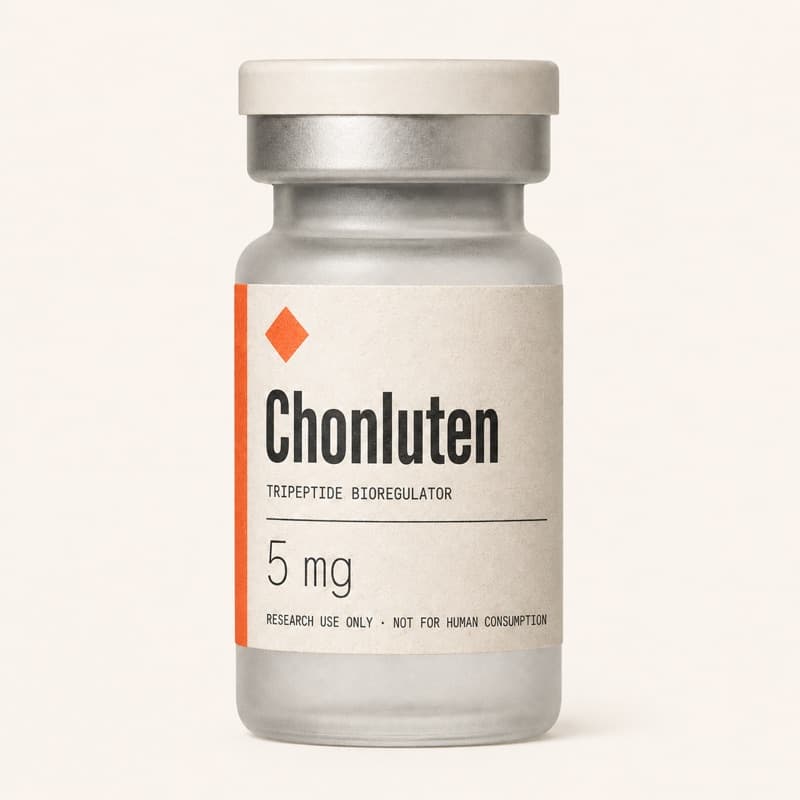
Chonluten
EDG Tripeptide · Bronchial/Lung Bioregulator
Tripeptide bioregulator (EDG) of the Khavinson series, sourced from lung tissue of the respiratory tract. It came out of Russia's St. Petersburg Institute of Bioregulation and Gerontology; the bronchopulmonary system is its target, and it carries secondary activity in the GI tract. Genes tied to proliferation responses, antioxidant activity, and inflammation are regulated, research shows. Monocyte TNF production is inhibited. Study has also treated it as a potential geroprotective agent, one that may support lung function where COPD and similar conditions are present.
Overview
Tripeptide bioregulator (EDG) of the Khavinson series, sourced from lung tissue of the respiratory tract. It came out of Russia's St. Petersburg Institute of Bioregulation and Gerontology; the bronchopulmonary system is its target, and it carries secondary activity in the GI tract. Genes tied to proliferation responses, antioxidant activity, and inflammation are regulated, research shows. Monocyte TNF production is inhibited. Study has also treated it as a potential geroprotective agent, one that may support lung function where COPD and similar conditions are present.
The mechanism is epigenetic: cell and nuclear membranes are crossed, promoter or suppressor regions of DNA bound, and transcriptional control modulated. Genes under that regulation include c-Fos, HSP70 (heat-shock protein), SOD (superoxide dismutase), COX-2 and TNF-alpha, all tied to oxidative stress and proliferative regulation. In monocytes exposed to pro-inflammatory LPS, TNF production is inhibited, and inflammatory action is attenuated by way of TNF tolerance mechanisms.
Research indications
What the compound has been studied for, grouped by body system. Effect size is the reported magnitude where it was measured — not a recommendation.
Respiratory system function is normalized via regulation of gene expression.
Alveolar tissues of the lung and mucous membranes of the bronchi are restored and maintained.
Mucosal function may be modulated in chronic obstructive pulmonary disease.
TNF production in monocytes is inhibited, and inflammatory responses fall.
Expression of SOD and antioxidant genes is supported.
Under research as an agent that may slow the aging of cells.
Modulation extends to c-Fos and to proliferative gene activity.
- Class
- Tripeptide bioregulator
- Research status
- Moderate research
- Chain length
- 3 residues
- Molecular weight
- 319 Da
- Typical dose
- 10–20 mg daily
- Frequency
- Once daily for 10–20 consecutive days
- Cycle length
- 10–20 days per cycle
- Storage
- Capsules: room temperature; Injectable lyophilized: 2-8°C; Reconstituted: 2-8°C refrigerated
Molecular data
- Type
- Tripeptide bioregulator
- Molecular weight
- 319 Da
- Chain length
- 3 residues
EDGDosing reference
Doses reported in the literature and by suppliers. These are a record of what has been used in research — reference, never instruction.
| Context | Route | Amount | Frequency |
|---|---|---|---|
| Standard protocol | Oral capsules | 10-20 mg | Daily for 10-20 days |
| Maintenance | Oral capsules | 10 mg | 2-3 cycles yearly |
| Enhanced absorption | Sublingual | 10-20 mg | Daily for 10-20 days |
| Research protocol | IM or SubQ | 10 mg | Daily for 10 days |
Interactions
Mucosal health is supported by both, through different mechanisms.
Related bioregulators for the respiratory system; the mechanisms complement.
Comprehensive Khavinson anti-aging protocols often include both.
Immune-modulating properties in each; tissue targets differ.
What to expect
Safety
Mechanistic flags — properties of the pathway, not observed adverse events.
- Tolerated well overall
- Side effects reported as minimal
- Allergic reactions
- Unusual respiratory symptoms
- Known hypersensitivity
- Pregnancy or breastfeeding
- Respiratory emergencies in progress — seek medical care
Quality checklist
What to confirm before trusting a batch of research material. A verification aid — not an endorsement of any supplier.
- Third-party Certificate of AnalysisIndependent lab · dated · lot-matched.
- HPLC purity ≥ 98%Reverse-phase trace included.
- Mass-spec confirms 319 g/molMALDI-TOF or ESI-MS.
- Counterion stated (acetate ≫ TFA)TFA salts can confound bioassays.
- Endotoxin / sterility statementRelevant once reconstituted.
- Lyophilised · cold-chain shippedStored −20 °C, shipped on ice.
- Labelled “research use only”No therapeutic or dosing claims.
Recorded signals for this compound · 7
- ✓White powder or capsules
- ✓If reconstituted, a clear solution
- ✓Packaging and labeling done properly
- !Source or purity unknown
- ×Discoloration
- ×Unusual odor
- ×Damaged packaging
FAQ
Is Chonluten taken orally, or does it require injection?
Several forms exist: oral capsules, sublingual, and injectable. Being a short tripeptide, it absorbs favorably taken orally (10–20mg daily), and sublingual delivery enhances absorption. The common pattern is a 10–20 day oral cycle, while injectable forms skip GI metabolism and deliver directly.
At what interval are Chonluten cycles repeated?
The standard protocol is a 10–20 day cycle, run 2–3 times a year, with breaks between. Effects persist for weeks after a cycle ends, a consequence of epigenetic changes in gene expression, so spaced cycles let the body hold the benefits while habituation is avoided.
Does Chonluten do anything for chronic respiratory conditions such as COPD?
Effectiveness for COPD support is moderate in the research, working through TNF inhibition and restoration of lung alveolar tissues. Respiratory function is normalized by regulation of gene expression. The role that fits best is preventative and maintenance rather than acute treatment of active respiratory emergencies.
What separates Chonluten from other immune-supporting peptides?
Derivation is from bronchial lung tissue and the primary target is the respiratory system, unlike broad immune peptides. Genes such as c-Fos, HSP70, SOD and TNF-alpha are regulated to reduce inflammatory responses and support lung tissue health, which makes it unique for respiratory-specific immune modulation.