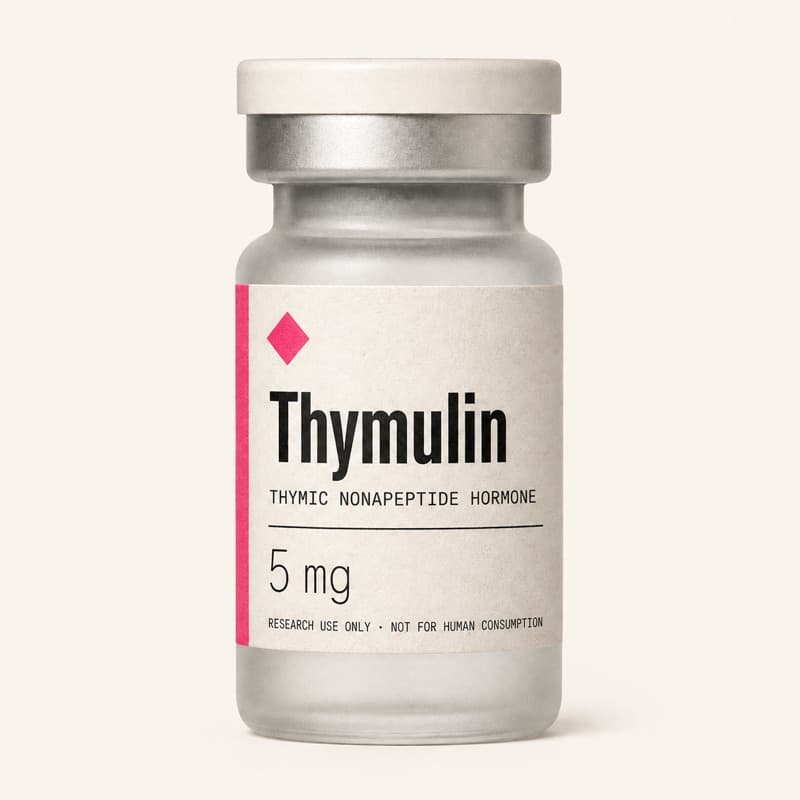
Thymulin
FTS · Zinc-Dependent Thymic Nonapeptide
Nonapeptide hormone secreted only by thymic epithelial cells, discovered by Jean-François Bach in the 1970s. Thymalin is a mixture of peptide extract; thymulin by contrast is a single, defined peptide of 9 amino acids whose biological activity requires zinc binding. It is crucial to T-cell differentiation and maturation inside the thymus. Serum levels fall significantly with age and with zinc deficiency, feeding age-related immune decline (immunosenescence). Research has looked at restoring immune function, managing autoimmune conditions, and use as an anti-inflammatory agent.
Overview
Nonapeptide hormone secreted only by thymic epithelial cells, discovered by Jean-François Bach in the 1970s. Thymalin is a mixture of peptide extract; thymulin by contrast is a single, defined peptide of 9 amino acids whose biological activity requires zinc binding. It is crucial to T-cell differentiation and maturation inside the thymus. Serum levels fall significantly with age and with zinc deficiency, feeding age-related immune decline (immunosenescence). Research has looked at restoring immune function, managing autoimmune conditions, and use as an anti-inflammatory agent.
Action begins at high-affinity receptors carried by T-lymphocytes and other immune cells. Biological activity belongs to the zinc-thymulin complex; absent zinc, immunological activity is nil. Five effects are promoted: (1) immature T-cells differentiate into mature T-cell subsets, (2) cytokine release is modulated, IL-2 and interferon-gamma among them, (3) the balance of T-helper and T-suppressor cells is regulated, (4) NK cell activity rises, and (5) pro-inflammatory mediators are suppressed, giving an anti-inflammatory effect. Neuroendocrine effects follow as well, reaching the hypothalamic-pituitary-adrenal axis.
Research indications
What the compound has been studied for, grouped by body system. Effect size is the reported magnitude where it was measured — not a recommendation.
Reduced immune function correlates with the age-related fall in thymulin; T-cell parameters may be restored by supplementation.
Drives T-lymphocytes in the thymus toward differentiation and maturation.
Zinc governs thymulin activity; zinc-depleted conditions have been studied.
Pro-inflammatory cytokines and mediators are suppressed, per the research.
Studied as a way to bring immune balance back in autoimmune states.
Diabetes models have been used to examine pancreatic beta cell effects and immune modulation.
Influence reaches hypothalamic-pituitary-adrenal axis function.
Protection of neural tissue is suggested by some research.
- Class
- Thymic nonapeptide hormone
- Research status
- Well studied
- Chain length
- 9 residues
- Molecular weight
- 857 Da
- Half-life
- ~10 min
- Typical dose
- 1–10 µg per injection (research protocols)
- Frequency
- Daily during research protocols
- Cycle length
- Varies by research protocol
- Storage
- Reconstituted: 2-8°C, use within 4 weeks
Molecular data
- Type
- Thymic nonapeptide hormone
- Molecular weight
- 857 Da
- Chain length
- 9 residues
- Half-life
- 10 min
Levels in single-dose multiples. A shape, not a pharmacokinetic prediction.
Dosing reference
Doses reported in the literature and by suppliers. These are a record of what has been used in research — reference, never instruction.
| Context | Route | Amount | Frequency |
|---|---|---|---|
| Research protocol (immune) | SubQ | 1-10 mcg | Daily |
| Intranasal (experimental) | Intranasal | Variable | As studied |
Interactions
Essential: biological activity requires zinc. Adequate zinc status is a precondition.
Thymic peptides that differ, on mechanisms that complement.
Where thymalin is a mixture of peptides, thymulin is one defined peptide; the two can complement.
Mechanisms differ, and no negative interactions are known.
No interactions known; the mechanisms are unrelated.
What to expect
Safety
Mechanistic flags — properties of the pathway, not observed adverse events.
- Mild reactions where injected
- Tolerated well overall in research
- Signs of allergic reaction
- Unexpected immune changes
- Pregnancy or breastfeeding
- Autoimmune disease, where medical supervision is required
- Thymic peptides: known hypersensitivity
- Recipients of an organ transplant, on immunosuppression
Quality checklist
What to confirm before trusting a batch of research material. A verification aid — not an endorsement of any supplier.
- Third-party Certificate of AnalysisIndependent lab · dated · lot-matched.
- HPLC purity ≥ 98%Reverse-phase trace included.
- Mass-spec confirms 857 g/molMALDI-TOF or ESI-MS.
- Counterion stated (acetate ≫ TFA)TFA salts can confound bioassays.
- Endotoxin / sterility statementRelevant once reconstituted.
- Lyophilised · cold-chain shippedStored −20 °C, shipped on ice.
- Labelled “research use only”No therapeutic or dosing claims.
Recorded signals for this compound · 9
- ✓White lyophilized powder
- ✓Certificate of analysis that verifies the sequence
- ✓Solution clear once reconstituted
- ✓Vacuum seal intact
- !Slight clumping, dissolving readily
- ×Particulates present
- ×Powder discolored
- ×Solution cloudy once reconstituted
- ×Seal broken
FAQ
Is Thymulin distinct from Thymalin and Thymosin Alpha-1?
Yes. Thymulin (FTS, or Serum Thymic Factor) is a unique nonapeptide hormone of 9 amino acids, secreted naturally by thymic epithelial cells and discovered by Jean-François Bach. Thymalin is a mixture of peptides; Thymosin Alpha-1 is a synthetic peptide of 28 amino acids. Thymic origin is shared by all three, structure is not.
Is zinc supplementation required for Thymulin to work?
Yes. Biological activity is absolutely dependent on zinc (Zn2+), since the active form is the zinc-thymulin complex. Immunological activity falls to zero where zinc is inadequate. Sufficient zinc intake during Thymulin use is therefore required, from zinc supplements or from dietary sources such as oysters, beef, and pumpkin seeds.
On what basis is Thymulin applied to age-related immune decline?
Age brings a dramatic fall in serum Thymulin, which correlates with immunosenescence. Supplementation drives T-cell differentiation, modulates the release of cytokines, regulates the T-helper/T-suppressor balance, and raises NK cell activity — in essence, youthful T-cell function is restored in aging individuals.
In autoimmune disease, does Thymulin help or aggravate?
The classification is immunomodulator — a balancer — rather than simple immune stimulant, which is why autoimmune conditions are a subject of study rather than a reason to avoid it. Active autoimmune disease still calls for medical supervision. Where the disease is in remission or mild, immune balance may be restored without flares being triggered.