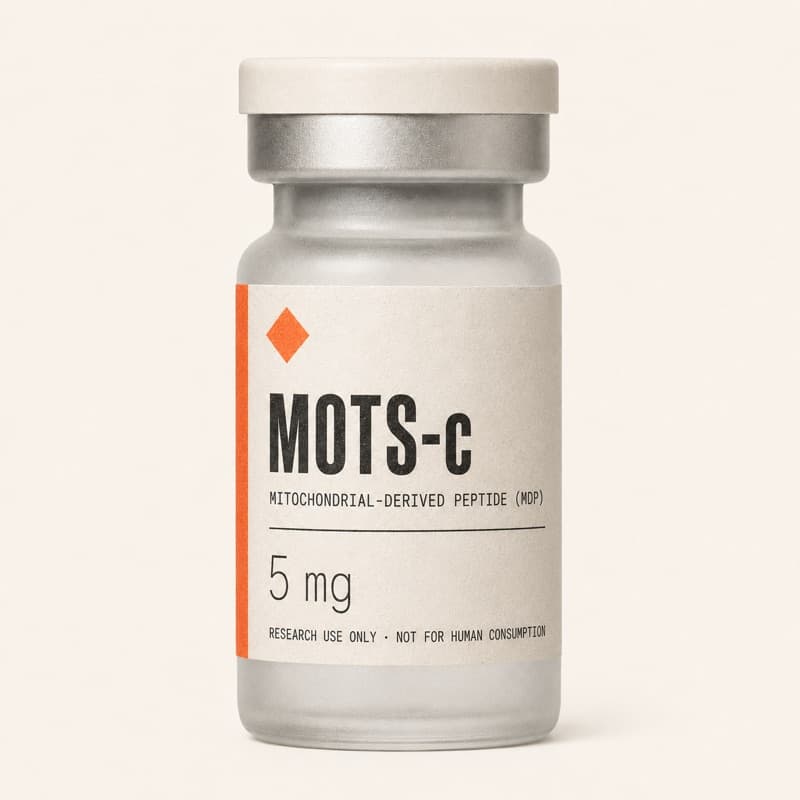
MOTS-c
Mitochondrial-Derived Peptide · Metabolic Regulator
Mitochondrial-derived peptide operating as a mitohormone by way of the Folate-AICAR-AMPK pathway. Metabolic stress sends it into the nucleus, where it binds stress-response transcription factors (NRF2, ATF1/ATF7) and regulates genes involved in metabolism and cellular adaptation.
Overview
Mitochondrial-derived peptide operating as a mitohormone by way of the Folate-AICAR-AMPK pathway. Metabolic stress sends it into the nucleus, where it binds stress-response transcription factors (NRF2, ATF1/ATF7) and regulates genes involved in metabolism and cellular adaptation.
Inhibition of the folate cycle is what leads to AMPK activation. Under metabolic stress the peptide translocates to the nucleus, binding stress-response transcription factors and regulating genes for metabolism, insulin sensitivity and cellular adaptation.
Research indications
What the compound has been studied for, grouped by body system. Effect size is the reported magnitude where it was measured — not a recommendation.
Insulin sensitivity gains roughly 30% in animal studies, by way of AMPK activation.
Sensitization of the insulin receptor restores metabolic function.
Fatty acid oxidation is promoted even where caloric intake is identical.
Age-dependent physical decline reverses in animal models.
PGC-1α activation enhances mitochondrial function.
Mice studies observed median lifespan extended 6.4%.
Exercise drove an 11.9-fold rise in skeletal muscle MOTS-c.
Recovery of muscle is supported, as is adaptation to exercise.
Studies recorded running performance improved 12–15% from a single dose.
- Class
- Mitochondrial-derived peptide (MDP)
- Research status
- Well studied
- Chain length
- 16 residues
- Molecular weight
- 2174.6 Da
- Half-life
- ~30 min
- Typical dose
- 5 mg daily starting; titrated to 10–15 mg
- Frequency
- Daily for metabolic support, or 3 times weekly for anti-aging
- Cycle length
- 4–12 weeks depending on goals
- Storage
- Refrigerate reconstituted solution at 2-8°C, use within 14 days
Molecular data
- Type
- Mitochondrial-derived peptide (MDP)
- Molecular weight
- 2174.6 Da
- Chain length
- 16 residues
- Half-life
- 30 min
MRWQEMGYIFYPRKLRLevels in single-dose multiples. A shape, not a pharmacokinetic prediction.
Dosing reference
Doses reported in the literature and by suppliers. These are a record of what has been used in research — reference, never instruction.
| Context | Route | Amount | Frequency |
|---|---|---|---|
| Metabolic health | SubQ | 5-10mg | Once daily |
| Anti-aging protocol | SubQ | 15mg | 3x weekly |
| Exercise performance | SubQ | 10-15mg | Pre-workout |
| Conservative start | SubQ | 5mg | Once daily |
Interactions
AMPK is activated by both; watch for additive hypoglycemic effects.
Mitochondrial enhancement is complementary, the pathways different.
Mechanisms differ, so the combination is safe.
Two AMPK activators; watch for additive effects.
SIRT1/AMPK activation pathways complement.
Dose adjustments may be needed to prevent hypoglycemia.
What to expect
Safety
Mechanistic flags — properties of the pathway, not observed adverse events.
- Animal studies show general tolerability, side effects minimal
- Mild reactions at the injection site (redness, swelling)
- Hypoglycemia recurring (<50 mg/dL)
- Injection site reactions, severe and persistent
- Unexplained loss of weight, >10% of baseline
- Anaphylaxis, or severe allergic reactions
- Pregnancy or breastfeeding
- Prohibited by WADA; banned in athletic competition
- Human safety data over the long term are limited
Quality checklist
What to confirm before trusting a batch of research material. A verification aid — not an endorsement of any supplier.
- Third-party Certificate of AnalysisIndependent lab · dated · lot-matched.
- HPLC purity ≥ 98%Reverse-phase trace included.
- Mass-spec confirms 2174.6 g/molMALDI-TOF or ESI-MS.
- Counterion stated (acetate ≫ TFA)TFA salts can confound bioassays.
- Endotoxin / sterility statementRelevant once reconstituted.
- Lyophilised · cold-chain shippedStored −20 °C, shipped on ice.
- Labelled “research use only”No therapeutic or dosing claims.
Recorded signals for this compound · 8
- ✓Powder white to off-white and uniform in appearance, which indicates proper storage
- ✓After reconstitution the solution is clear and colorless, free of particles
- ✓Verified sequence (MRWQEMGYIFYPRKLR), with a CoA showing >95% purity by RP-HPLC
- !Human clinical data are limited, so a conservative start is indicated
- !Banned by WADA; not for athletes in competition
- ×Certificate of analysis not available
- ×Powder or solution discolored
- ×Solution cloudy once reconstituted
FAQ
What does MOTS-c do in insulin resistance?
AMPK, a cellular energy sensor, is activated by MOTS-c, and insulin sensitivity improves by approximately 30% in animal studies. The route is the Folate-AICAR-AMPK pathway, with glucose uptake in muscle tissue enhanced. Metabolic dysfunction is addressed at the mitochondrial level.
Is MOTS-c useful for weight loss?
Indirectly. Fatty acid oxidation is promoted despite identical caloric intake, which improves metabolic flexibility. Paired with exercise and diet, the body's capacity to burn fat for fuel is enhanced. This is not a direct weight-loss peptide in the way GLP-1 agonists are, but metabolic health is supported.
Does MOTS-c extend human lifespan?
Unknown in humans. Median lifespan extension of 6.4% appears in mice studies. Healthspan and metabolic optimization are clearly supported, but human longevity data do not exist. The compound supports longevity rather than being a proven life-extension drug.
Is MOTS-c dosed before or after exercise?
Morning, before exercise, is optimal. AMPK activation occurs inside 30 minutes and exercise performance improves 12–15% in studies. Benefits after a workout are seen too, for recovery. Pre-exercise timing is what maximizes performance enhancement during the workout itself.
References
- 1The Mitochondrial-Derived Peptide MOTS-c Promotes Metabolic Homeostasis and Reduces Obesity and Insulin ResistanceLee, C., et al. · Cell Metabolism · 2015
Landmark discovery paper identifying MOTS-c as a 16-amino-acid peptide encoded by mitochondrial DNA. Prevented age-dependent and high-fat-diet-induced insulin resistance and obesity in mice via AMPK activation in skeletal muscle.
Animal in vivo · inferredPubMed 25738453 ↗ - 2The Mitochondrial-Encoded Peptide MOTS-c Translocates to the Nucleus to Regulate Nuclear Gene Expression in Response to Metabolic StressKim, S.J., et al. · Cell Metabolism · 2018
MOTS-c rapidly translocates to the nucleus within 30 minutes under metabolic stress in an AMPK-dependent manner, where it interacts with stress-responsive transcription factors including NRF2 and ATF7 to regulate nuclear gene expression.
Review · inferredPubMed 29983246 ↗ - 3MOTS-c Is an Exercise-Induced Mitochondrial-Encoded Regulator of Age-Dependent Physical Decline and Muscle HomeostasisReynolds, J.C., et al. · Nature Communications · 2021
Exercise induced an 11.9-fold increase in skeletal muscle MOTS-c. MOTS-c enhanced physical performance across age groups and improved muscle homeostasis in aging mice.
Animal in vivo · inferredPubMed 33473109 ↗ - 4MOTS-c Increases in Skeletal Muscle Following Long-Term Physical Activity and Improves Acute Exercise Performance After a Single DoseHyatt, J.K. · Physiological Reports · 2022
4-8 weeks of voluntary running increased MOTS-c protein expression ~1.5-5-fold in rodent skeletal muscles, sustained for 4-6 weeks of detraining. Single dose improved acute exercise performance.
Animal in vivoPubMed 35808870 ↗ - 5The Mitochondrial-Derived Peptide MOTS-c Relieves Hyperglycemia and Insulin Resistance in Gestational Diabetes MellitusYin, Y., et al. · Pharmacological Research · 2022
MOTS-c significantly alleviated hyperglycemia, improved insulin sensitivity and glucose tolerance, and reduced birth weight and offspring death in a gestational diabetes mouse model.
Animal in vivoPubMed 34798268 ↗
MOTS-c blocks senescence in pancreatic islet beta cells, a mitochondrial peptide signalling route that delays the onset of diabetes.
Administered exogenously to diabetic rats, MOTS-c slowed weight gain and improved mitochondrial function in cardiac muscle, a candidate approach in metabolic disorders.
Serum and tumour tissue from patients with ovarian cancer showed lowered MOTS-c; administered MOTS-c curbed proliferation, migration and invasion in ovarian cancer cells through USP7-mediated deubiquitination of LARS1.