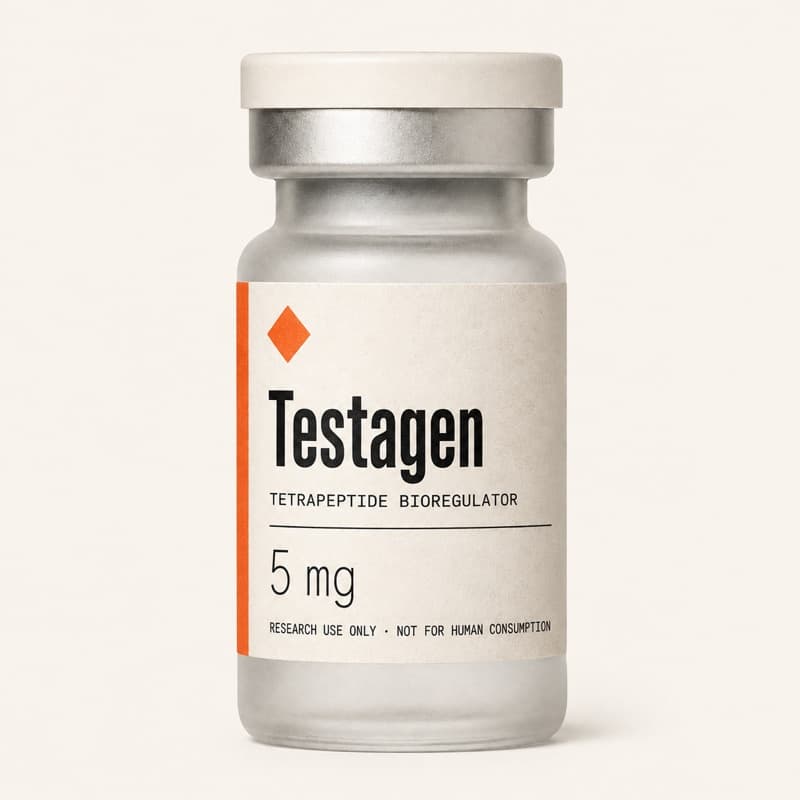
Testagen
KEDG Tetrapeptide · Testicular Bioregulator
Khavinson bioregulator tetrapeptide (KEDG), isolated originally from testicular tissue extracts. Professor Vladimir Khavinson developed it at the St. Petersburg Institute of Bioregulation and Gerontology; testosterone biosynthesis is promoted through stimulation of Leydig cell activity and better cellular metabolism in testicular tissue. Research shows normal communication restored within the hypothalamic-pituitary-gonadal (HPG) axis, which governs testosterone production and spermatogenesis.
Overview
Khavinson bioregulator tetrapeptide (KEDG), isolated originally from testicular tissue extracts. Professor Vladimir Khavinson developed it at the St. Petersburg Institute of Bioregulation and Gerontology; testosterone biosynthesis is promoted through stimulation of Leydig cell activity and better cellular metabolism in testicular tissue. Research shows normal communication restored within the hypothalamic-pituitary-gonadal (HPG) axis, which governs testosterone production and spermatogenesis.
Epigenetic regulation is the route: cell and nuclear membranes are both crossed, so that DNA in target tissues is acted on directly. Cytoplasm, nucleus, and nucleolus are all penetrated, and various cellular components, DNA and RNA included, are interacted with. Different nucleotide sequences can be told apart, and the methylation status of cytosine recognized. Interaction extends to the anterior pituitary gland and to the endocrine pathways behind testosterone and TSH synthesis, which restores communication along the HPG axis.
Research indications
What the compound has been studied for, grouped by body system. Effect size is the reported magnitude where it was measured — not a recommendation.
Testosterone biosynthesis is promoted by way of Leydig cell stimulation.
Communication along the hypothalamic-pituitary-gonadal axis returns to normal.
Declining testosterone is addressed by improving cellular metabolism.
Spermatogenesis is supported, as is reproductive balance.
Testicular function normalizes as peptide deficiency is reduced.
Male sexual function may be enhanced where testosterone is supported.
Research records a drop in prostate tissue inflammation markers.
- Class
- Tetrapeptide bioregulator
- Research status
- Moderate research
- Chain length
- 4 residues
- Molecular weight
- 419 Da
- Typical dose
- 10–20 mg daily during cycle
- Frequency
- Daily for 10–20 days, then break
- Cycle length
- 10–20 day cycles (typical bioregulator protocol)
- Storage
- Capsules: room temperature. Reconstituted: 2-8°C
Molecular data
- Type
- Tetrapeptide bioregulator
- Molecular weight
- 419 Da
- Chain length
- 4 residues
KEDGDosing reference
Doses reported in the literature and by suppliers. These are a record of what has been used in research — reference, never instruction.
| Context | Route | Amount | Frequency |
|---|---|---|---|
| Standard protocol | Oral capsules | 10-20 mg | Daily for 10-20 days |
| Maintenance | Oral capsules | 10 mg | 2-3 cycles yearly |
| Research protocol | IM or SubQ | 10 mg | Daily for 10 days |
Interactions
Two male reproductive bioregulators that complement each other; tissue targets differ.
HPG axis function is supported by both, on different mechanisms.
Comprehensive Khavinson anti-aging protocols often include both.
Testosterone is supported by both; the mechanisms differ.
What to expect
Safety
Mechanistic flags — properties of the pathway, not observed adverse events.
- Tolerated well overall
- Side effects reported as minimal
- Allergic reactions
- Signs of hormone imbalance
- Known hypersensitivity
- Hormone-sensitive cancers, where an oncologist should be consulted
- Use in women is not established
Quality checklist
What to confirm before trusting a batch of research material. A verification aid — not an endorsement of any supplier.
- Third-party Certificate of AnalysisIndependent lab · dated · lot-matched.
- HPLC purity ≥ 98%Reverse-phase trace included.
- Mass-spec confirms 419 g/molMALDI-TOF or ESI-MS.
- Counterion stated (acetate ≫ TFA)TFA salts can confound bioassays.
- Endotoxin / sterility statementRelevant once reconstituted.
- Lyophilised · cold-chain shippedStored −20 °C, shipped on ice.
- Labelled “research use only”No therapeutic or dosing claims.
Recorded signals for this compound · 7
- ✓White powder or capsules
- ✓If reconstituted, a clear solution
- ✓Packaging and labeling done properly
- !Source or purity unknown
- ×Discoloration
- ×Unusual odor
- ×Damaged packaging
FAQ
Does Testagen raise testosterone, or only support natural production?
Biosynthesis is promoted rather than exogenous testosterone supplied. Leydig cell activity is stimulated and testicular cellular metabolism improved through epigenetic regulation, so the body's own production is restored rather than replaced.
On what timescale does Testagen raise testosterone levels?
Changes in gene expression and improvements to cellular metabolism are the route, and they develop over the course of weeks to months. Most users report noticeable benefits tied to testosterone — energy, libido, mood — once 2–4 weeks of cycling have passed, and improvements grow more significant across 2–3 months of intermittent use.
Is Testagen cycled, or can it run continuously?
Cycling follows the Khavinson bioregulator pattern: 10–20 days on, then off, and the cycle repeats 2–3 times a year. Running it continuously is not recommended — cycling is where the epigenetic regulatory effects are strongest, and it leaves the natural feedback mechanisms of the body free to hold balance.
How does Testagen sit with men who have prostate issues?
Prostate health may in fact benefit, since inflammation markers fall in prostate tissue. An oncologist should be consulted first, though, by men whose prostate cancer is hormone-sensitive. Ordinary prostate conditions — BPH, inflammation — may improve, on the dual basis of testosterone support and anti-inflammatory effects from Testagen.