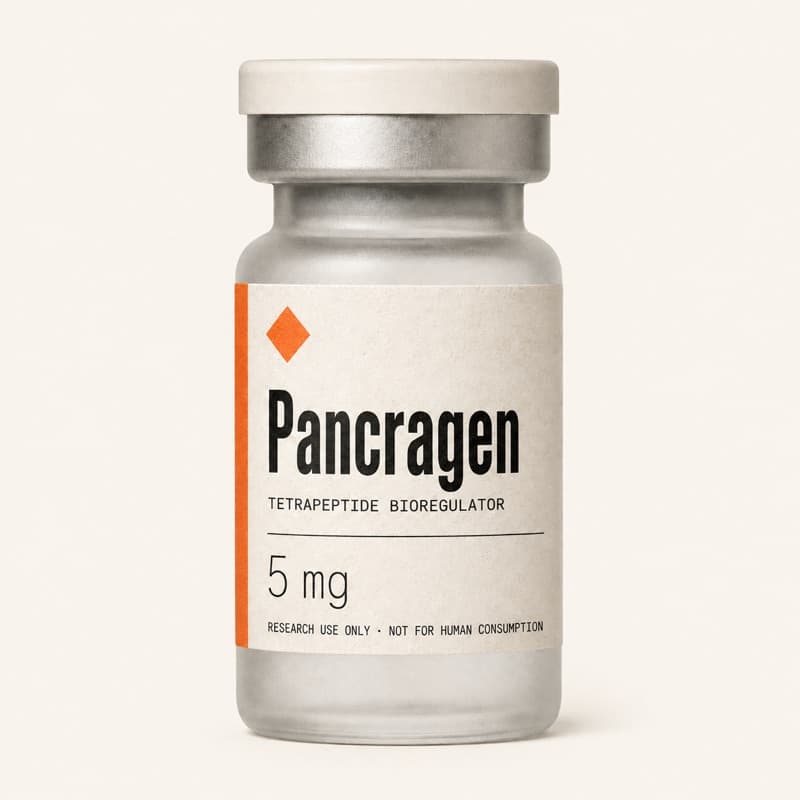
Pancragen
KEDW Tetrapeptide · Pancreas Bioregulator
Khavinson bioregulator tetrapeptide (KEDW), isolated originally from bovine pancreatic cells. Developed at Russia's St. Petersburg Institute of Bioregulation and Gerontology, it interacts with DNA directly to regulate pancreatic gene expression. In old rhesus monkeys, research recorded impaired glucose tolerance corrected, insulin and C-peptide levels normalized, and endocrine pancreatic function improved. It counts as safe and effective against age-related metabolic disturbances.
Overview
Khavinson bioregulator tetrapeptide (KEDW), isolated originally from bovine pancreatic cells. Developed at Russia's St. Petersburg Institute of Bioregulation and Gerontology, it interacts with DNA directly to regulate pancreatic gene expression. In old rhesus monkeys, research recorded impaired glucose tolerance corrected, insulin and C-peptide levels normalized, and endocrine pancreatic function improved. It counts as safe and effective against age-related metabolic disturbances.
Epigenetic regulation is the route: chromatin complexes and DNA structures are engaged, and pancreatic gene expression is modulated as a result. Transcription factors critical to pancreatic cell maturation are upregulated in the research — Pdx1, Pax6, Ptf1a, Foxa2, Nkx2.2 and Pax4. At 4 amino acids and roughly 576 Da, the molecule is small enough to cross cellular membranes and reach nuclear components, histones and DNA among them.
Research indications
What the compound has been studied for, grouped by body system. Effect size is the reported magnitude where it was measured — not a recommendation.
Primate studies report correction of age-related disturbances in glucose tolerance.
Both the incidence and the magnitude of metabolic syndrome fall.
Blood sugar control is helped by support of pancreatic function.
Pancreatic cell differentiation is affected during aging.
Pancreatic endocrine function improves.
Age-related imbalance in pancreatic function is addressed.
Regulation of pancreatic gene expression comes from direct interaction with DNA.
- Class
- Tetrapeptide bioregulator
- Research status
- Moderate research
- Chain length
- 4 residues
- Molecular weight
- 576 Da
- Typical dose
- 10–20 mg daily
- Frequency
- Daily for 10–20 days per cycle
- Cycle length
- 10–20 days
- Storage
- Capsules at room temperature; reconstituted injectable at 2-8°C refrigerated
Molecular data
- Type
- Tetrapeptide bioregulator
- Molecular weight
- 576 Da
- Chain length
- 4 residues
KEDWDosing reference
Doses reported in the literature and by suppliers. These are a record of what has been used in research — reference, never instruction.
| Context | Route | Amount | Frequency |
|---|---|---|---|
| Standard protocol | Oral capsules | 10-20 mg | Daily for 10-20 days |
| Maintenance | Oral capsules | 10 mg | 2-3 cycles yearly |
| Research protocol | IM | 0.05 mg/kg | Daily for 10 days |
Interactions
Comprehensive Khavinson anti-aging protocols often include both.
Organ targets differ; comprehensive bioregulator protocols can include both.
Belongs to the Khavinson bioregulator family, with a different tissue target.
Glucose metabolism is affected by both; the interaction is unknown.
What to expect
Safety
Mechanistic flags — properties of the pathway, not observed adverse events.
- Tolerated well overall
- Side effects reported as minimal
- Allergic reactions
- Signs of hypoglycemia
- Unusual changes in blood sugar
- Known hypersensitivity
- Pregnancy or breastfeeding
- Ongoing pancreatic emergency (medical care needed)
- Type 1 diabetes (physician consultation)
Quality checklist
What to confirm before trusting a batch of research material. A verification aid — not an endorsement of any supplier.
- Third-party Certificate of AnalysisIndependent lab · dated · lot-matched.
- HPLC purity ≥ 98%Reverse-phase trace included.
- Mass-spec confirms 576 g/molMALDI-TOF or ESI-MS.
- Counterion stated (acetate ≫ TFA)TFA salts can confound bioassays.
- Endotoxin / sterility statementRelevant once reconstituted.
- Lyophilised · cold-chain shippedStored −20 °C, shipped on ice.
- Labelled “research use only”No therapeutic or dosing claims.
Recorded signals for this compound · 7
- ✓White powder or capsules
- ✓If reconstituted, a clear solution
- ✓Packaging and labeling done properly
- !Source or purity unknown
- ×Discoloration
- ×Unusual odor
- ×Damaged packaging
FAQ
Is glucose intolerance cured by Pancragen, or merely masked?
The mechanism is epigenetic: DNA is engaged directly and pancreatic transcription factors are upregulated. Insulin and C-peptide levels normalized in primate studies, which points to pancreatic function being restored rather than masked. That applies only to age-related glucose tolerance decline, not to Type 1 diabetes or severe pancreatic damage.
Is Pancragen appropriate in Type 1 diabetes?
Type 1 diabetes appears in the contraindications as a case requiring physician consultation. The condition involves autoimmune destruction of the pancreas, unlike the age-related metabolic decline Pancragen targets. Endocrinologist consultation is indicated before use, and autoimmune pancreatic damage is not an appropriate target.
How long before Pancragen improves blood sugar?
Because the mechanism runs through changes in gene expression, results accumulate. Transcription factors are upregulated across the 10–20 day cycle, while visible glucose improvement usually appears over weeks to months. A recommendation of 2–3 cycles per year implies that sustained benefit depends on repeated cycles.
Does Pancragen call for closer blood sugar monitoring?
Yes. Blood glucose monitoring and HbA1c testing are recommended with long-term use. Insulin sensitivity and pancreatic function both improve, so blood sugar may improve as well, and other diabetes medications may need adjustment to avoid hypoglycemia.