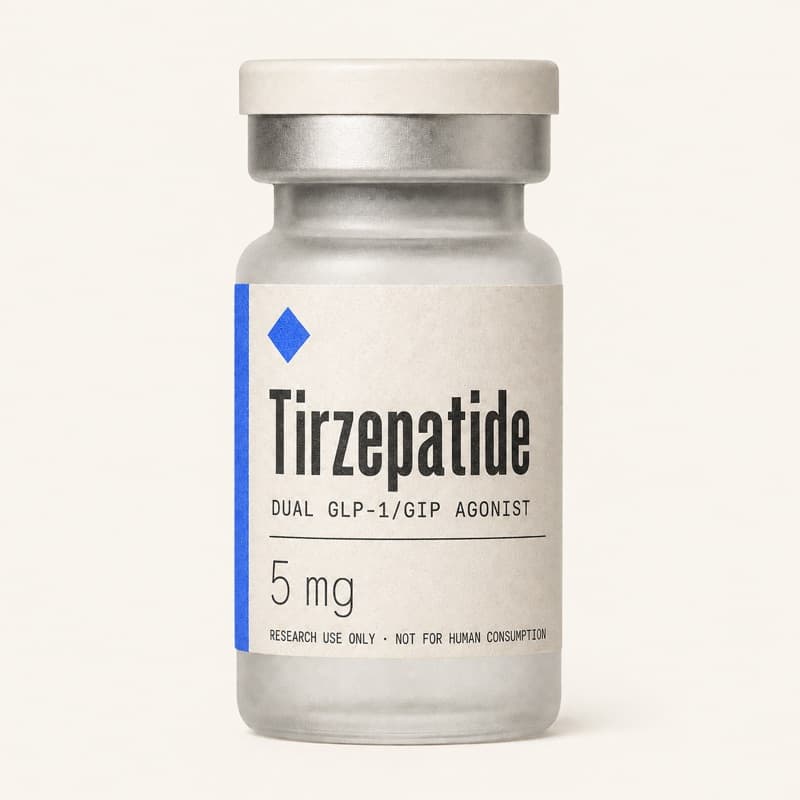
Tirzepatide
Dual GIP/GLP-1 Receptor Agonist · Weight Loss & Diabetes
Dual receptor agonist with FDA approval for type 2 diabetes and chronic weight management. Efficacy runs above that of single-mechanism alternatives, with body weight reduced 15–22% in clinical trials. As the first-in-class dual GIP/GLP-1 agonist it delivers metabolic benefits beyond those of GLP-1-only medications.
Overview
Dual receptor agonist with FDA approval for type 2 diabetes and chronic weight management. Efficacy runs above that of single-mechanism alternatives, with body weight reduced 15–22% in clinical trials. As the first-in-class dual GIP/GLP-1 agonist it delivers metabolic benefits beyond those of GLP-1-only medications.
A dual agonist at the GIP and GLP-1 receptors alike. The downstream effects are insulin stimulation that depends on glucose, gastric emptying that slows, glucagon that is suppressed, and central satiety signaling carried along hypothalamic pathways.
Research indications
What the compound has been studied for, grouped by body system. Effect size is the reported magnitude where it was measured — not a recommendation.
Insulin resistance markers improved, as did triglycerides, HDL cholesterol, blood pressure, and waist circumference.
Visceral adipose tissue is reduced preferentially; lean muscle mass is preserved where resistance training is present.
In non-diabetic obese individuals, clinical trials demonstrate body weight down 15–22%, superior to existing weight loss medications.
Clinical trials report HbA1c falling 1.5–2.4%, a superior reduction.
Insulin sensitivity improves in diverse populations.
Pancreatic beta cell function may be preserved and restored.
The SURPASS-CVOT trial demonstrated major adverse cardiovascular events down 26%.
Blood pressure fell 8–12 mmHg, systolic and diastolic.
Triglycerides improved 20–30%, HDL rose, apolipoprotein B fell.
- Class
- Dual GLP-1/GIP agonist
- Research status
- FDA approved
- Chain length
- 39 residues
- Molecular weight
- 4813.55 Da
- Half-life
- ~120 h
- Typical dose
- 2.5 mg starting; titrated to 5–15 mg weekly
- Frequency
- Once weekly (same day each week)
- Cycle length
- Ongoing therapy as prescribed
- Storage
- Pen: 2-8°C before first use, room temp up to 21 days after. Compounded: 2-8°C
Molecular data
- Type
- Dual GLP-1/GIP agonist
- Molecular weight
- 4813.55 Da
- Chain length
- 39 residues
- Half-life
- 7200 min
Levels in single-dose multiples. A shape, not a pharmacokinetic prediction.
Dosing reference
Doses reported in the literature and by suppliers. These are a record of what has been used in research — reference, never instruction.
| Context | Route | Amount | Frequency |
|---|---|---|---|
| Weight loss initiation | SubQ injection | 2.5mg | Once weekly x 4 weeks |
| Weight loss progression | SubQ injection | 5mg | Once weekly |
| Weight loss optimization | SubQ injection | 7.5-10mg | Once weekly |
| Maximum weight loss | SubQ injection | 12.5-15mg | Once weekly |
| Diabetes management (mild) | SubQ injection | 5-7.5mg | Once weekly |
| Diabetes management (severe) | SubQ injection | 10-15mg | Once weekly |
Interactions
Two GLP-1 agonists: the combination raises the risk of hypoglycemia and of severe GI side effects.
A second GLP-1 agonist; additive effects make dual therapy contraindicated.
Improved sensitivity may call for a significant cut in insulin dose.
Mechanisms that complement across diabetes management and weight loss.
Muscle mass may be preserved during weight loss with growth hormone support.
Both metabolic rate and muscle preservation may be maintained.
No interactions known; possible gut-health support and reduced GI effects.
For metabolic optimization, GLP-1 effects may be complemented by NNMT inhibition.
What to expect
Safety
Mechanistic flags — properties of the pathway, not observed adverse events.
- Possible fatigue during adaptation
- Diarrhea or constipation
- Reduced food cravings
- Nausea, mild to moderate, over the first 2–4 weeks
- Reduced appetite
- Neck lumps, hoarseness, trouble swallowing — thyroid concerns
- Nausea or vomiting severe enough to prevent adequate nutrition
- Abdominal pain that is severe or persistent, given pancreatitis risk
- Severe hypoglycemia signaled by confusion, sweating, or rapid heartbeat
- Allergic reactions that are severe — rash, breathing difficulty
- Suicidal thoughts, or depression that is severe
- Gallbladder trouble, marked by severe upper right pain
- Dehydration where vomiting persists
- Kidney impairment: urination decreased, swelling
- Multiple Endocrine Neoplasia syndrome type 2 (MEN2)
- Pregnancy or breastfeeding
- History of pancreatitis
- Medullary thyroid carcinoma in the individual, or in family history
Quality checklist
What to confirm before trusting a batch of research material. A verification aid — not an endorsement of any supplier.
- Third-party Certificate of AnalysisIndependent lab · dated · lot-matched.
- HPLC purity ≥ 98%Reverse-phase trace included.
- Mass-spec confirms 4813.55 g/molMALDI-TOF or ESI-MS.
- Counterion stated (acetate ≫ TFA)TFA salts can confound bioassays.
- Endotoxin / sterility statementRelevant once reconstituted.
- Lyophilised · cold-chain shippedStored −20 °C, shipped on ice.
- Labelled “research use only”No therapeutic or dosing claims.
Recorded signals for this compound · 8
- ✓Vial seal unbroken; batch numbers and mg dosage labeling both visible
- ✓Storage held correctly at 2–8°C and protected from light
- ✓Lyophilized powder, white to off-white, showing no clumping
- ✓Reconstituted solution clear and colorless
- !Compounded versions lacking proper quality control
- ×Unusual crystallization patterns
- ×Clumped powder, discoloration, or a yellow/brown appearance
- ×Cloudiness that persists after reconstitution
FAQ
How does tirzepatide's weight loss compare with semaglutide's?
Head-to-head trials (SURMOUNT-5) put tirzepatide at 20.2% weight loss against 13.7% for semaglutide at 72 weeks. Significantly greater effectiveness follows from the dual GIP/GLP-1 mechanism — close to 7% more weight reduction, and ≥20% weight loss reached by 57% of tirzepatide users.
Does tirzepatide help in HFpEF — heart failure where ejection fraction is preserved?
Yes. Among HFpEF patients with obesity, the SUMMIT trial recorded a 38% reduction in the composite of cardiovascular death or worsening heart failure. That is a major cardiovascular indication sitting outside weight loss and diabetes, and it establishes tirzepatide as cardioprotective at the tissue level.
Does progression from prediabetes to diabetes slow under tirzepatide?
Yes. The SURMOUNT-1 extension, at 3 years, showed progression to type 2 diabetes reduced 93% among treated prediabetic individuals with obesity. Set alongside sustained weight loss of 19.7%, that makes it highly effective for diabetes prevention in at-risk populations.
References
- 1Tirzepatide versus Semaglutide Once Weekly in Patients with Type 2 Diabetes (SURPASS-2)Frías, J.P., et al. · New England Journal of Medicine · 2021
Tirzepatide was noninferior and superior to semaglutide 1mg for HbA1c reduction and weight loss in type 2 diabetes. The 15mg dose achieved nearly twice the weight loss of semaglutide.
Human RCTPubMed 34170647 ↗ - 2Tirzepatide Once Weekly for the Treatment of Obesity (SURMOUNT-1)Jastreboff, A.M., et al. · New England Journal of Medicine · 2022
Landmark phase 3 trial: 15mg weekly achieved 22.5% weight loss vs 2.4% placebo over 72 weeks. Weight reduction of ≥20% achieved in 57% of 15mg recipients.
Human RCTPubMed 35658024 ↗ - 3Tirzepatide once weekly for the treatment of obesity in people with type 2 diabetes (SURMOUNT-2)Garvey, W.T., et al. · The Lancet · 2023
15mg dose achieved 15.7% weight loss over 72 weeks with significant cardiometabolic improvements. 79-83% of tirzepatide recipients achieved ≥5% weight loss vs 32% placebo.
Human RCTPubMed 37385275 ↗ - 4Tirzepatide for Heart Failure with Preserved Ejection Fraction and Obesity (SUMMIT)Packer, M., et al. · New England Journal of Medicine · 2024
Tirzepatide reduced the composite of CV death or worsening heart failure by 38% (HR 0.62) vs placebo over median 104 weeks. Improved health status scores and 6-minute walk distance.
Human RCTPubMed 39555826 ↗ - 5Tirzepatide for the Treatment of Obstructive Sleep Apnea and Obesity (SURMOUNT-OSA)Malhotra, A., et al. · New England Journal of Medicine · 2024
Tirzepatide significantly reduced AHI with resolution of OSA in approximately 50% of participants. Also reduced body weight, hypoxic burden, hsCRP, and systolic blood pressure.
Human RCTPubMed 38912654 ↗ - 6Cardiovascular Outcomes with Tirzepatide versus Dulaglutide in Type 2 Diabetes (SURPASS-CVOT)Nicholls, S.J., et al. · New England Journal of Medicine · 2025
Tirzepatide was noninferior to dulaglutide for MACE (composite of CV death, MI, or stroke). Several secondary endpoints favored tirzepatide, including reduced all-cause mortality after 4-year median follow-up.
Human pilotPubMed 41406444 ↗ - 7Tirzepatide as Compared with Semaglutide for the Treatment of Obesity (SURMOUNT-5)Aronne, L.J., et al. · New England Journal of Medicine · 2025
Head-to-head comparison: tirzepatide achieved 20.2% weight loss vs 13.7% with semaglutide at 72 weeks. Tirzepatide was superior for body weight and waist circumference reduction.
Human pilotPubMed 40353578 ↗ - 8Tirzepatide for Obesity Treatment and Diabetes Prevention (SURMOUNT-1 3-Year Extension)Jastreboff, A.M., et al. · New England Journal of Medicine · 2025
Three years of tirzepatide resulted in sustained weight reduction of up to 19.7% (15mg) and 93% lower risk of progression to type 2 diabetes vs placebo (HR 0.07).
Human RCTPubMed 39536238 ↗
SURPASS-CVOT, reported in NEJM, enrolled 13,299 patients with type 2 diabetes and atherosclerotic cardiovascular disease and found tirzepatide to be noninferior to dulaglutide on MACE, with favourable trends in secondary endpoints, all-cause mortality among them.
A head-to-head NEJM trial in adults with obesity found tirzepatide outperformed semaglutide on weight loss at 72 weeks (20.2% versus 13.7%) and on waist circumference reduction.
Extension of SURMOUNT-1 to three years showed weight loss of up to 19.7% maintained on tirzepatide, with a 93% reduction in new-onset type 2 diabetes among adults with obesity and prediabetes.
In the phase 3 SUMMIT trial, tirzepatide lowered the composite of worsening heart failure or cardiovascular death by 38% among people with HFpEF and obesity, evidence of benefit beyond weight loss.