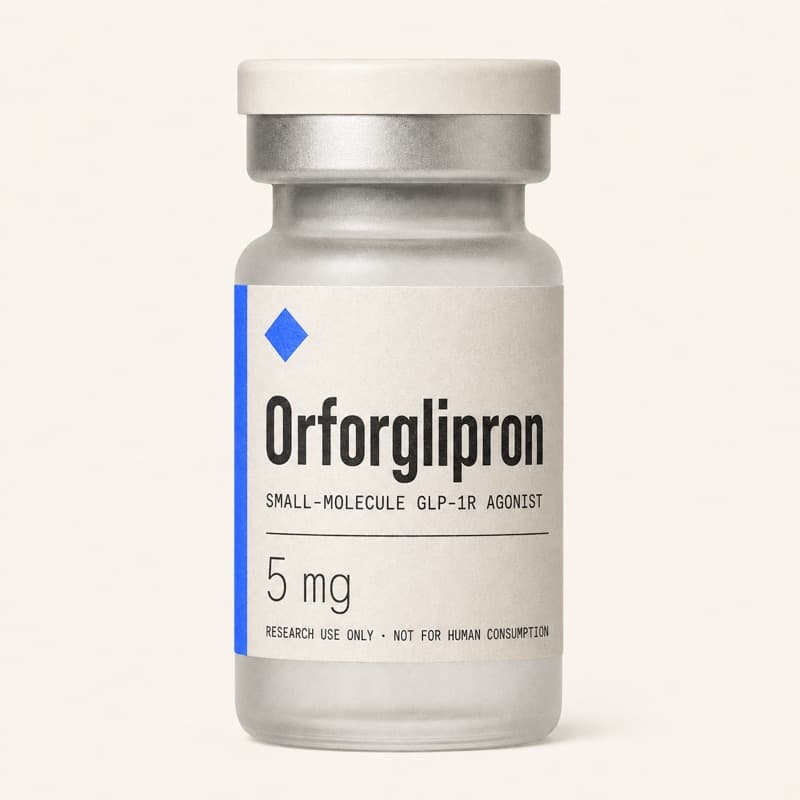
Orforglipron
Oral Small-Molecule GLP-1 Receptor Agonist · Weight Loss & Diabetes
The first oral non-peptide GLP-1 to complete Phase 3 trials. Substantial weight loss comes without injections, refrigeration, or dietary restrictions, and clinical evidence puts the reduction at 12.4% by 72 weeks.
Overview
The first oral non-peptide GLP-1 to complete Phase 3 trials. Substantial weight loss comes without injections, refrigeration, or dietary restrictions, and clinical evidence puts the reduction at 12.4% by 72 weeks.
A small-molecule GLP-1 receptor agonist whose biased signaling favors the G protein/cAMP pathways: insulin secretion is enhanced, glucagon suppressed, gastric emptying delayed and appetite reduced, with receptor desensitization held to a minimum. Oral bioavailability is 79.1%, half-life 29–49 hours.
Research indications
What the compound has been studied for, grouped by body system. Effect size is the reported magnitude where it was measured — not a recommendation.
ATTAIN-1: at 72 weeks the 36 mg dose gave 12.4% weight loss (27.3 lbs), and ≥10% weight loss was reached by 59.6%.
ATTAIN-2 recorded weight loss of 10.5%, and 72.8% reached ≥5% weight loss.
Waist circumference improved, as did systolic blood pressure (8–12 mmHg) and triglycerides (-20–30%).
Near-normal blood sugar was reached by 91%, against 42% on placebo.
Insulin sensitivity indices improve significantly inside 4 weeks of starting therapy.
The Phase 3 ACHIEVE-1 trial recorded HbA1c falling 1.3–1.6% from a baseline of 8.0%, with 76.2% reaching HbA1c <7%.
- Class
- Small-molecule GLP-1R agonist
- Research status
- Extensively studied
- Molecular weight
- 882.974 Da
- Half-life
- ~46.6 h
- Typical dose
- 3–6 mg daily starting; titrated to 12–36 mg
- Frequency
- Once daily oral tablet
- Cycle length
- Long-term continuous therapy (72+ weeks in trials)
- Storage
- Room temperature 15-30°C; no refrigeration needed
Molecular data
- Type
- Small-molecule GLP-1R agonist
- Molecular weight
- 882.974 Da
- Half-life
- 2796 min
Levels in single-dose multiples. A shape, not a pharmacokinetic prediction.
Dosing reference
Doses reported in the literature and by suppliers. These are a record of what has been used in research — reference, never instruction.
| Context | Route | Amount | Frequency |
|---|---|---|---|
| Type 2 diabetes initiation | Oral tablet | 3mg daily | Once daily, any time |
| Type 2 diabetes moderate control | Oral tablet | 12mg daily | Once daily, any time |
| Type 2 diabetes optimal control | Oral tablet | 36mg daily | Once daily, any time |
| Weight loss initiation | Oral tablet | 6mg daily | Once daily, any time |
| Weight loss optimization | Oral tablet | 36mg daily | Once daily, any time |
Interactions
Two GLP-1 agonists; combining raises both severe hypoglycemia and GI adverse effects that are excessive.
A dual GIP/GLP-1 agonist overlapping the GLP-1 mechanism; the combination is contraindicated.
GLP-1 agonist again; mechanisms overlap, so concurrent use is contraindicated.
Insulin sensitivity is enhanced by orforglipron; a significant reduction in insulin dose may be required.
Mechanisms complement in diabetes management; enhanced efficacy appeared in Phase 3 trials.
No interactions known; possible support for gut health and reduction of GI adverse effects.
What to expect
Safety
Mechanistic flags — properties of the pathway, not observed adverse events.
- Diarrhea (prevalence above that of injectable GLP-1s)
- Nausea (typically improving past the first month)
- Reduced appetite
- Abdominal pain, severe or persistent, radiating to the back (potential pancreatitis)
- Lumps in the neck; hoarseness; swallowing difficulty; swelling of the neck
- Severe hypoglycemia signaled by confusion, sweating or rapid heartbeat
- Suicidal thoughts, depression that is severe, or significant mood changes
- Changes in vision, or eye pain that persists
- Nausea or vomiting severe enough to prevent adequate nutrition or hydration
- Multiple Endocrine Neoplasia syndrome type 2 (MEN2)
- Pregnancy and breastfeeding
- Medullary thyroid carcinoma in the individual, or in family history
Quality checklist
What to confirm before trusting a batch of research material. A verification aid — not an endorsement of any supplier.
- Third-party Certificate of AnalysisIndependent lab · dated · lot-matched.
- HPLC purity ≥ 98%Reverse-phase trace included.
- Mass-spec confirms 882.974 g/molMALDI-TOF or ESI-MS.
- Counterion stated (acetate ≫ TFA)TFA salts can confound bioassays.
- Endotoxin / sterility statementRelevant once reconstituted.
- Lyophilised · cold-chain shippedStored −20 °C, shipped on ice.
- Labelled “research use only”No therapeutic or dosing claims.
Recorded signals for this compound · 6
- ✓Tablet packaging intact, labeling proper, batch numbers and expiration dates present
- ✓Tablets uniform in appearance, free of discoloration, chipping or cracking
- ✓Held at 15–30°C, which is room temperature
- !Orforglipron is investigational only as of late 2025; a product claiming FDA approval is fraudulent
- ×Tablets discolored, crumbling or damaged point to improper storage
- ×Exposure to moisture, or humidity damage
FAQ
Where does orforglipron stand against semaglutide for weight loss?
Weight loss came to 12.4% for orforglipron against semaglutide's 15–20% in trials, but orforglipron is an oral tablet where semaglutide is a weekly injection. Daily-pill convenience outweighs a slightly lower weight-loss number for many people. Phase 3 trials are still running (no FDA approval yet), while semaglutide is established.
What accounts for orforglipron causing more diarrhea than other GLP-1s?
Diarrhea is specifically noted as more prevalent with orforglipron than with injectable GLP-1s. The likely reason is its oral bioavailability, and the way a small-molecule formulation acts on the GI tract differently from a peptide injection. Improvement typically follows past the first month as the body adapts.
Is orforglipron taken with food, or on an empty stomach?
Per the protocols, orforglipron goes with or without food, at any time of day. That flexibility is a key advantage over some other GLP-1 formulations. Administration need not be planned around meals.
Is orforglipron appropriate where there is a family history of thyroid cancer?
No. Contraindication applies to a personal or family history of medullary thyroid carcinoma or MEN2 syndrome. As with other GLP-1 agonists, thyroid C-cell tumors are a theoretical risk. Family history is to be discussed thoroughly with a healthcare provider before starting.