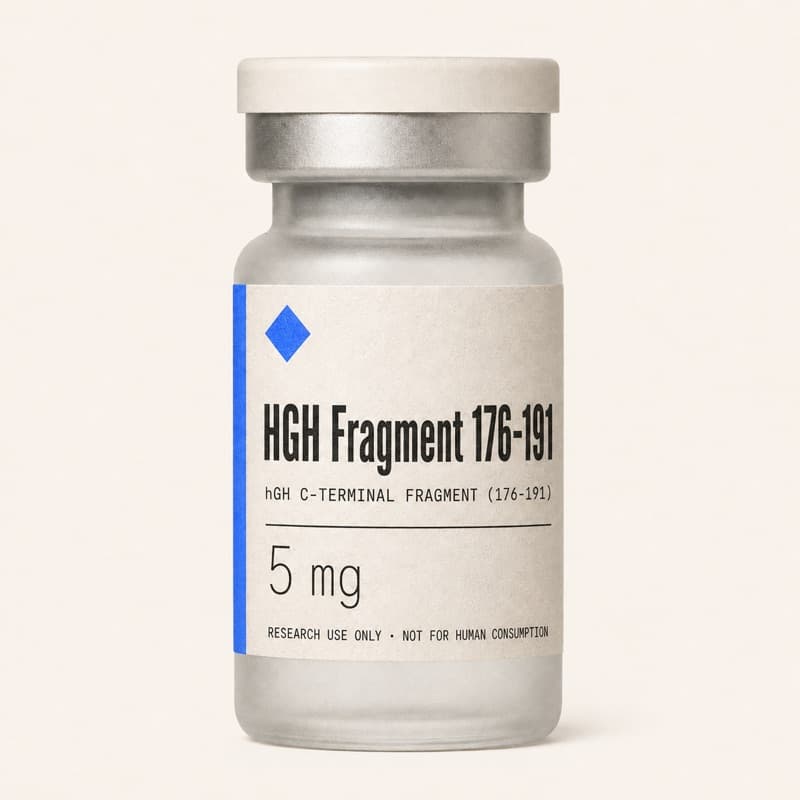
HGH Fragment 176-191
Growth Hormone Fragment · Fat Loss Peptide
The segment of human growth hormone responsible for fat burning: amino acids 176 through 191 within the full GH molecule. It stimulates lipolysis and inhibits lipogenesis, leaving out the effects on growth and on insulin that come with HGH at full length. Adding an N-terminal tyrosine residue to this fragment gives AOD-9604.
Overview
The segment of human growth hormone responsible for fat burning: amino acids 176 through 191 within the full GH molecule. It stimulates lipolysis and inhibits lipogenesis, leaving out the effects on growth and on insulin that come with HGH at full length. Adding an N-terminal tyrosine residue to this fragment gives AOD-9604.
The lipolytic region of human growth hormone is what this fragment mimics, driving fat breakdown by way of beta-3 adrenergic receptor pathways. The growth hormone receptor is not a binding target, unlike full HGH — hence no rise in IGF-1 and no interference with glucose metabolism. Adipose tissue is targeted selectively, and fat oxidation follows.
Research indications
What the compound has been studied for, grouped by body system. Effect size is the reported magnitude where it was measured — not a recommendation.
Fat oxidation rises, as does breakdown of triglycerides stored in adipose tissue, with glucose homeostasis untouched.
Synthesis and storage of new fat both fall, which complements the lipolytic action and reduces fat overall.
Fat loss is selective and lean mass is spared; the effect is particularly strong alongside a caloric deficit and exercise.
- Class
- hGH C-terminal fragment (176-191)
- Research status
- Moderate research
- Chain length
- 16 residues
- Molecular weight
- 1817.1 Da
- Half-life
- ~20 min
- Typical dose
- 250–500 µg
- Frequency
- Twice daily (fasted)
- Cycle length
- 8–12 weeks
- Storage
- Lyophilized: room temp or freezer long-term. Reconstituted: 2-8 degrees C for 28 days
Molecular data
- Type
- hGH C-terminal fragment (176-191)
- Molecular weight
- 1817.1 Da
- Chain length
- 16 residues
- Half-life
- 20 min
LRIVQCRSVEGSCGFLevels in single-dose multiples. A shape, not a pharmacokinetic prediction.
Dosing reference
Doses reported in the literature and by suppliers. These are a record of what has been used in research — reference, never instruction.
| Context | Route | Amount | Frequency |
|---|---|---|---|
| Fat loss - Standard | SubQ | 250mcg | Twice daily (morning fasted + pre-bed) |
| Enhanced fat loss | SubQ | 500mcg | Twice daily (morning fasted + pre-bed) |
| Conservative start | SubQ | 250mcg | Once daily (morning, fasted) |
Interactions
The lipolytic mechanism is redundant here: the 176-191 sequence is already part of full HGH, so the pair yields diminishing fat-loss returns while piling on HGH-related side effects.
One mechanism of action between them. AOD-9604 is this fragment in modified form, which makes running both redundant and unnecessary.
Fat loss is the shared target, reached by complementary adrenergic pathways. Lipolysis in combination may exceed what either compound achieves alone.
What to expect
Safety
Mechanistic flags — properties of the pathway, not observed adverse events.
- Injection site irritation (redness, mild swelling)
- Headache, particularly in the first few days
- Generally well-tolerated with a favorable safety profile
- Severe injection site reactions or signs of infection
- Hypoglycemia symptoms if combined with insulin (dizziness, sweating, confusion)
- Allergic reactions (rare)
- Any persistent or concerning symptoms
- Pregnancy or breastfeeding
- Active cancer or history of malignancy
- WADA prohibited - athletes subject to testing must avoid
Quality checklist
What to confirm before trusting a batch of research material. A verification aid — not an endorsement of any supplier.
- Third-party Certificate of AnalysisIndependent lab · dated · lot-matched.
- HPLC purity ≥ 98%Reverse-phase trace included.
- Mass-spec confirms 1817.1 g/molMALDI-TOF or ESI-MS.
- Counterion stated (acetate ≫ TFA)TFA salts can confound bioassays.
- Endotoxin / sterility statementRelevant once reconstituted.
- Lyophilised · cold-chain shippedStored −20 °C, shipped on ice.
- Labelled “research use only”No therapeutic or dosing claims.
Recorded signals for this compound · 9
- ✓Cold-chain shipping done properly
- ✓Lyophilized powder that is white and uniform in appearance
- ✓After reconstitution, a crystal-clear solution carrying no particles
- ✓Purity >98% by HPLC on the certificate of analysis
- !WADA prohibited substance
- !No FDA approval — a research chemical only
- ×Powder discolored or clumped, with yellow pointing to degradation
- ×Solution cloudy once reconstituted
- ×Appearance collapsed or moisture-damaged
FAQ
Can insulin be used alongside HGH Fragment 176-191?
Blood glucose and insulin sensitivity are not directly affected, which sets the fragment apart from full-length HGH. Monitoring blood glucose in combination with insulin is still warranted, given the fragment's lipolytic effects and the possibility of unpredictable metabolic changes.
Does HGH Fragment 176-191 stack with full-length HGH?
Not recommended. The 176-191 sequence sits inside HGH already, so the fragment adds redundant lipolytic action and more HGH-related side effects without a proportional fat-loss return. One or the other.
When does fat loss appear on HGH Fragment 176-191?
Week 3–4 is when fat loss typically becomes noticeable, given proper diet and exercise. Reduction is more significant across weeks 5–8. Cycles of 8–12 weeks are the norm, and benefits stay observable through week 12.
Is fasting required before an HGH Fragment 176-191 injection?
Yes. Optimal effect depends on it. The injection goes in on an empty stomach, with at least 30 minutes before food. Insulin elevated by food intake can suppress the lipolytic signaling the fragment works through.
References
- 1Metabolic studies of a synthetic lipolytic domain (AOD9604) of human growth hormoneNg FM, Jiang WJ, Gianello R, Pitt C, Heffernan M · Hormone Research · 2000
Characterized metabolic properties of AOD-9604 as a synthetic lipolytic domain of hGH with antilipogenic activity that does not interact with the GH receptor.
Animal in vivoPubMed 11146367 ↗ - 2Effects of oral administration of a synthetic fragment of human growth hormone on lipid metabolismHeffernan MA, Heffernan MJ, Jiang WJ, Thorburn AW, Ng FM · American Journal of Physiology - Endocrinology and Metabolism · 2000
Oral treatment of ob/ob mice with AOD-9401 for 30 days significantly reduced body weight gain and altered lipogenic and lipolytic activity in adipose tissue.
Animal in vivo · inferredPubMed 10950816 ↗ - 3Increase of fat oxidation and weight loss in obese mice caused by chronic treatment with human growth hormone or a modified C-terminal fragmentHeffernan MA, Thorburn AW, Fam B, Summers R, Conway-Campbell B, Waters MJ, Ng FM · International Journal of Obesity · 2001
Both hGH and AOD-9604 reduced body weight gain, increased fat oxidation, and stimulated lipolysis in obese ob/ob mice after 14 days chronic IP administration, without affecting glucose metabolism.
Animal in vivoPubMed 11673763 ↗ - 4The effects of human GH and its lipolytic fragment (AOD9604) on lipid metabolism following chronic treatment in obese mice and beta(3)-AR knock-out miceHeffernan MA, Jiang WJ, Thorburn AW, Ng FM · Endocrinology · 2001
Both hGH and AOD-9604 increased repressed beta-3 adrenergic receptor RNA expression in obese mice to levels comparable with lean mice. Effects abolished in beta-3-AR knockout mice, confirming pathway involvement.
Animal in vivo · inferredPubMed 11713213 ↗
Analytical methods were established for detecting AOD-9604 alongside other hGH fragments, and in vitro metabolism was characterised for the 176-191 sequence to support anti-doping testing.