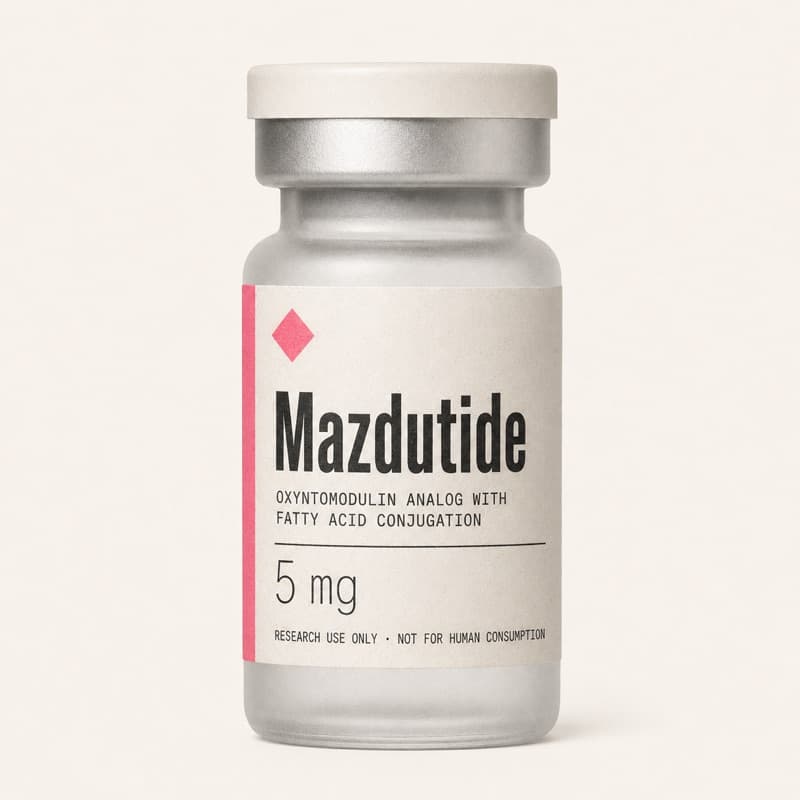
Mazdutide
Dual GLP-1/Glucagon Receptor Agonist · Weight Loss & Diabetes
Dual GLP-1 and glucagon receptor agonist, first in its class, pairing appetite suppression with stimulated thermogenesis. Phase 3 trials showed it superior to semaglutide on weight loss and glycemic control.
Overview
Dual GLP-1 and glucagon receptor agonist, first in its class, pairing appetite suppression with stimulated thermogenesis. Phase 3 trials showed it superior to semaglutide on weight loss and glycemic control.
Activation is dual-agonist. On the GLP-1 side: insulin is stimulated, glucagon suppressed, gastric emptying slowed. On the glucagon side: energy expenditure and thermogenesis rise, while the glucose-raising effects are counteracted by GLP-1.
Research indications
What the compound has been studied for, grouped by body system. Effect size is the reported magnitude where it was measured — not a recommendation.
Liver fat fell 80.2% in exploratory analysis, which suggests benefit in MASLD/MASH.
Significant falls in waist circumference, in systolic BP (-7.57 mmHg), and in triglycerides (-43%).
In GLORY-2, 9 mg over 60 weeks produced 20.1% weight loss, and 48.7% reached a reduction of ≥20%.
Across trials HbA1c fell 1.41–2.03%; in DREAMS-3 the figure was -2.03% against semaglutide's -1.84%.
Both HbA1c <7.0% and ≥10% weight loss were reached by 48%, against 21% on semaglutide.
Clinical trials recorded -7.57 mmHg systolic and -2.98 mmHg diastolic.
Triglycerides -43.29%, total cholesterol -16.82%, LDL -17.07%.
- Class
- Oxyntomodulin analog with fatty acid conjugation
- Research status
- Extensively studied
- Chain length
- 33 residues
- Molecular weight
- 4563.1 Da
- Half-life
- ~168 h
- Typical dose
- 1.5–3 mg weekly starting; titrated to 6–9 mg weekly
- Frequency
- Once weekly injection
- Cycle length
- 48–60+ weeks in clinical trials
- Storage
- Refrigerate reconstituted solution at 2-8°C, use within 30 days; lyophilized powder at -20°C until reconstitution
Molecular data
- Type
- Oxyntomodulin analog with fatty acid conjugation
- Molecular weight
- 4563.1 Da
- Chain length
- 33 residues
- Half-life
- 10080 min
Levels in single-dose multiples. A shape, not a pharmacokinetic prediction.
Dosing reference
Doses reported in the literature and by suppliers. These are a record of what has been used in research — reference, never instruction.
| Context | Route | Amount | Frequency |
|---|---|---|---|
| Weight loss initiation (3mg target) | SubQ | 1.5mg → 3mg | Once weekly |
| Weight loss progression (4.5mg target) | SubQ | 1.5mg → 3mg → 4.5mg | Once weekly |
| Weight loss optimization (6mg target) | SubQ | 2mg → 4mg → 6mg | Once weekly |
| Maximum weight loss (9mg target) | SubQ | 3mg → 6mg → 9mg | Once weekly |
| T2D management (mild-moderate) | SubQ | 3-4.5mg weekly | Once weekly |
Interactions
Two GLP-1 agonists: combined, the risk of hypoglycemia and of severe GI side effects rises.
The GLP-1 receptor is targeted by each; effects on GI symptoms and hypoglycemia risk are additive.
A further GLP-1 agonist; receptor activation would be additive, so dual therapy is contraindicated.
Improved glucose control may call for significant dose reduction; hypoglycemia warrants monitoring.
Hypoglycemia risk rises; a dose reduction may be needed.
Mechanisms complement; stable metformin use was allowed in clinical trials, with efficacy enhanced.
No interactions known; may support the gut and reduce GI side effects.
Absorption may be affected by delayed gastric emptying; administration is separated by 1 hour.
What to expect
Safety
Mechanistic flags — properties of the pathway, not observed adverse events.
- Diarrhea
- Vomiting
- Nausea — mild-moderate, typically improving with time
- Heart rate up (5–17 bpm observed)
- Abdominal pain, severe or persistent (pancreatitis possible)
- Lumps in the neck, hoarseness, or trouble swallowing
- Severe hypoglycemia signalled by confusion, sweating, shakiness
- Allergic reactions, severe — rash, difficulty breathing, swelling of the face
- Mood changes that are unusual, depression, or suicidal thoughts
- Gallbladder problems, signalled by severe upper right abdominal pain
- Nausea or vomiting severe enough to prevent adequate nutrition or hydration
- History of MEN2 syndrome (a class warning across GLP-1 agonists)
- Pregnancy or breastfeeding (safety data insufficient)
- Medullary thyroid carcinoma in the individual, or in family history
Quality checklist
What to confirm before trusting a batch of research material. A verification aid — not an endorsement of any supplier.
- Third-party Certificate of AnalysisIndependent lab · dated · lot-matched.
- HPLC purity ≥ 98%Reverse-phase trace included.
- Mass-spec confirms 4563.1 g/molMALDI-TOF or ESI-MS.
- Counterion stated (acetate ≫ TFA)TFA salts can confound bioassays.
- Endotoxin / sterility statementRelevant once reconstituted.
- Lyophilised · cold-chain shippedStored −20 °C, shipped on ice.
- Labelled “research use only”No therapeutic or dosing claims.
Recorded signals for this compound · 6
- ✓Lyophilized powder, white to off-white, with no clumping and no discoloration
- ✓After reconstitution: entirely clear, colorless, no visible particles
- ✓Vial seal intact; labeling clear, giving mg dosage, batch numbers, expiration dates
- !Verification of the source is critical; supply comes from research chemical suppliers
- ×Powder showing moisture, discoloration, or clumping
- ×Degradation is indicated where cloudiness or particles persist after reconstitution
FAQ
How does weight loss on mazdutide compare with semaglutide?
Phase 3 work (GLORY-2) recorded 20.1% weight loss across 60 weeks, with 48.7% of users reaching ≥20% reduction. Semaglutide's typical losses of 12–17% were exceeded. Superior weight loss and metabolic improvement are attributed to the dual GLP-1/glucagon mechanism.
What accounts for thermogenesis on mazdutide but not on semaglutide?
Glucagon receptor agonism raises energy expenditure and thermogenesis — calories are burned actively rather than appetite merely reduced. Semaglutide is GLP-1 only. Mazdutide's superior elevation of metabolic rate is explained by that dual-agonist approach.
Does mazdutide cause less nausea than semaglutide?
Not necessarily. GLP-1-induced nausea occurs with both early in treatment, and typically improves as the dose escalates. The heart rate increase mazdutide adds (5–17 bpm), coming from glucagon agonism, is a distinct side effect, and cardiovascular monitoring is required for it.
Is switching from semaglutide to mazdutide feasible?
Potentially, under medical supervision. Both being GLP-1 agonists, overlap through the transition risks hypoglycemia and severe GI effects. The gap after stopping semaglutide is 1–2 weeks before mazdutide starts, with glucose monitored carefully. The two are never combined.