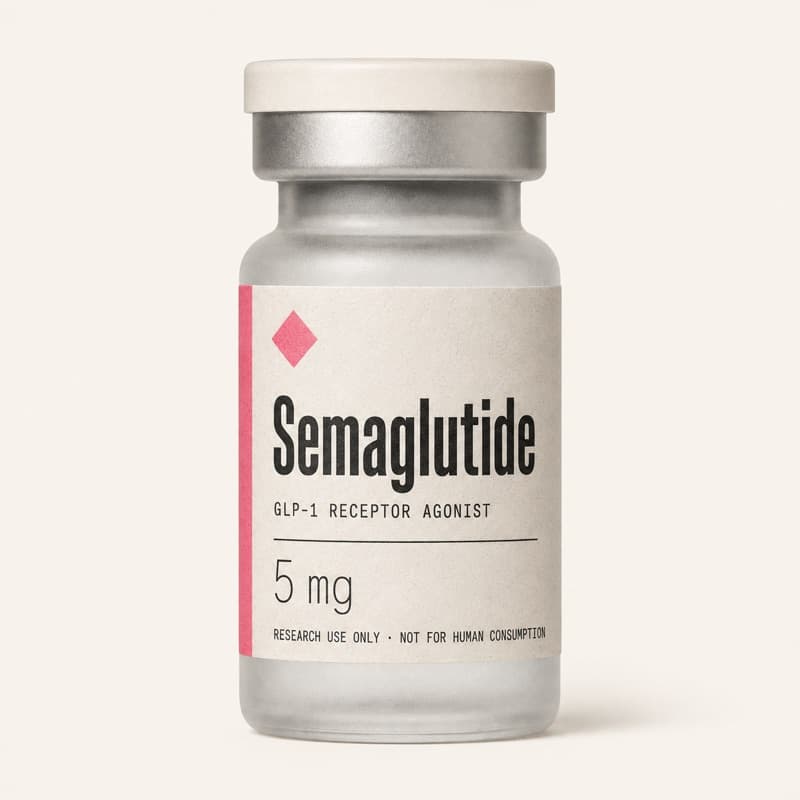
Semaglutide
GLP-1 Receptor Agonist · Weight Loss & Diabetes
GLP-1 receptor agonist, long-acting, with approval for chronic weight management and type 2 diabetes. Significant efficacy has been demonstrated across more than 17,000 trial participants, by way of glycemic control and appetite suppression. Weekly dosing is convenient, enabled by the 7-day half-life.
Overview
GLP-1 receptor agonist, long-acting, with approval for chronic weight management and type 2 diabetes. Significant efficacy has been demonstrated across more than 17,000 trial participants, by way of glycemic control and appetite suppression. Weekly dosing is convenient, enabled by the 7-day half-life.
Native GLP-1 is mimicked; receptor binding then stimulates glucose-dependent insulin secretion, suppresses glucagon, slows gastric emptying, and cuts appetite through hypothalamic pathways.
Research indications
What the compound has been studied for, grouped by body system. Effect size is the reported magnitude where it was measured — not a recommendation.
Chronic weight management carries FDA approval, with clinical trials averaging 15–20% loss of body weight.
Hunger and food cravings both fall once GLP-1 receptors in the central nervous system are activated.
Over 2+ years of continued treatment, long-term studies show weight loss is maintained.
Type 2 diabetes is an FDA-approved indication; HbA1c fell 1.5–2% in clinical trials.
Insulin secretion improves, and pancreatic beta cell function may be preserved.
In high-risk diabetes patients, cardiovascular death, MI, or stroke fell 26%, a proven reduction.
Evidence is emerging of improvement in non-alcoholic fatty liver disease.
Markers of systemic inflammation fall independently of weight loss.
Several components are addressed at once — weight, glucose, blood pressure, lipids.
- Class
- GLP-1 receptor agonist
- Research status
- FDA approved
- Chain length
- 31 residues
- Molecular weight
- 4113.64 Da
- Half-life
- ~168 h
- Typical dose
- 0.25 mg starting; titrated to 1–2.4 mg weekly
- Frequency
- Once weekly (same day each week)
- Cycle length
- Ongoing therapy as prescribed
- Storage
- Pen: 2-8°C before first use, room temp up to 56 days after. Compounded: 2-8°C
Molecular data
- Type
- GLP-1 receptor agonist
- Molecular weight
- 4113.64 Da
- Chain length
- 31 residues
- Half-life
- 10080 min
Levels in single-dose multiples. A shape, not a pharmacokinetic prediction.
Dosing reference
Doses reported in the literature and by suppliers. These are a record of what has been used in research — reference, never instruction.
| Context | Route | Amount | Frequency |
|---|---|---|---|
| Weight Loss Initiation | Subcutaneous | 0.25mg | Weekly x 4 weeks, then increase |
| Weight Loss Maintenance | Subcutaneous | 2.4mg | Weekly (after 16-week titration) |
| Diabetes Management | Subcutaneous | 0.5-1mg | Weekly |
| Cardiovascular Protection | Subcutaneous | 0.5-1mg | Weekly |
| Tolerability-Based | Subcutaneous | 0.25-2.4mg | Weekly (individualized) |
| Diabetes Initiation | Oral (empty stomach) | 3mg | Daily x 30 days |
| Standard Diabetes Dose | Oral (empty stomach) | 7mg | Once daily |
| Maximum Diabetes Dose | Oral (empty stomach) | 14mg | Once daily |
Interactions
Hypoglycemia risk may rise in combination; blood glucose monitoring is required.
Two incretin mimetics whose mechanisms overlap; side effects increase under concurrent use.
The pair is CagriSema in clinical trials, where weight loss efficacy is enhanced.
A common pairing in diabetes management, with a good safety profile.
Nothing contraindicated; may ease GI side effects.
Hypoglycemia risk increases; the sulfonylurea dose may need reducing.
Absorption of oral medications may be affected by delayed gastric emptying.
What to expect
Safety
Mechanistic flags — properties of the pathway, not observed adverse events.
- Nausea
- Diarrhea
- Vomiting
- Constipation
- Abdominal pain
- Kidney impairment: urination decreased, swelling
- Abdominal pain, severe and persistent, with pancreatitis possible
- Vomiting that persists and prevents fluid intake
- Thyroid tumor signalled by a neck lump, hoarseness, trouble swallowing
- Rash, itching, difficulty breathing — a severe allergic reaction
- Changes in vision, with diabetic retinopathy possibly progressing
- Severe hypoglycemia, where insulin or sulfonylureas are combined
- Pregnancy or breastfeeding
- History of pancreatitis
- Medullary thyroid cancer in personal or family history
- Type 2 multiple endocrine neoplasia syndrome (MEN 2)
Quality checklist
What to confirm before trusting a batch of research material. A verification aid — not an endorsement of any supplier.
- Third-party Certificate of AnalysisIndependent lab · dated · lot-matched.
- HPLC purity ≥ 98%Reverse-phase trace included.
- Mass-spec confirms 4113.64 g/molMALDI-TOF or ESI-MS.
- Counterion stated (acetate ≫ TFA)TFA salts can confound bioassays.
- Endotoxin / sterility statementRelevant once reconstituted.
- Lyophilised · cold-chain shippedStored −20 °C, shipped on ice.
- Labelled “research use only”No therapeutic or dosing claims.
Recorded signals for this compound · 7
- ✓Branded products with FDA approval: Ozempic, Wegovy, Rybelsus
- ✓Refrigeration verified as proper, expiration date not passed
- ✓Solution in the pen or vial clear, and colorless to slightly yellow
- !Compounded versions — the FDA has warned that compounded semaglutide is untested
- ×Particles or precipitation that can be seen
- ×Sources outside a pharmacy, or online sellers unverified
- ×Solution cloudy or discolored
FAQ
Is weight regain prevented once semaglutide is stopped?
No. In long-term studies weight loss is sustained only while treatment continues, and weight typically returns after discontinuation. That points to a long-term maintenance therapy rather than a temporary reset. Phase 3 trials, with 2+ years of data, confirm that ongoing use is needed to hold the loss.
Why is there a heart disease benefit in the absence of diabetes?
The SELECT trial, at 17,604 people, proved a 20% reduction in cardiovascular events among obese people without diabetes. Behind it sit reduced inflammation, improved lipid profiles, lowered blood pressure, and reduced hepatic fat — protection for the heart that runs independently of glucose control.
Can oral Rybelsus replace the injection for those avoiding needles?
Yes, with caveats. Administration of Rybelsus tablets is very strict: empty stomach, no food or medication for 30 minutes, a specific volume of water. Bioavailability is lower than the injection, so doses run higher — 7–14mg against 0.5–2.4mg weekly by injection. Many prefer the injection despite the needle, on the grounds that it is more forgiving.
Is the weight lost genuinely fat, or largely water and muscle?
Mostly genuine fat loss. Clinical trials show fat mass reduced substantially while lean mass is preserved, at a ratio similar to other weight loss treatments. The 15–20% is sustained fat reduction rather than water alone. Some lean mass is nonetheless lost, which is the reason resistance training is recommended.
References
- 1Semaglutide and Cardiovascular Outcomes in Patients with Type 2 Diabetes (SUSTAIN-6)Marso, S.P., et al. · New England Journal of Medicine · 2016
26% reduction in MACE (HR 0.74) with semaglutide vs placebo. Established cardiovascular safety and benefit profile for semaglutide in type 2 diabetes.
Human RCTPubMed 27633186 ↗ - 2Oral Semaglutide and Cardiovascular Outcomes in Patients with Type 2 Diabetes (PIONEER 6)Husain, M., et al. · New England Journal of Medicine · 2019
Oral semaglutide was noninferior to placebo for cardiovascular safety. Numerically fewer CV deaths in oral semaglutide group (0.9% vs 1.9%).
Human RCTPubMed 31185157 ↗ - 3Once-Weekly Semaglutide in Adults with Overweight or Obesity (STEP 1)Wilding, J.P.H., et al. · New England Journal of Medicine · 2021
14.9% average weight loss vs 2.4% placebo over 68 weeks with 2.4mg weekly. 86% achieved ≥5% weight loss; 51-64% achieved ≥15% weight loss.
Human RCTPubMed 33567185 ↗ - 4Two-year effects of semaglutide in adults with overweight or obesity (STEP 5)Garvey, W.T., et al. · Nature Medicine · 2022
Sustained weight loss of 15.2% at week 104 vs 2.6% placebo. 77.1% achieved ≥5% weight loss at 2 years, demonstrating long-term efficacy.
Human RCTPubMed 36216945 ↗ - 5Once-Weekly Semaglutide in Adolescents with Obesity (STEP TEENS)Weghuber, D., et al. · New England Journal of Medicine · 2022
16.1% BMI reduction with semaglutide vs 0.6% increase with placebo over 68 weeks. 44.9% of semaglutide recipients reclassified to normal-weight or overweight BMI category.
Human RCTPubMed 36322838 ↗ - 6Semaglutide in Patients with Heart Failure with Preserved Ejection Fraction and Obesity (STEP-HFpEF)Kosiborod, M.N., et al. · New England Journal of Medicine · 2023
Semaglutide 2.4mg reduced symptoms, physical limitations, and improved exercise function in obesity-related HFpEF. Reduced inflammation and appeared to improve adverse cardiac remodeling.
Human RCTPubMed 37622681 ↗ - 7Semaglutide and Cardiovascular Outcomes in Obesity without Diabetes (SELECT)Lincoff, A.M., et al. · New England Journal of Medicine · 2023
20% reduction in MACE (CV death, MI, or stroke) with semaglutide 2.4mg vs placebo over mean 40 months. First GLP-1 RA to demonstrate cardiovascular benefit in non-diabetic population.
Human RCTPubMed 37952131 ↗ - 8Effects of Semaglutide on Chronic Kidney Disease in Patients with Type 2 Diabetes (FLOW)Perkovic, V., et al. · New England Journal of Medicine · 2024
24% lower risk of primary kidney outcome (kidney failure, sustained eGFR decline, or renal/CV death) with semaglutide vs placebo. 29% reduction in CV death. Trial stopped early for efficacy.
Human RCTPubMed 38785209 ↗ - 9Phase 3 Trial of Semaglutide in Metabolic Dysfunction-Associated Steatohepatitis (ESSENCE)Sanyal, A.J., et al. · New England Journal of Medicine · 2025
62.9% achieved MASH resolution without fibrosis worsening vs 34.3% placebo at 72 weeks. Combined resolution and fibrosis improvement in 32.7% vs 16.1% placebo. Mean weight loss of 10.5%.
Human RCTPubMed 40305708 ↗
Interim phase 3 ESSENCE results published in the NEJM put MASH resolution at 62.9% among patients whose liver fibrosis was moderate-to-advanced, on semaglutide 2.4 mg.
In the FLOW trial, semaglutide cut progression of kidney disease by 24% and cardiovascular death by 29% among people with type 2 diabetes and chronic kidney disease; the trial was halted early for efficacy, a first for a GLP-1 receptor agonist.
SELECT enrolled 17,604 patients who had obesity and cardiovascular disease without diabetes; semaglutide 2.4mg lowered MACE by 20%, extending the cardiovascular indication to non-diabetic populations.