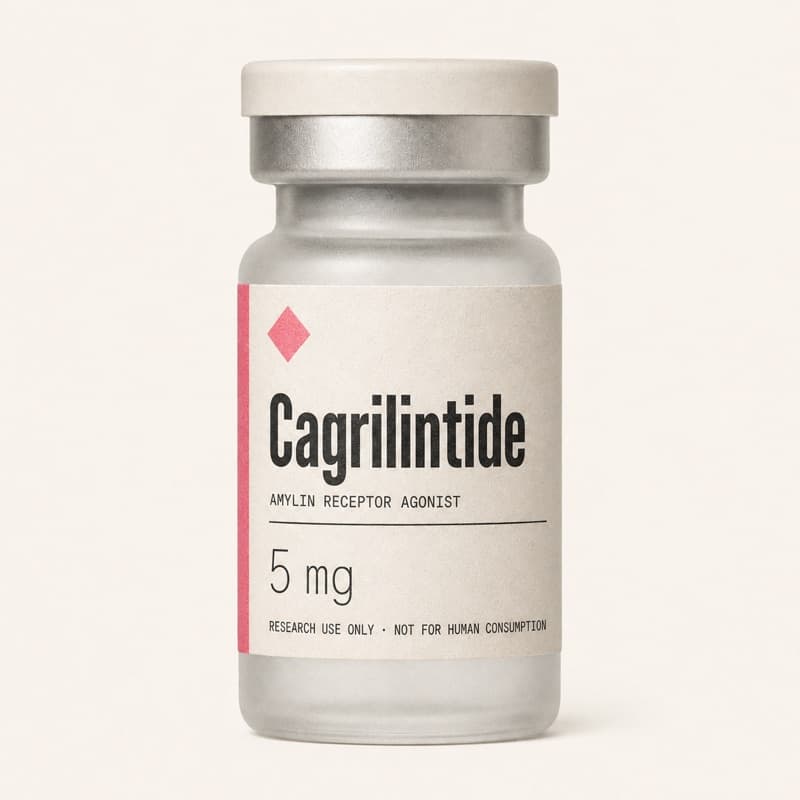
Cagrilintide
Long-Acting Amylin Receptor Agonist · Weight Loss & Diabetes
Long-acting lipidated amylin analog that acts at both the amylin and calcitonin receptors, aimed at weight management and type 2 diabetes. In the CagriSema combination, phase 3 trials report 22.7% weight loss.
Overview
Long-acting lipidated amylin analog that acts at both the amylin and calcitonin receptors, aimed at weight management and type 2 diabetes. In the CagriSema combination, phase 3 trials report 22.7% weight loss.
Bioavailability is optimal by subcutaneous injection, with amylin and calcitonin receptors both targeted for satiety and metabolic regulation. Insulin sensitivity rises; gastric emptying is controlled.
Research indications
What the compound has been studied for, grouped by body system. Effect size is the reported magnitude where it was measured — not a recommendation.
Weight loss of 22.7% on the CagriSema combination, ahead of existing therapies.
Diabetic patients lost 15.7% of weight, with glycemic improvements alongside.
Significant weight loss in Phase 3 trials.
HbA1c fell 2.2% on CagriSema, measured against semaglutide alone.
Insulin sensitivity and glucose metabolism improve when amylin receptors are activated.
Satiety arrives by two pathways, amylin and calcitonin receptor activation.
- Class
- Amylin receptor agonist
- Research status
- Extensively studied
- Chain length
- 37 residues
- Molecular weight
- 4409.01 Da
- Half-life
- ~168 h
- Typical dose
- 2.4 mg weekly (after escalation)
- Frequency
- Once weekly, same day each week
- Cycle length
- Continuous long-term therapy
- Storage
- Lyophilized: -20°C frozen; Reconstituted: 2-8°C refrigerated, use within 30 days
Molecular data
- Type
- Amylin receptor agonist
- Molecular weight
- 4409.01 Da
- Chain length
- 37 residues
- Half-life
- 10080 min
Levels in single-dose multiples. A shape, not a pharmacokinetic prediction.
Dosing reference
Doses reported in the literature and by suppliers. These are a record of what has been used in research — reference, never instruction.
| Context | Route | Amount | Frequency |
|---|---|---|---|
| Weight Loss (Monotherapy) | SubQ | 2.4mg | Once weekly |
| Weight Loss (CagriSema) | SubQ | 2.4mg + semaglutide 2.4mg | Once weekly |
| Type 2 Diabetes Management | SubQ with metformin | 2.4mg weekly | Once weekly |
| Dose Escalation Protocol | SubQ | 0.25mg → 0.5mg → 1.0mg → 1.7mg → 2.4mg | Weekly increases over 16 weeks |
Interactions
Weight loss is greater on the CagriSema combination, the GLP-1 and amylin pathways being complementary.
Mechanisms differ, so concurrent use is workable; no direct interactions are known.
GI side effects compound, a substantial risk absent specialist supervision.
Phase 2/3 trials found it well-tolerated, with no pharmacokinetic interactions.
Concurrent use proved safe in clinical trials, the mechanisms being complementary.
Two amylin agonists: combining them adds no benefit and raises GI risks.
Absorption may be affected by delayed gastric emptying; separate administration by 1 hour.
What to expect
Safety
Mechanistic flags — properties of the pathway, not observed adverse events.
- Gastrointestinal effects in the first weeks — nausea, vomiting, diarrhea
- Anti-cagrilintide antibodies appear in 46–73%, with no effect on efficacy
- In the REDEFINE 1 trial only 57.3% reached the maximum 2.4mg dose
- Severe, persistent nausea/vomiting that blocks hydration
- Severe abdominal pain that radiates to the back, signaling pancreatitis
- Significant reactions at the injection site, or abscess formation
- Anaphylaxis, or severe allergic reactions
- Commercial availability has not arrived (FDA approval expected Q1 2026)
- Not advised in pregnancy or during breastfeeding
Quality checklist
What to confirm before trusting a batch of research material. A verification aid — not an endorsement of any supplier.
- Third-party Certificate of AnalysisIndependent lab · dated · lot-matched.
- HPLC purity ≥ 98%Reverse-phase trace included.
- Mass-spec confirms 4409.01 g/molMALDI-TOF or ESI-MS.
- Counterion stated (acetate ≫ TFA)TFA salts can confound bioassays.
- Endotoxin / sterility statementRelevant once reconstituted.
- Lyophilised · cold-chain shippedStored −20 °C, shipped on ice.
- Labelled “research use only”No therapeutic or dosing claims.
Recorded signals for this compound · 7
- ✓Pen is pre-filled once approved
- ✓Purity >98%, pharmaceutical grade
- ✓Stable in frozen storage at -20°C
- ✓Stability extends across the 7-day dosing interval
- !Standard bacteriostatic water works short-term, though degradation can occur at neutral pH; pH ~4.0 gives optimal stability
- ×Improper pH brings fibril formation — the solution must stay clear
- ×Degradation is indicated by aggregation or precipitation
FAQ
What weight loss does CagriSema combination therapy produce?
In the Phase 3 REDEFINE trials, estimated mean weight loss reached -20.4% at 68 weeks in participants without diabetes, against -3% on placebo. Among diabetic patients the figures were -13.7% for CagriSema and -3.4% for placebo. No approved or experimental therapy has produced more dramatic weight loss results to date.
What drives anti-cagrilintide antibody formation in 46–73% of people, and does it matter?
Roughly half of users develop anti-cagrilintide antibodies, most likely because the peptide is foreign. Clinical trial data showed no reduction in efficacy from them — weight loss continues despite antibody formation. The implication of that unusual finding is that the antibodies do not significantly neutralize the therapeutic effect.
Why does pH matter so much when cagrilintide is reconstituted?
At neutral pH the peptide structure is prone to fibril formation and aggregation. Holding pH 3.5–4.5 prevents that self-assembly into inactive clumps. The solution must stay clear; cloudiness or particles indicate degradation, and the dose should then be discarded rather than injected as aggregated material that may be less potent or harmful.
References
- 1Efficacy and safety of co-administered once-weekly cagrilintide 2.4 mg with once-weekly semaglutide 2.4 mg in type 2 diabetes: a multicentre, randomised, double-blind, active-controlled, phase 2 trialFrias JP, Deenadayalan S, Erichsen L, Knop FK, Lingvay I, Machineni S, Mathieu C, Pedersen SD, Davies M · The Lancet · 2023
32-week phase 2 trial at 17 US sites. CagriSema showed greater weight loss vs semaglutide or cagrilintide alone. HbA1c improvements significant. Well tolerated with predominantly GI adverse events.
Human RCTPubMed 37364590 ↗ - 2Cagrilintide-Semaglutide in Adults with Overweight or Obesity and Type 2 DiabetesNovo Nordisk REDEFINE 2 Investigators · New England Journal of Medicine · 2025
Phase 3a REDEFINE 2 trial: Adults with BMI ≥27, HbA1c 7-10%, and type 2 diabetes. Mean weight loss -13.7% with CagriSema vs -3.4% placebo at 68 weeks. Significant improvements in glycemic measures.
Human RCTPubMed 40544432 ↗ - 3Coadministered Cagrilintide and Semaglutide in Adults with Overweight or ObesityNovo Nordisk REDEFINE 1 Investigators · New England Journal of Medicine · 2025
Phase 3a REDEFINE 1 trial: 3,417 adults without diabetes. Estimated mean weight loss -20.4% with CagriSema vs -3.0% placebo at 68 weeks. GI adverse events in 79.6% of treatment group, mainly transient and mild-to-moderate.
Human RCTPubMed 40544433 ↗
A post-hoc analysis of REDEFINE 1 in adults with overweight or obesity found CagriSema lowered systolic blood pressure by 10.9 mmHg against 2.8 mmHg on placebo, and diastolic pressure by 5.4 mmHg against 1.7 mmHg, with the effect holding across subgroups, resistant hypertension among them.
In rats, CagriSema produced weight loss chiefly by lowering how much energy the animals consumed, with energy expenditure maintained, which sets it apart from caloric restriction on its own.