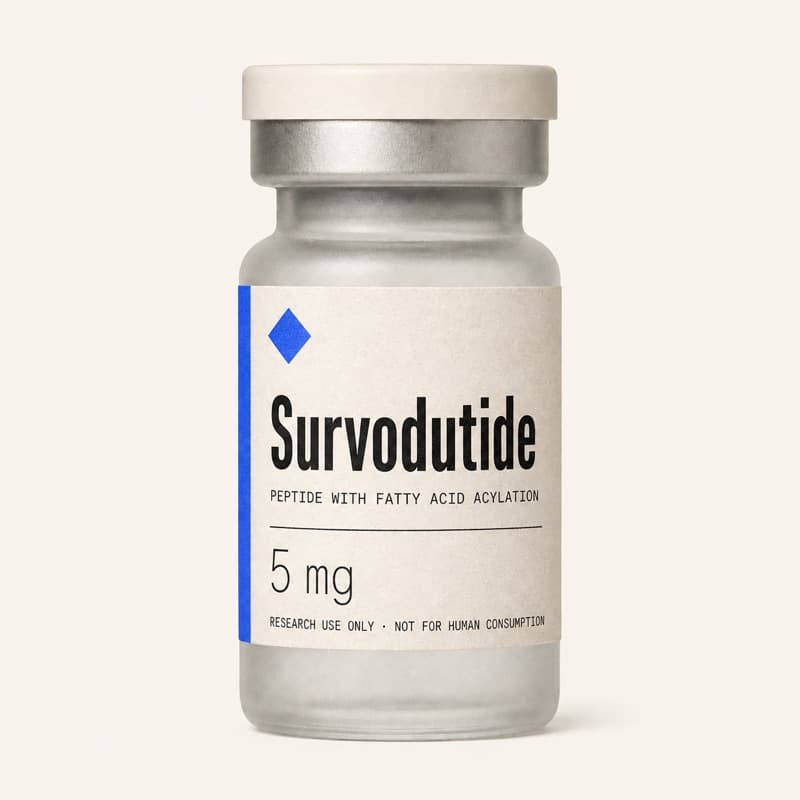
Survodutide
Dual GLP-1/Glucagon Receptor Agonist · Weight Loss & Diabetes
Investigational dual receptor agonist for metabolic disease, working through balanced activation of GLP-1R and GCGR. Phase 2/3 clinical trials show superior weight loss and efficacy in MASH treatment.
Overview
Investigational dual receptor agonist for metabolic disease, working through balanced activation of GLP-1R and GCGR. Phase 2/3 clinical trials show superior weight loss and efficacy in MASH treatment.
Agonism runs on two receptors: appetite falls and gastric emptying slows through GLP-1R, while energy expenditure and hepatic fat oxidation rise through GCGR. EC50 is 0.52nM at GCGR and 0.33nM at GLP-1R.
Research indications
What the compound has been studied for, grouped by body system. Effect size is the reported magnitude where it was measured — not a recommendation.
Mean weight loss was 14.9% at week 46 on 4.8mg; 55% reached a reduction of ≥15%.
Ahead of semaglutide at 16 weeks — -8.7% against -5.3%.
Energy intake and expenditure are both addressed by the dual mechanism.
On 4.8mg, 62% reached MASH improvement with no worsening of fibrosis.
Liver fat reduction of ≥30% was reached by 63–67%.
At the highest doses HbA1c fell as far as -1.6%.
- Class
- Peptide with fatty acid acylation
- Research status
- Extensively studied
- Chain length
- 29 residues
- Molecular weight
- 4500 Da
- Half-life
- ~112 h
- Typical dose
- 0.6 mg starting; titrated to 3.6–6.0 mg weekly
- Frequency
- Once weekly (same day each week)
- Cycle length
- 24–76+ weeks continuous therapy
- Storage
- Reconstituted: 2-8°C immediately after mixing
Molecular data
- Type
- Peptide with fatty acid acylation
- Molecular weight
- 4500 Da
- Chain length
- 29 residues
- Half-life
- 6720 min
Levels in single-dose multiples. A shape, not a pharmacokinetic prediction.
Dosing reference
Doses reported in the literature and by suppliers. These are a record of what has been used in research — reference, never instruction.
| Context | Route | Amount | Frequency |
|---|---|---|---|
| Obesity - Conservative Start | SubQ | 0.6mg titrated over 24 weeks | Once weekly with 4-week intervals |
| Obesity - Standard Protocol | SubQ | 3.6-6.0mg | Once weekly |
| MASH Treatment | SubQ | 2.4-4.8mg | Once weekly |
| Type 2 Diabetes | SubQ | 0.3-2.7mg | Once weekly |
Interactions
Two GLP-1 agonists; combined, the risk is excessive activation and GI side effects.
The pair was demonstrated in Phase 2 diabetes trials.
No interactions are known; Phase 3 allowed it under monitoring.
A hypoglycemia risk; dose reduction is worth considering.
Improved glycemic control may call for a reduced insulin dose.
Gastric emptying is delayed, so dosing falls 1+ hour ahead of survodutide.
Glucagon receptor activation risks running excessive.
What to expect
Safety
Mechanistic flags — properties of the pathway, not observed adverse events.
- Nausea (40-66%)
- Diarrhea (25-49%)
- Vomiting (15-41%)
- Heart rate up slightly, mean 2–5 bpm
- Nausea or vomiting, severe and persistent, preventing oral intake
- Pancreatitis signs: abdominal pain, severe, radiating through to the back
- Rash, itching, difficulty breathing: allergic reactions
- Severe hypoglycemia where insulin or sulfonylureas are involved
- Gallbladder symptoms, felt as right upper quadrant pain
- Marked tachycardia, or arrhythmias
- Contraception is used throughout treatment
- Not advised in pregnancy or during breastfeeding
Quality checklist
What to confirm before trusting a batch of research material. A verification aid — not an endorsement of any supplier.
- Third-party Certificate of AnalysisIndependent lab · dated · lot-matched.
- HPLC purity ≥ 98%Reverse-phase trace included.
- Mass-spec confirms 4500 g/molMALDI-TOF or ESI-MS.
- Counterion stated (acetate ≫ TFA)TFA salts can confound bioassays.
- Endotoxin / sterility statementRelevant once reconstituted.
- Lyophilised · cold-chain shippedStored −20 °C, shipped on ice.
- Labelled “research use only”No therapeutic or dosing claims.
Recorded signals for this compound · 6
- ✓Within expiration date
- ✓Solution clear to slightly opalescent, no visible particles
- ✓Vial sealed, rubber stopper intact
- !Slight foam on reconstitution is normal provided it disappears within minutes
- ×Contamination is indicated by a cloudy solution or visible particles
- ×Powder or solution discolored
FAQ
What puts survodutide ahead of semaglutide on weight loss?
Glucagon receptor agonism is added to the GLP-1 effects, so appetite suppression and raised energy expenditure run together. Head-to-head trials at 16 weeks show -8.7% weight loss against semaglutide's -5.3%, the glucagon pathway enhancing fat burning independently of appetite.
Is MASH — metabolic dysfunction-associated steatohepatitis — reversed by survodutide?
Yes: on 4.8mg weekly, clinical trials show 62% of MASH patients reaching improvement with no worsening of fibrosis, and 63–67% reaching a ≥30% liver fat reduction. That places it among the first investigational agents with FDA potential across both MASH treatment and weight loss.
Does a 6-day half-life cover once-weekly dosing?
Yes. Once-weekly dosing works on the ~6-day half-life because peak levels stay therapeutic across the week. Semaglutide sits at a 7-day half-life by contrast; survodutide's slightly shorter figure still covers the weekly interval adequately.
Are heart rate increases seen with survodutide, as with other GLP-1 drugs?
A mean increase of 2–5 bpm is recorded, similar to semaglutide. Glucagon receptor activation stays modest enough to avoid significant tachycardia, though close monitoring applies to patients with cardiac conditions, as with all GLP-1 agonists.