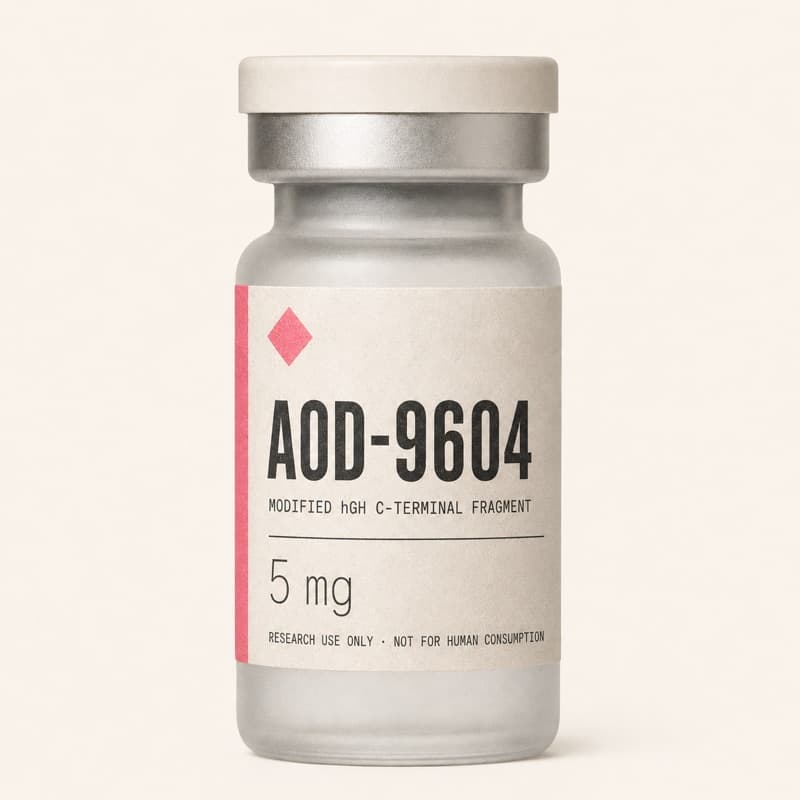
AOD-9604
Modified hGH Fragment · Fat Loss Peptide
A modified fragment of human growth hormone spanning amino acids 176–191. Lipolysis is stimulated and lipogenesis inhibited, without the side effects that accompany full growth hormone: IGF-1 does not rise, glucose metabolism is unaffected, and insulin resistance does not follow.
Overview
A modified fragment of human growth hormone spanning amino acids 176–191. Lipolysis is stimulated and lipogenesis inhibited, without the side effects that accompany full growth hormone: IGF-1 does not rise, glucose metabolism is unaffected, and insulin resistance does not follow.
Upregulation of the beta-3 adrenergic receptor drives lipolysis up and lipogenesis down, with no binding at the GH receptor. Glucose metabolism is untouched and IGF-1 levels do not rise.
Research indications
What the compound has been studied for, grouped by body system. Effect size is the reported magnitude where it was measured — not a recommendation.
Fat oxidation and plasma glycerol levels rise, body weight falls in obese models, and glucose metabolism is unaffected.
Synthesis and storage of fat in adipose tissue are reduced.
No hyperglycemia, no reduction of insulin secretion, no increase in insulin resistance.
Cartilage regeneration was enhanced by hyaluronic acid in combination, within osteoarthritis models.
Effects synergize with hyaluronic acid where joint health is concerned.
- Class
- Modified hGH C-terminal fragment
- Research status
- Well studied
- Chain length
- 17 residues
- Molecular weight
- 1815.1 Da
- Half-life
- ~4 min
- Typical dose
- 250–500 µg
- Frequency
- Once daily
- Cycle length
- 8–12 weeks
- Storage
- Lyophilized: room temp or freezer long-term. Reconstituted: 2-8°C for 28 days
Molecular data
- Type
- Modified hGH C-terminal fragment
- Molecular weight
- 1815.1 Da
- Chain length
- 17 residues
- Half-life
- 4 min
YLRIVQCRSVEGSCGFLevels in single-dose multiples. A shape, not a pharmacokinetic prediction.
Dosing reference
Doses reported in the literature and by suppliers. These are a record of what has been used in research — reference, never instruction.
| Context | Route | Amount | Frequency |
|---|---|---|---|
| Fat loss - Standard | SubQ | 250-300mcg | Once daily (morning, fasted) |
| Enhanced fat loss | SubQ | 400-500mcg | Once daily (morning, fasted) |
| Joint support | SubQ | 250mcg | Once daily |
| Conservative start | SubQ | 200mcg | Once daily |
Interactions
Combined for joint health, cartilage repair is enhanced.
Separate mechanisms, sometimes stacked for comprehensive healing.
The GH axis is untouched by AOD-9604, so the two can run together.
Mechanisms differ; no interactions known.
Weight-loss mechanisms that complement, over different pathways.
Unlike full hGH, AOD-9604 leaves glucose metabolism alone.
What to expect
Safety
Mechanistic flags — properties of the pathway, not observed adverse events.
- Tolerance in clinical trials was generally good
- Effects on insulin or blood glucose have not been reported
- Mild reactions possible where injected
- Swelling that is unusual, or redness that persists
- Symptoms unexpected or concerning
- Severe reactions where injected, or infection signs
- Rare allergic reactions
- Pregnancy or breastfeeding
- On the WADA prohibited list; avoidance is required for athletes subject to testing
Quality checklist
What to confirm before trusting a batch of research material. A verification aid — not an endorsement of any supplier.
- Third-party Certificate of AnalysisIndependent lab · dated · lot-matched.
- HPLC purity ≥ 98%Reverse-phase trace included.
- Mass-spec confirms 1815.1 g/molMALDI-TOF or ESI-MS.
- Counterion stated (acetate ≫ TFA)TFA salts can confound bioassays.
- Endotoxin / sterility statementRelevant once reconstituted.
- Lyophilised · cold-chain shippedStored −20 °C, shipped on ice.
- Labelled “research use only”No therapeutic or dosing claims.
Recorded signals for this compound · 9
- ✓Cold-chain shipping done properly
- ✓Lyophilized powder that is white and uniform in appearance
- ✓After reconstitution, a crystal-clear solution carrying no particles
- ✓Purity >98% by HPLC on the certificate of analysis
- !WADA prohibited substance
- !Research chemical only — therapeutic-drug approval from the FDA is absent
- ×Powder discolored or clumped, with yellow pointing to degradation
- ×Appearance collapsed or moisture-damaged
- ×Solution cloudy once reconstituted
FAQ
Does AOD-9604 disturb blood sugar the way full human growth hormone does?
No. It is a modified hGH fragment: lipolysis is stimulated without any binding at the GH receptor and without effect on glucose metabolism. Full GH brings hyperglycemia and insulin resistance; AOD-9604 raises no IGF-1 and leaves glucose homeostasis intact, which makes it metabolically safer.
How quickly does fat loss appear on AOD-9604?
Weeks 1–2 pass with little noticeable as the compound accumulates. Weeks 3–4 bring subtle changes in body composition. Weeks 5–8 make fat loss more noticeable, especially where diet and exercise are in place. Weeks 8–12 continue the fat reduction and improve body composition. The whole timeline runs slower than GLP-1 agonists.
Does AOD-9604 stack with semaglutide, or with other peptides for weight loss?
Yes. A lipolytic mechanism on one side and semaglutide's appetite suppression on the other complement each other over completely different pathways. Combination data is limited, though. Each is safe on its own; combining calls for monitoring of the additive dehydration and GI effects common with semaglutide.
Does human cartilage repair evidence exist for AOD-9604?
Animal studies pair it with hyaluronic acid and report enhanced cartilage regeneration in osteoarthritis models. That work is preclinical; no human cartilage repair data exists. Joint health claims stand as theoretical unless clinical trial data backs them.
References
- 1Effects of oral administration of a synthetic fragment of human growth hormone on lipid metabolismHeffernan MA, Heffernan MJ, Jiang WJ, Thorburn AW, Ng FM · American Journal of Physiology - Endocrinology and Metabolism · 2000
Oral treatment of ob/ob mice with AOD-9401 for 30 days significantly reduced body weight gain and altered lipogenic and lipolytic activity in adipose tissue.
Animal in vivo · inferredPubMed 10950816 ↗ - 2Metabolic studies of a synthetic lipolytic domain (AOD9604) of human growth hormoneNg FM, Jiang WJ, Gianello R, Pitt C, Heffernan M · Hormone Research · 2000
Characterized metabolic properties of AOD-9604 as a synthetic lipolytic domain of hGH with antilipogenic activity that does not interact with the GH receptor.
Animal in vivoPubMed 11146367 ↗ - 3Increase of fat oxidation and weight loss in obese mice caused by chronic treatment with human growth hormone or a modified C-terminal fragmentHeffernan MA, Thorburn AW, Fam B, Summers R, Conway-Campbell B, Waters MJ, Ng FM · International Journal of Obesity · 2001
Both hGH and AOD-9604 reduced body weight gain, increased fat oxidation, and stimulated lipolysis in obese ob/ob mice after 14 days chronic IP administration, without affecting glucose metabolism.
Animal in vivoPubMed 11673763 ↗ - 4The effects of human GH and its lipolytic fragment (AOD9604) on lipid metabolism following chronic treatment in obese mice and beta(3)-AR knock-out miceHeffernan MA, Jiang WJ, Thorburn AW, Ng FM · Endocrinology · 2001
Both hGH and AOD-9604 increased repressed beta-3 adrenergic receptor RNA expression in obese mice to levels comparable with lean mice. Effects abolished in beta-3-AR knockout mice, confirming pathway involvement.
Animal in vivo · inferredPubMed 11713213 ↗ - 5Effect of Intra-articular Injection of AOD9604 with or without Hyaluronic Acid in Rabbit Osteoarthritis ModelKwon DR, Park GY, Lee SU · Annals of Clinical and Laboratory Science · 2015
Intra-articular AOD-9604 injections enhanced cartilage regeneration in collagenase-induced osteoarthritis rabbit model. Combined AOD-9604 and hyaluronic acid injections were more effective than either alone.
Animal in vivoPubMed 26275694 ↗
Work on AOD9604, a substance banned under WADA rules, mapped how the peptide is metabolised in vitro and established assays capable of detecting it for doping control.