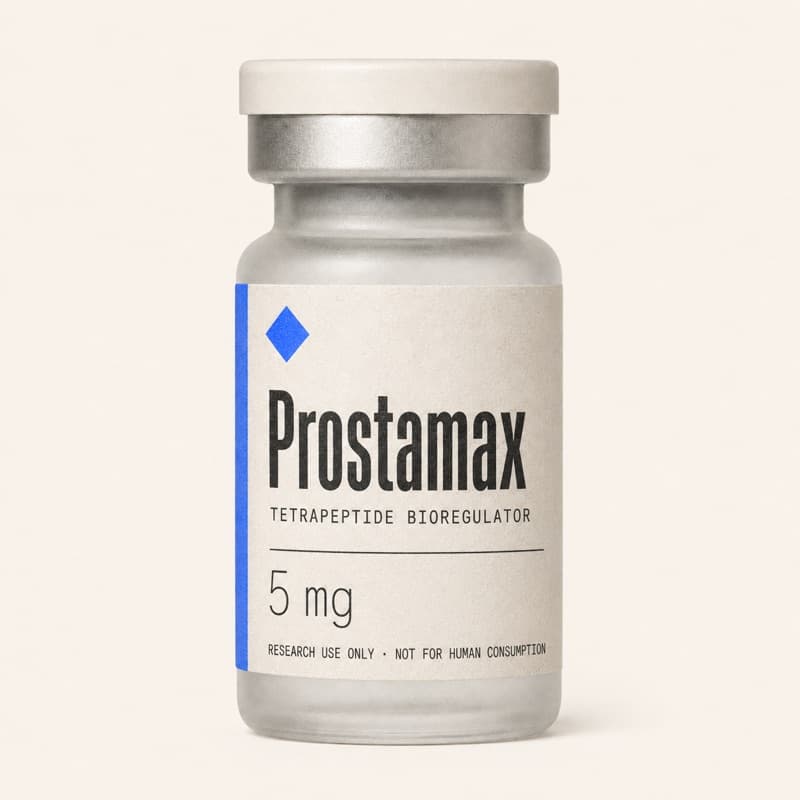
Prostamax
KEDP Tetrapeptide · Prostate Bioregulator
Khavinson bioregulator tetrapeptide (KEDP) whose primary repair effects fall on prostate tissue. Professor Vladimir Khavinson developed it at the St. Petersburg Institute of Bioregulation and Gerontology; in cells from elderly individuals it alters chromatin structure, promoting deheterochromatinization and potentially reactivating genes repressed during aging. Rat models show prostate inflammation reduced, swelling decreased, and the pathological remodeling associated with prostatitis slowed.
Overview
Khavinson bioregulator tetrapeptide (KEDP) whose primary repair effects fall on prostate tissue. Professor Vladimir Khavinson developed it at the St. Petersburg Institute of Bioregulation and Gerontology; in cells from elderly individuals it alters chromatin structure, promoting deheterochromatinization and potentially reactivating genes repressed during aging. Rat models show prostate inflammation reduced, swelling decreased, and the pathological remodeling associated with prostatitis slowed.
Epigenetic regulation proceeds by alteration of chromatin structure. Sister chromatid exchanges become more frequent, as do Ag-positive nucleolar organizer regions (NORs), while large segments of pericentromeric heterochromatin are reduced. Chromatin decondensation and deheterochromatinization follow from those changes, with genes repressed during aging potentially reactivated. Heterochromatin arrangements in human lymphocytes are influenced, and age-related changes in cellular function normalized.
Research indications
What the compound has been studied for, grouped by body system. Effect size is the reported magnitude where it was measured — not a recommendation.
Prostatitis models show inflammation and swelling reduced.
Prostate tissue shows less inflammation and less infiltration by immune cells.
Pathological remodeling and scarring in the prostate decrease.
Deheterochromatinization in elderly cells is promoted.
Genes repressed during the aging process may be reactivated.
Changes to lymphocyte function that come with age are normalized.
- Class
- Tetrapeptide bioregulator
- Research status
- Moderate research
- Chain length
- 4 residues
- Molecular weight
- 473 Da
- Typical dose
- 10–20 mg daily
- Frequency
- Daily for 10–20 days per cycle
- Cycle length
- 10–20 days
- Storage
- Capsules at room temperature; reconstituted injectable at 2-8°C refrigerated
Molecular data
- Type
- Tetrapeptide bioregulator
- Molecular weight
- 473 Da
- Chain length
- 4 residues
KEDPDosing reference
Doses reported in the literature and by suppliers. These are a record of what has been used in research — reference, never instruction.
| Context | Route | Amount | Frequency |
|---|---|---|---|
| Standard protocol | Oral capsules | 10-20 mg | Daily for 10-20 days |
| Maintenance | Oral capsules | 10 mg | 2-3 cycles yearly |
| Research protocol | IM or SubQ | 10 mg | Daily for 10-15 days |
Interactions
Two male reproductive bioregulators that complement each other; tissue targets differ.
Comprehensive Khavinson anti-aging protocols often include both.
Organ targets differ; comprehensive bioregulator protocols can include both.
Belongs to the Khavinson bioregulator family, with a different tissue target.
What to expect
Safety
Mechanistic flags — properties of the pathway, not observed adverse events.
- Tolerated well overall
- Side effects reported as minimal
- Allergic reactions
- Unusual urinary symptoms
- Known hypersensitivity
- Pregnancy (not applicable)
- Prostate cancer (oncologist consultation)
Quality checklist
What to confirm before trusting a batch of research material. A verification aid — not an endorsement of any supplier.
- Third-party Certificate of AnalysisIndependent lab · dated · lot-matched.
- HPLC purity ≥ 98%Reverse-phase trace included.
- Mass-spec confirms 473 g/molMALDI-TOF or ESI-MS.
- Counterion stated (acetate ≫ TFA)TFA salts can confound bioassays.
- Endotoxin / sterility statementRelevant once reconstituted.
- Lyophilised · cold-chain shippedStored −20 °C, shipped on ice.
- Labelled “research use only”No therapeutic or dosing claims.
Recorded signals for this compound · 7
- ✓White powder or capsules
- ✓If reconstituted, a clear solution
- ✓Packaging and labeling done properly
- !Source or purity unknown
- ×Discoloration
- ×Unusual odor
- ×Damaged packaging
FAQ
Is Prostamax safe where prostate cancer runs in the family?
No. 'Carcinogenic-risk' appears among the safety flags, and the contraindications call for oncologist consultation where prostate cancer is present. Benign prostate conditions are the target, but the carcinogenic-risk flag points to unknown interactions with cancer development. Professional medical consultation before use is warranted by family history.
How is prostate swelling reduced without hormone manipulation?
The route is epigenetic chromatin remodeling: the physical structure of chromatin is altered, sister chromatid exchanges rise and heterochromatin falls. 'Deheterochromatinization' follows, and genes silenced during aging are reactivated. No hormone is blocked; gene expression patterns in prostate cells are reset.
Does Prostamax apply to benign prostatic hyperplasia (BPH)?
Yes. Prostate inflammation, swelling and scarring — the key pathologies in BPH — are reduced in animal studies. The results are preclinical, in rats, and human clinical trials are absent. Whether it complements standard treatments such as alpha-blockers is a question for a urologist.
Is PSA testing indicated before starting Prostamax?
Yes. PSA testing before use is recommended for men over 50. A baseline is essential, as is ruling out prostate cancer before starting. Repeat testing during treatment is prudent, the more so given the carcinogenic-risk flag in the pharmacology section.