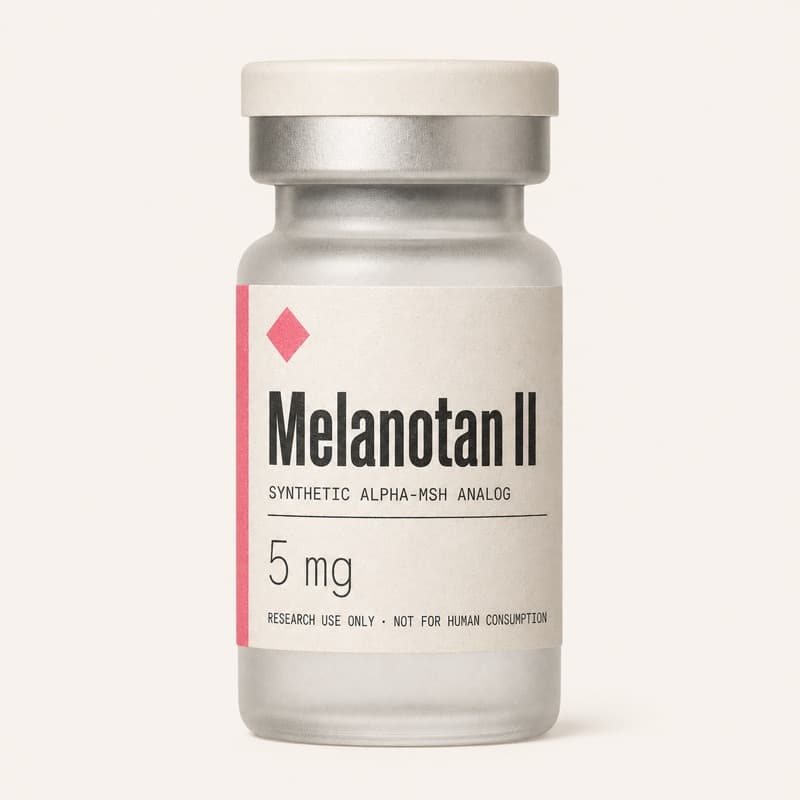
Melanotan II
Synthetic Melanocortin Peptide · Tanning & Sexual Function
Synthetic analog of alpha-melanocyte-stimulating hormone (α-MSH) whose activity spans melanocortin receptors throughout the body. Melanin production for tanning follows MC1R activation, while the MC4R effect falls on sexual arousal and appetite control.
Overview
Synthetic analog of alpha-melanocyte-stimulating hormone (α-MSH) whose activity spans melanocortin receptors throughout the body. Melanin production for tanning follows MC1R activation, while the MC4R effect falls on sexual arousal and appetite control.
Melanocortin receptors are the target — MC1R for tanning, MC4R for sexual function and appetite. Occupying them drives melanin production, raises libido and suppresses appetite by way of hypothalamic pathways.
Research indications
What the compound has been studied for, grouped by body system. Effect size is the reported magnitude where it was measured — not a recommendation.
Appetite falls when MC4R is activated in the hypothalamus; studies recorded a 15% reduction in caloric intake.
Metabolic pathway activation raises fat oxidation.
Tanning follows from stimulated natural melanin production, with no UV exposure required.
Sun damage is buffered by the natural SPF that added melanin provides.
Certain pigmentation disorders may be addressed.
Clinical trials recorded arousal within 24 hours in 73% of women.
MC4R activation raises sexual desire in men and in women alike.
Studies in psychogenic erectile dysfunction report a response rate of 80%.
- Class
- Synthetic alpha-MSH analog
- Research status
- Well studied
- Half-life
- ~2 h
- Typical dose
- Loading: 0.25 mg daily, increasing to 0.5–1 mg; maintenance: 0.5–1 mg 2–3 times weekly
- Frequency
- Loading phase: daily for first week, then tanning maintenance 2–3 times weekly or as needed for sexual enhancement
- Cycle length
- 4–8 weeks loading phase for tanning, then ongoing maintenance as needed
- Storage
- Refrigerate at 2-8°C wrapped in aluminum foil (light-sensitive); use reconstituted solution within 4 weeks
Molecular data
- Type
- Synthetic alpha-MSH analog
- Half-life
- 120 min
Levels in single-dose multiples. A shape, not a pharmacokinetic prediction.
Dosing reference
Doses reported in the literature and by suppliers. These are a record of what has been used in research — reference, never instruction.
| Context | Route | Amount | Frequency |
|---|---|---|---|
| Initial loading phase | SubQ | 0.25mg | 1x daily |
| Tanning maintenance | SubQ | 0.5-1mg | 2-3x weekly |
| Sexual enhancement | SubQ | 0.5-1mg | As needed |
| Minimal side effects | SubQ | 0.1-0.25mg | Every other day |
| Photoprotection | SubQ | 0.5mg | 2x weekly |
| Nasal administration | Nasal spray | 1-2mg | 1-2x daily |
| Localized tanning | Topical application | 1-2mg/mL solution | 1-2x daily |
Interactions
Melanocortin receptors are the shared target; combined, side effects may be excessive.
Mechanism is redundant, and side effect risk rises.
Sexual effects may be enhanced; cardiovascular impact needs monitoring.
Blood pressure can be affected by MT-II.
No interactions known.
Pathways differ; no interactions.
MT-II suppresses appetite, so additive effects are possible.
What to expect
Safety
Mechanistic flags — properties of the pathway, not observed adverse events.
- Facial flushing
- Temporary blood pressure elevation
- Fatigue
- Spontaneous erections
- Nausea — antiemetics beforehand are recommended
- Nausea or vomiting that is severe and persistent
- Chest pain, or blood pressure elevation that is significant
- Moles changing in size, shape or color — close monitoring needed
- Painful, prolonged erections (priapism)
- Allergic reaction with rash, swelling, or breathing difficulty
- Severe headaches, or changes in vision
- Pregnancy or breastfeeding
- Cardiovascular conditions
- Uncontrolled hypertension
- Prior melanoma or dysplastic nevi
Quality checklist
What to confirm before trusting a batch of research material. A verification aid — not an endorsement of any supplier.
- Third-party Certificate of AnalysisIndependent lab · dated · lot-matched.
- HPLC purity ≥ 98%Reverse-phase trace included.
- Mass-spec identity confirmedMALDI-TOF or ESI-MS.
- Counterion stated (acetate ≫ TFA)TFA salts can confound bioassays.
- Endotoxin / sterility statementRelevant once reconstituted.
- Lyophilised · cold-chain shippedStored −20 °C, shipped on ice.
- Labelled “research use only”No therapeutic or dosing claims.
Recorded signals for this compound · 7
- ✓Reconstituted solution runs clear to pale yellow
- ✓Vial vacuum sealed; opening gives an audible 'pop'
- ✓Lyophilized powder, white to off-white
- !MT-II is photosensitive, so protection from light exposure is required
- !Vials stored wrapped in foil
- ×Powder that is brown or dark points to oxidation or impurities
- ×Cloudiness once mixed points to degradation or contamination
FAQ
Loading or pre-tan only — which Melanotan II protocol brings less nausea?
Nausea is significantly lower on the pre-tan-only protocol, where injections fall on tanning days alone and starting doses are very low (50–75 µg). Much more nausea comes with the traditional loading phase, which runs daily injections at higher doses. Side effects are minimized by starting extremely low and stepping up gradually, by 25 µg.
Is the sexual-function effect of Melanotan II borne out in trials?
Yes. In men with psychogenic ED, clinical trials show an 80% response rate for erectile function; among women, 73% reported arousal within 24 hours. The route is MC4R activation in the brain, which triggers natural sexual responses rather than acting on the genitals directly.
What dosing frequency is used with Melanotan II for sexual effects?
Use is as-needed for sexual enhancement at 0.5–1 mg, though 2–3 injections weekly are reported by some users for maintained libido benefits. Onset falls within hours and the peak lands around 3–5 hours after injection, which makes timing around sexual activity practical.
Can Melanotan II leave permanent mole changes?
Possible. Melanocortin receptors are activated broadly by MT-II, existing moles and freckles included, and permanent enlargement or darkening of existing moles is reported by some users. Regular skin monitoring is essential; a rapidly changing mole calls for dermatology evaluation whether or not MT-II is involved.
References
- 1Evaluation of Melanotan-II, a Superpotent Cyclic Melanotropic Peptide in a Pilot Phase-I Clinical StudyDorr RT, Lines R, Levine N, Brooks C, et al. · Life Sciences · 1996
Phase I study in 3 normal male volunteers. Daily subcutaneous injections for 2 weeks produced visible skin darkening in the face, upper body, and buttock after only 5 low doses.
Human RCTPubMed 8637402 ↗ - 2Melanocortin Receptor Agonists, Penile Erection, and Sexual Motivation: Human Studies with Melanotan IIWessells H, Levine N, Hadley ME, Dorr RT, Hruby VJ · International Journal of Impotence Research · 2000
20 men with psychogenic/organic ED; 0.025mg/kg dose. Melanotan II induced penile erection in 17/20 men without sexual stimulation. Increased sexual desire in 68% vs 19% placebo (P<0.01).
Human RCTPubMed 11035391 ↗ - 3Increased Eumelanin Expression and Tanning Is Induced by a Superpotent Melanotropin [Nle4-D-Phe7]-alpha-MSH in HumansDorr RT, Lines R, Levine N, et al. · Journal of Investigative Dermatology · 2000
Seven volunteers received 0.16mg/kg/day subcutaneous injections for 10 days. Mean 49% increase in forehead eumelanin and 98% increase in forearm eumelanin one week post-treatment.
Human pilotPubMed 11045725 ↗ - 4Discovery that a Melanocortin Regulates Sexual Functions in Male and Female HumansHadley ME, Dorr RT · Peptides · 2006
Melanotan II enhances sexual function in both males and females by working at the brain level, triggering a natural sexual response via melanocortin receptor activation.
ReviewPubMed 15996790 ↗
In a randomised multicentre vitiligo trial, adding afamelanotide, an MC1R agonist, to narrowband UV-B gave repigmentation that was both greater and faster than narrowband UV-B on its own.
This review appraises the hazards of unregulated alpha-melanocyte-stimulating hormone analogue use and advises clinicians to watch users for pigmented lesions, transmission of infection, and sunbed exposure.